Hi, what do you want to do?






National Endowment for the Humanities
Martin Luther King, Jr. and Nonviolent Resistance
Was nonviolent resistance the best means of securing civil rights for black Americans in the 1960s? In this highly engaging and informative instructional activity, your young historians will closely analyze several key documents from the...

Mississippi Department of Archives and History
Protesting Violence without Violence
The ultimate legacy of Emmett Till's violent death is its role in the non-violent roots of the Civil Rights Movement. A lesson compares contemporaneous articles with the lyrics of Bob Dylan's "The Death of Emmett Till" and prompts...

Curated OER
Concept Formation Lesson Plan: Understanding "Protest"
After analyzing both examples and non-examples of a variety of protests conducted by ethnic groups in Seattle and the state of Washington during the twentieth century, your class members will work to identify the key ideas and...

ProCon
National Anthem Protests
San Francisco 49ers quarterback Colin Kaepernick refused to stand for the National Anthem in 2016 as a form of protest. Were his actions appropriate? Using the provided website, pupils attempt to decide for themselves by reading the main...

National Woman's History Museum
Taking a Stand: Woman Suffrage and Protest at the White House K-8
A class discussion opens a lesson plan on women suffragettes. Learners imagine they are preparing to protest for women's voting rights. Scholars create a colorful poster to hold up high when marching in front of the White House.

PBS
From Selma to Montgomery: An Introduction to the 1965 Marches
The 1965 Civil Rights marches from Selma to Montgomery and the resulting Voting Rights Act of 1965 are the focus of a social studies lesson. The resource uses film clips to inform viewers not only about the discrimination that gave rise...

K20 LEARN
Power To The People: Bill Of Rights Art
The works of Juane Quick-to-see Smith are featured in a lesson that asks pupils to consider the role artists play in bringing about social and political change. Scholars examine protest art by Smith and several street artists and...

Umoja Student Development Corporation
Martin Luther King, Jr.: What Did He Do? Why Does It Matter?
Young historians examine the work of Martin Luther King Jr. by reading and answering questions about the Montgomery Bus Boycott, the Albany Movement, the Birmingham and Chicago campaigns, and the Memphis Sanitation Worker's Strike....

Curated OER
Martin Luther King and Malcom X on Violence and Integration
Dr. Martin Luther King and Malcolm X were contemporaries. Both were gifted orators, both were preachers, both were leaders during the Civil Rights era, both were assassinated. But the two had very different views on violence and...

EngageNY
Grade 9 ELA Module 4, Unit 1, Lesson 22
Class members read "Satyagraha," the concluding section of Marc Aronson and Marina Budhos' Sugar Changed the World: A Story of Magic, Spice, Slavery, Freedom, and Science, and analyze how the authors support their claim that terrible...
Texas Education Agency
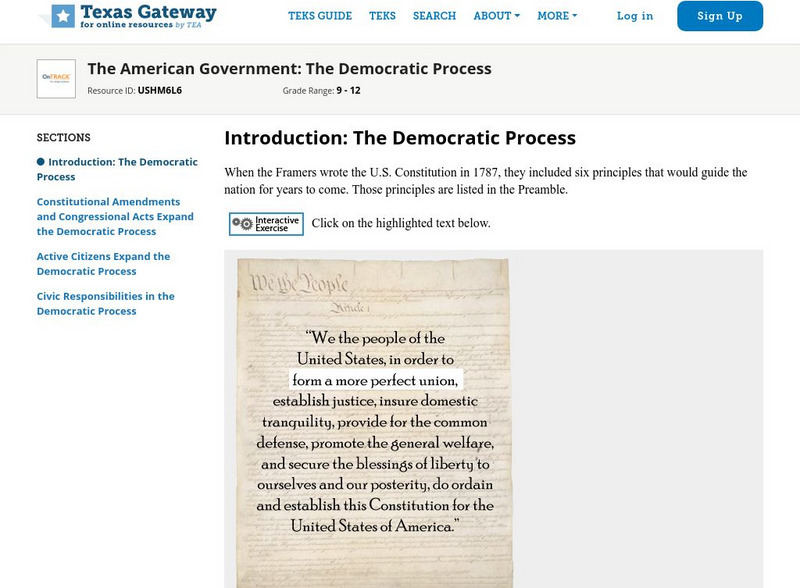
Texas Gateway: The American Government: The Democratic Process
Given primary and secondary resources, students will be able to identify and analyze various methods of expanding the right to participate in the democratic process.

CommonLit
Common Lit: "Dr. Martin Luther King Jr., Changing America" by Barbara Radner
This is an informational article about how Martin Luther King Jr. worked toward changing America in the 1950s and 1960s. It includes a short bio of Dr. King and a reading purpose: As you read, take notes on the problems that African...