Hi, what do you want to do?






National Endowment for the Humanities
Martin Luther King, Jr. and Nonviolent Resistance
Was nonviolent resistance the best means of securing civil rights for black Americans in the 1960s? In this highly engaging and informative lesson, your young historians will closely analyze several key documents from the civil rights...

PBS
From Selma to Montgomery: An Introduction to the 1965 Marches
The 1965 Civil Rights marches from Selma to Montgomery and the resulting Voting Rights Act of 1965 are the focus of a social studies instructional activity. The resource uses film clips to inform viewers not only about the discrimination...

Education World
Every Day Edit - Gandhi
For this everyday editing worksheet, students correct mistakes in a short paragraph about Gandhi. The errors range from punctuation, capitalization, grammar, and spelling.
C3 Teachers
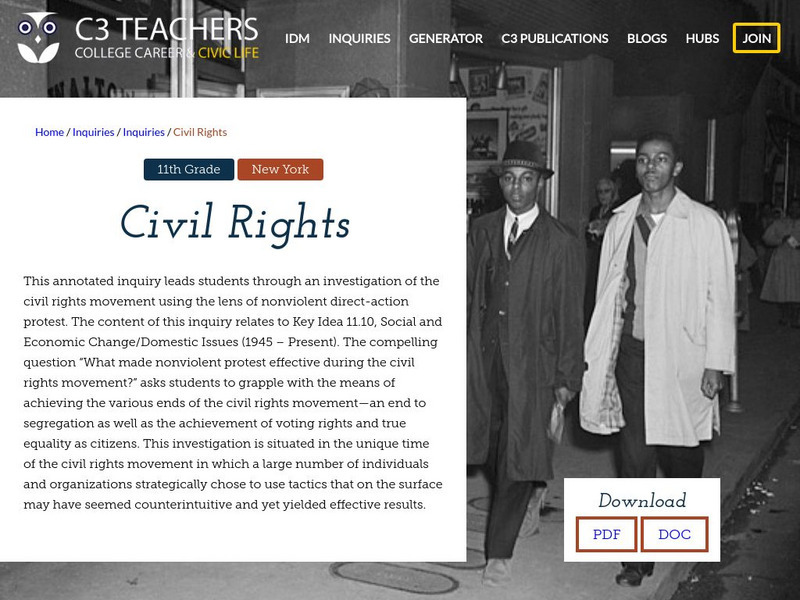
C3 Teachers: Inquiries: Civil Rights
A learning module on the use of nonviolent protests during the civil rights movement. It includes several supporting questions accompanied by formative tasks and source materials, followed by a summative performance task. Topics covered...
Khan Academy
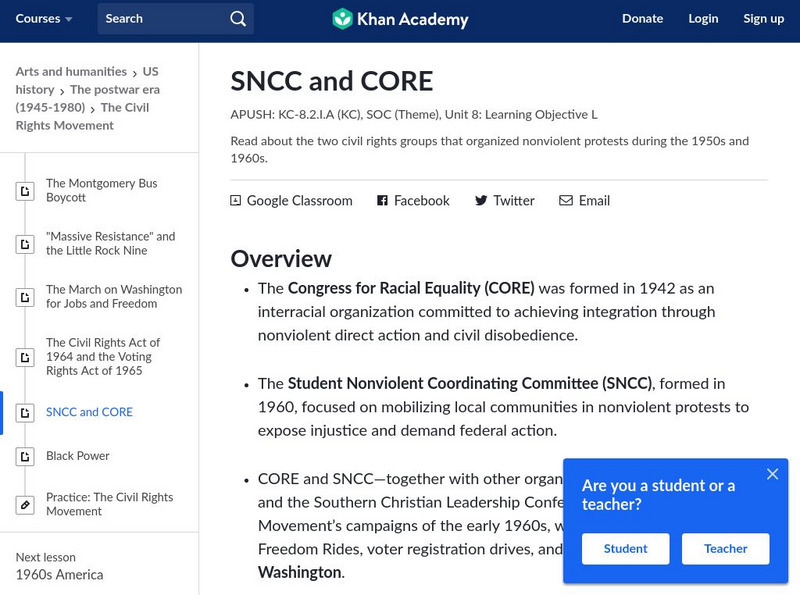
Khan Academy: Sncc and Core
Read about the Congress for Racial Equality (CORE) and the Student Nonviolent Coordinating Committee (SNCC), two groups that played pivotal roles in organizing nonviolent protests during the Civil Rights Movement of the 1950s and 1960s.
Other
Historical Thinking Matters: Rosa Parks: Intro
Extensive teaching aid to help students understand the Montgomery Bus Boycott using primary sources such as letters, police reports, leaflets, and speeches. Includes many student activities and resources.
Khan Academy
Khan Academy: Introduction to the Civil Rights Movement
Provides an overview and basic introduction to the civil rights movement of African Americans.