Hi, what do you want to do?






Core Knowledge Foundation
Animals and Habitats Tell It Again!™ Read-Aloud Anthology
A read-aloud anthology explores various habitats and the animals that inhabit them, from the Artic to the desert, the forest, and bodies of water. First graders listen to and discuss texts and complete word work. Each lesson offers...

Curated OER
The Chesapeake Bay in Captain John Smith's Time
When Captain John Smith visited the Chesapeake Bay in the summer of 1608, what types of animals and habitats did he encounter? Your young historians will analyze primary source documents to answer this question, as well as compare...

Rainforest Alliance
How Do Jaguars and Howler Monkeys in Belize Depend on Us?
How does weather play a role in the lives of land and sea creatures? Find out with a lesson focused on habitats and the ways animals from different homes are connected. Here, learners explore how the life of a jaguar and howler...

PreKinders
Colors of Nature
The colors of nature are the most beautiful and vivid colors in the world. Show kids the ways that colors are striking and changing throughout different habitats with a set of images that feature two animals or plants for each color.

Umaine Museum of Art
Bony Fish Anatomy Worksheet
Take time to appreciate the beauty in the anatomy of animals with this cross-curricular art and science activity. After viewing examples of fish-themed artwork, children complete the included worksheet by labeling the...

WolfQuest
The Return of Gray Wolves to Yellowstone National Park: Right or Wrong?
Should gray wolves be removed from Yellowstone National Park? After researching the complex relationships between the various habitats and species at Yellowstone National Park, including humans, class members take a position...

Rainforest Alliance
Protecting the Critical Habitat of the Manatee and Loggerhead Turtle
Explore ocean habitats with a lesson that showcases the home of manatees and loggerhead turtles in Belize. Here, pupils compare and contrast the homes of ocean animals to those of humans, listen to an original short story about...

Science Matters
That’s An Otter Story
Young scientists discover how sea otters' habitats have changed due to human impact. Through conversation, video observation, and story reading, scholars identify how human interactions change a specific ecosystem in both positive and...

K12 Reader
Competing for Resources
Young biologists examine the concept of scarce resources with a reading comprehension passage. After finishing the paragraphs, learners turn to the questions to demonstrate what they have learned about what is beneficial and what is...

University of South Carolina
Home Sweet Home
Fifth graders will research a biome (land or aquatic) and create a project (diorama, model or another idea of the student's choosing) which includes the geographic features of that biome as well as plants and animals found there and...

Curated OER
Whales and Fish: Creatures of the Deep
Practice comparing and contrasting details in informational text with a reading passage about whales. It explains the ways that fish and whales are similar, as well as the ways they are different, and specific characteristics of various...

American Museum of Natural History
Mammal Flipbooks
Scholars follow eight steps to create a flipbook and discover key facts about mammals' locomotion.

National Park Service
Living & Non-Living Interactions
What better way to learn about ecosystems than by getting outside and observing them first hand? Accompanying a field trip to a local park or outdoor space, this series of collaborative activities engages children in...
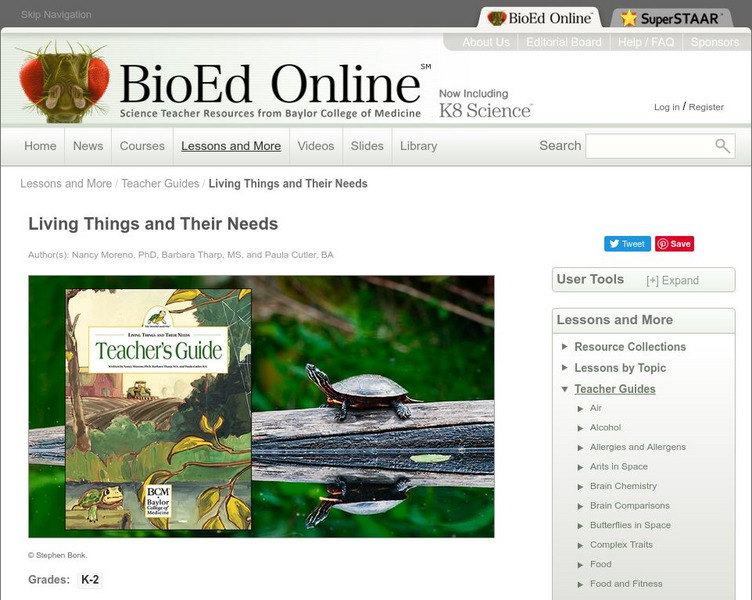
BioEd Online
Bio Ed Online: Living Things and Their Needs Teacher's Guide
This is a free downloadable teacher's guide (PDF) to teach young children (grades K-2) about living things and their needs.