Hi, what do you want to do?






Curated Video
Planet
This live-action video program is about the word planet. The program is designed to reinforce and support a student's comprehension and retention of the word planet through use of video footage, photographs, diagrams and colorful,...
Next Animation Studio
NASA Dawn mission: spacecraft takes first image of dwarf planet Ceres
NASA's Dawn spacecraft is currently on its way to the asteroid belt where it will rendezvous Ceres, its largest celestial body. Ceres, also classified as a dwarf planet, has an average diameter of about 950 km (590 miles) making it...
NASA
Gravity Assist: The Bright Spot of the Asteroid Belt, with Britney Schmidt
Between the orbits of Mars and Jupiter is a mysterious dwarf planet called Ceres. Its surface is dark and muddy, but has hundreds of patches of bright material.
Astrum
What did NASA's Dawn discover on Ceres?
NASA's Dawn mission finished in 2017. What did it discover while in orbit around Ceres?
Curated Video
Exploring the Reclassification of Pluto as a Dwarf Planet
Learn why Pluto was once considered a planet but is now classified as a dwarf planet. The video discusses the discovery of the Kuiper Belt and the debates that led to the reclassification of Pluto.
Curated Video
Exploring the Kuiper Belt: Home of Dwarf Planets and Frozen Debris
In this video, the topic of discussion is the Kuiper Belt, a region in our solar system that extends from the orbit of Neptune. It is similar to the asteroid belt but much larger, and is home to three recognized dwarf planets, including...
NASA
NASA's Hubble Discovers Moon Orbiting Dwarf Planet Makemake
Astronomers using the Hubble Space Telescope discovered a moon orbiting dwarf planet Makemake -- the third largest known object past the orbit of Neptune, about two thirds the size of Pluto. Further observations of this moon may...
NASA
NASA | Four Questions About New Horizons
NASA’s New Horizons spacecraft is speeding towards Pluto for the first-ever flyby on July 14, 2015. Scientists are eager to collect data on the dwarf planet’s chemical and atmospheric makeup, and the Ralph spectrometer will do just...
Curated Video
I WONDER - Is Pluto A Dwarf Planet?
This video is answering the question of is Pluto a dwarf planet.
NASA
Permanent Shadows on Ceres
Permanently shadowed regions capable of accumulating surface ice were identified in the northern hemisphere of Ceres using images taken by NASA’s Dawn mission combined with sophisticated computer modeling of...
Astrum
Why is Pluto not a planet?
I'm sure most of us grew up with the knowledge that Pluto was our solar system's ninth planet. So what changed about the definition?
Next Animation Studio
NASA Dawn spacecraft captures first picture of dwarf planet Ceres
NASA's Dawn spacecraft is currently on its way to the asteroid belt where it will eventually meet with Ceres, its largest celestial body. The dwarf planet has an average diameter of about 950 km (590 miles). Dawn captured the first image...
Professor Dave Explains
Eris: Queen of the Dwarf Planets
Apart from all the planets in the solar system, we've discussed smaller objects as well, like asteroids and comets, and also dwarf planets. While Pluto is the most famous dwarf planet, Eris is actually slightly more massive, making it...
FuseSchool
PHYSICS - Astrophysics - The Solar System (Part 2)
This video looks at the characteristics of the outer planets, dwarf planets, moons and comets.
Physics Girl
New Horizons first probe to reach pluto!
The New Horizons probe reached its closest approach to Pluto on July 14, 2015 at 7:49 EST. We have received more and more detailed images and data about the dwarf planet and its largest moon, Charon. Very exciting times!
Curated Video
Solar System
This live-action video program is about the term solar system. The program is designed to reinforce and support a student's comprehension and retention of the term solar system through use of video footage, photographs, diagrams and...
Professor Dave Explains
Pluto, Comets, Asteroids, and the Kuiper Belt
We've just wrapped up a survey of all the planets and moons in the solar system. But is that all there is? Not even close! There are tons of objects that make up the asteroid belt, the Kuiper belt, the Oort cloud, you can't even believe...
Wonderscape
Preschool Prep: Alphabet in Outer Space
In this video, Relevart, an alien, visits Earth and teaches a young Earthling named Will the Alphabet. They embark on a journey through space, exploring various celestial objects and learning about them. The video combines educational...

NASA
Nasa: Galleries: Video: What Is a Planet?
Explanation of the characteristics an object must have to be considered a planet. [7:53]
PBS
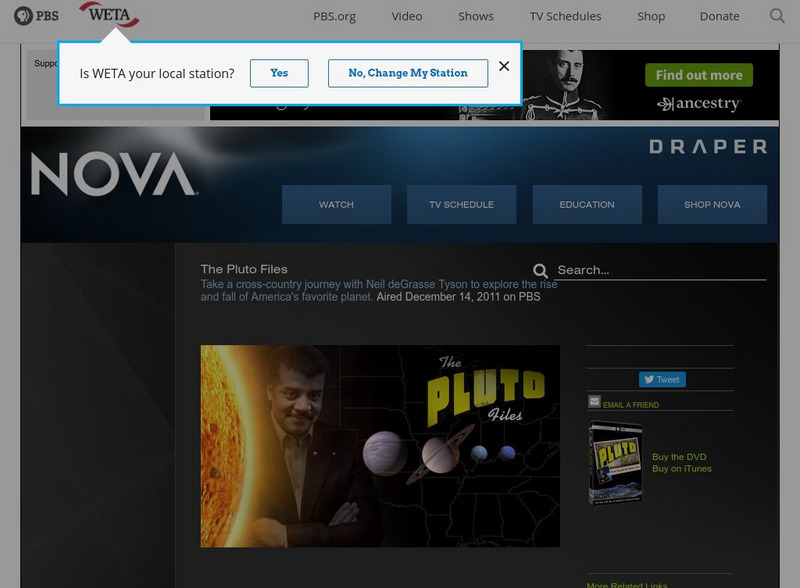
Pbs Nova: The Pluto Files
Pluto not a planet! This statement, made by Neil deGrasse Tyson, Director of the American Museum of Natural History's Hayden Planetarium, caused a furor with elementary students across the country. After 10 years, Tyson, travels across...
Kurzgesagt
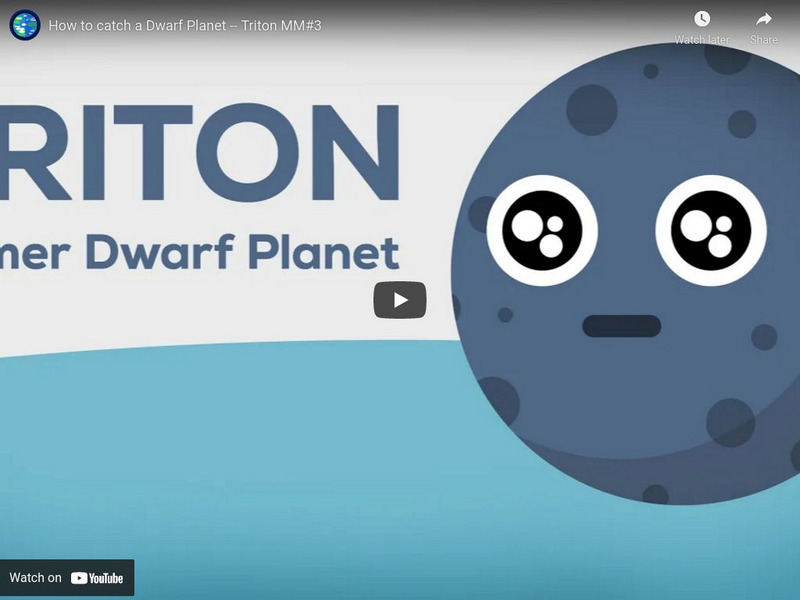
You Tube: Kurzgesagt: How to Catch a Dwarf Planet Triton
If Neptune didn't catch Triton we might have another Dwarf Planet in our Solar system -- maybe even another Planet or double system. We show how this could have happened. [2:06]
Science Friday Initiative
Science Friday: Dwarf Planet Found at the Edge of the Solar System
Dwarf planet 2012 VP-113 takes approximately 4,000 years to orbit the sun once. [11 mins. 55 secs.]
Next Vista for Learning
Next Vista for Learning: Pluto
A video reviewing the debate of whether Pluto should be classified as a planet or a dwarf planet. [1:31]