Hi, what do you want to do?






Curated OER
Heads or Tails
Seventh graders compare experimental and theoretical probabilities. In this comparing experimental and theoretical probabilities lesson, 7th graders discuss the theoretical probability of flipping a coin. Students flip a coin...
Texas Instruments
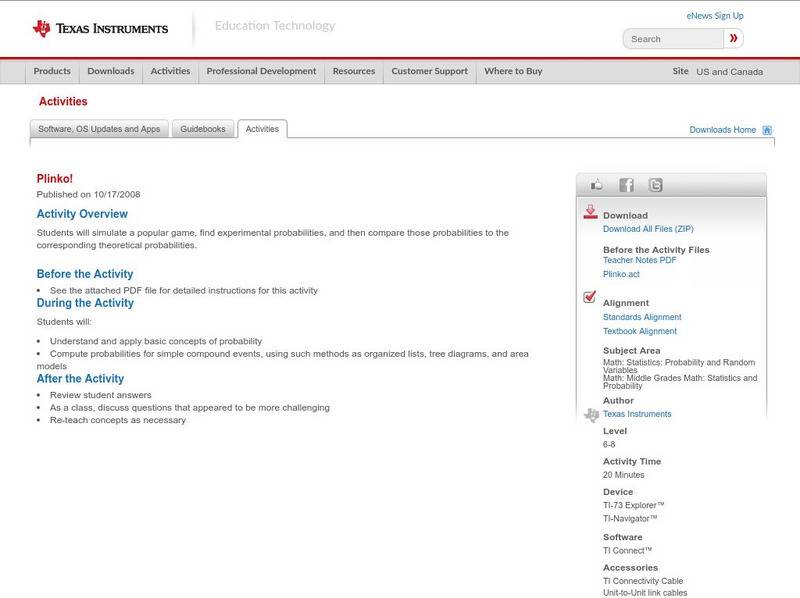
Texas Instruments: Plinko!
In this activity, students will simulate a popular game, find experimental probabilities, and then compare those probabilities to the corresponding theoretical probabilities.
Texas Instruments
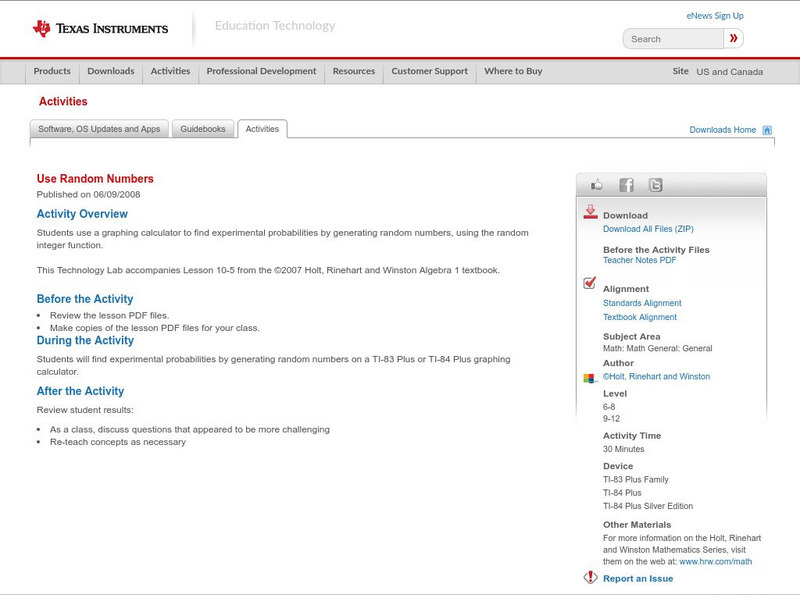
Texas Instruments: Use Random Numbers
Students use a graphing calculator to find experimental probabilities by generating random numbers, using the random integer function. This Technology Lab accompanies Lesson 10-5 from the 2007 Holt, Rinehart and Winston Algebra 1 textbook.
Texas Instruments
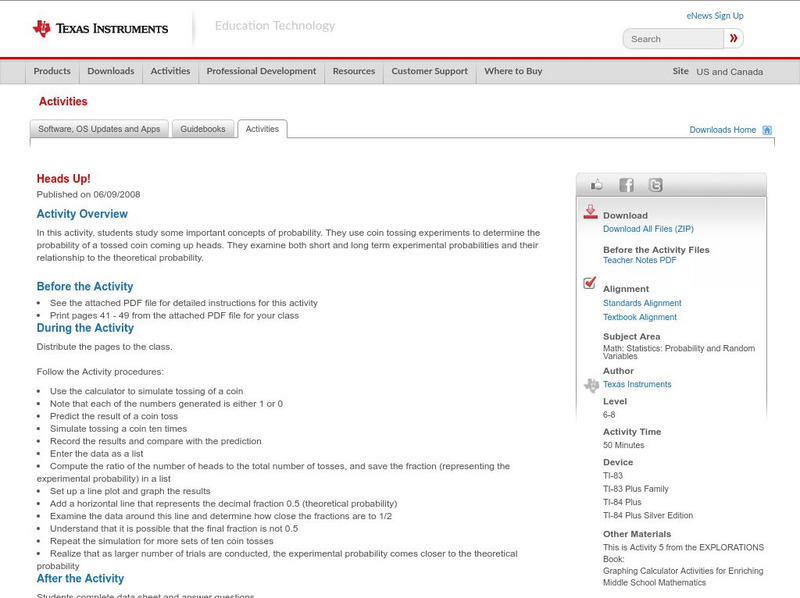
Texas Instruments: Heads Up!
In this activity, students study some important concepts of probability. They use coin tossing experiments to determine the probability of a tossed coin coming up heads. They examine both short and long term experimental probabilities...
Texas Instruments
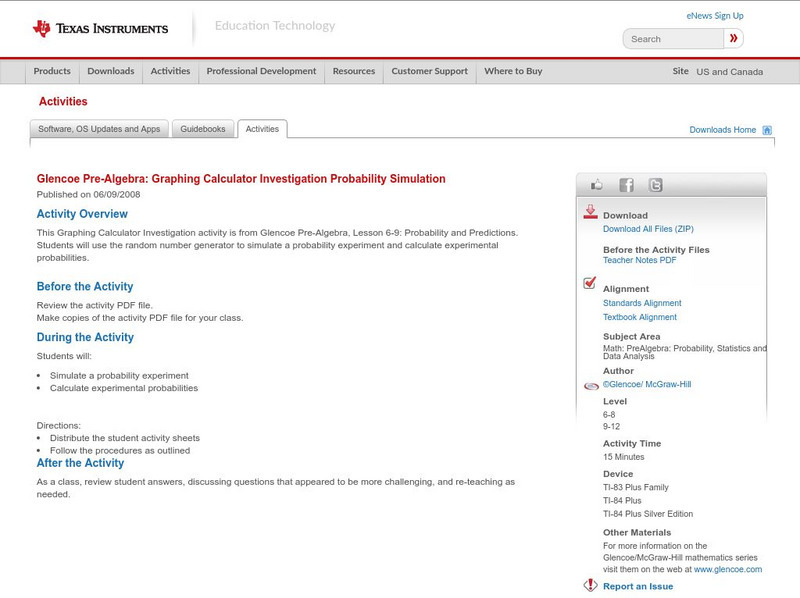
Texas Instruments: Graphing Calculator Investigation Probability Simulation
Students can use the random number generator to simulate a probability experiment and calculate experimental probabilities.

Shodor Education Foundation
Shodor Interactivate: Crazy Choices Game
Compare theoretical and experimental probabilities, using dice, cards, spinners, or coin tosses. Three different probabilities can be compared at once.
Shodor Education Foundation
Shodor Interactivate: Probability
Learners learn about probability by predicting the outcome of planned experiments and playing racing games.