TeachEngineering
Teach Engineering: Fluid Power Basics
Students learn about the basic fundamental concepts regarding fluid power, which includes both pneumatic, which utilize gas, and hydraulic, which utilize liquid, systems. Both systems contain four basic components: a reservoir, a pump or...
TeachEngineering
Teach Engineering: Blood Clots, Polymers and Strokes
Students are introduced to the circulatory system with an emphasis on the blood clotting process, including coagulation and the formation and degradation of polymers through their underlying atomic properties. They learn about the...
TeachEngineering
Teach Engineering: How Far Does a Lava Flow Go?
While learning about volcanoes, magma and lava flows, students learn about the properties of liquid movement, coming to understand viscosity and other factors that increase and decrease liquid flow. They also learn about lava composition...
TeachEngineering
Teach Engineering: Brain Is a Computer
Young scholars learn about the similarities between the human brain and its engineering counterpart, the computer. Since students work with computers routinely, this comparison strengthens their understanding of both how the brain works...
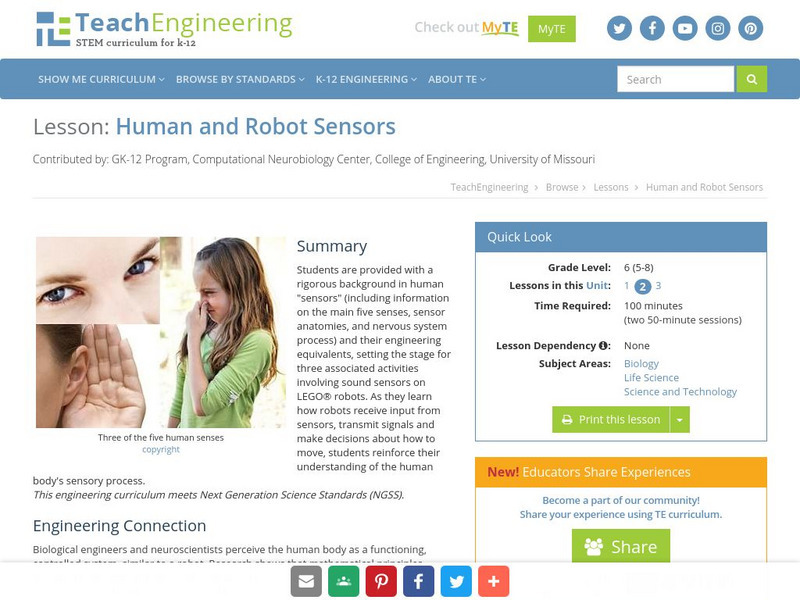
TeachEngineering
Teach Engineering: Human and Robot Sensors
Students are provided with a rigorous background in human "sensors" (including information on the main five senses, sensor anatomies, and nervous system process) and their engineering equivalents, setting the stage for three associated...
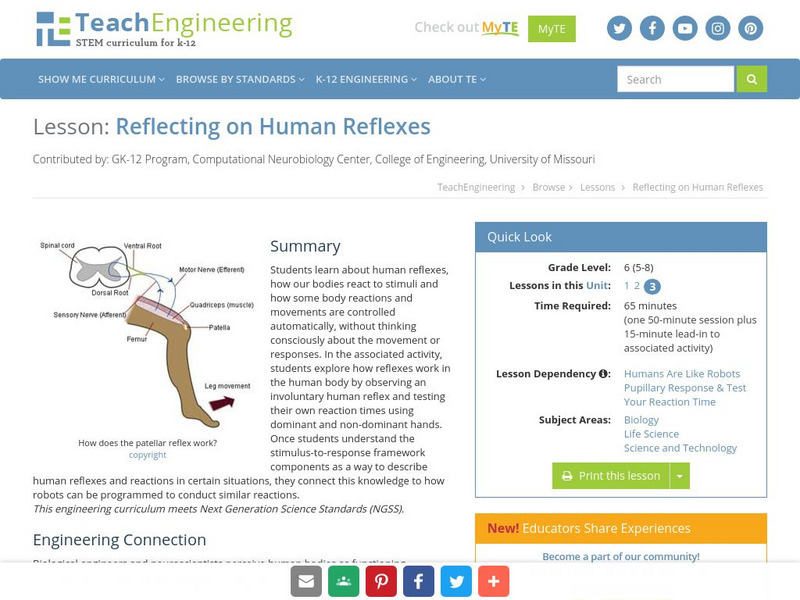
TeachEngineering
Teach Engineering: Reflecting on Human Reflexes
Students learn about human reflexes, how our bodies react to stimuli and how some body reactions and movements are controlled automatically, without thinking consciously about the movement or responses. In the associated activity,...
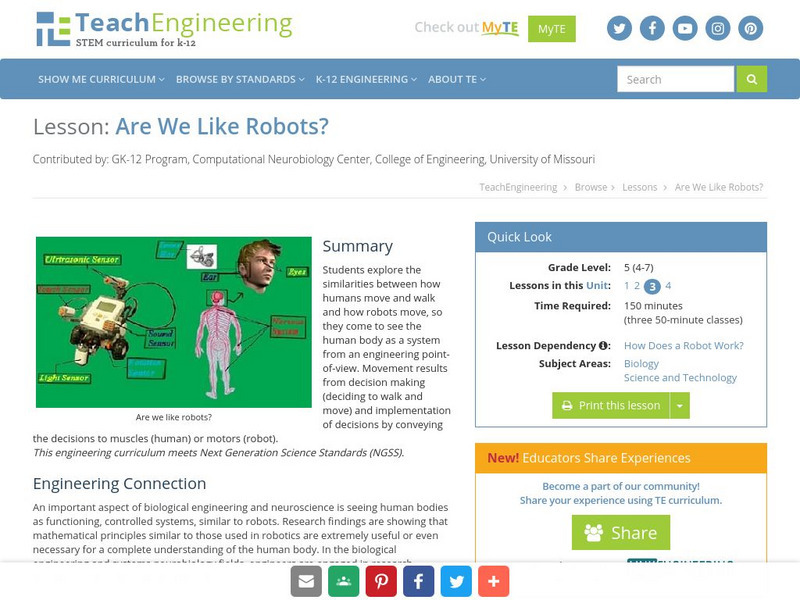
TeachEngineering
Teach Engineering: Are We Like Robots?
Students explore the similarities between how humans move and walk and how robots move, so they come to see the human body as a system from an engineering point-of-view. Movement results from decision making (deciding to walk and move)...
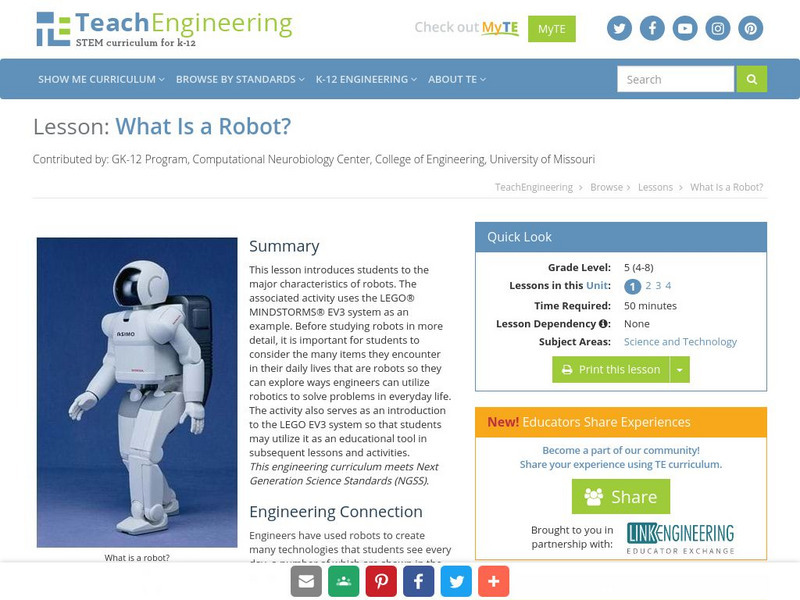
TeachEngineering
Teach Engineering: What Is a Robot?
This instructional activity introduces students to the major characteristics of robots. The associated activity uses the LEGO MINDSTORMS NXT system as an example. Before studying robots in more detail, it is important for students to...
TeachEngineering
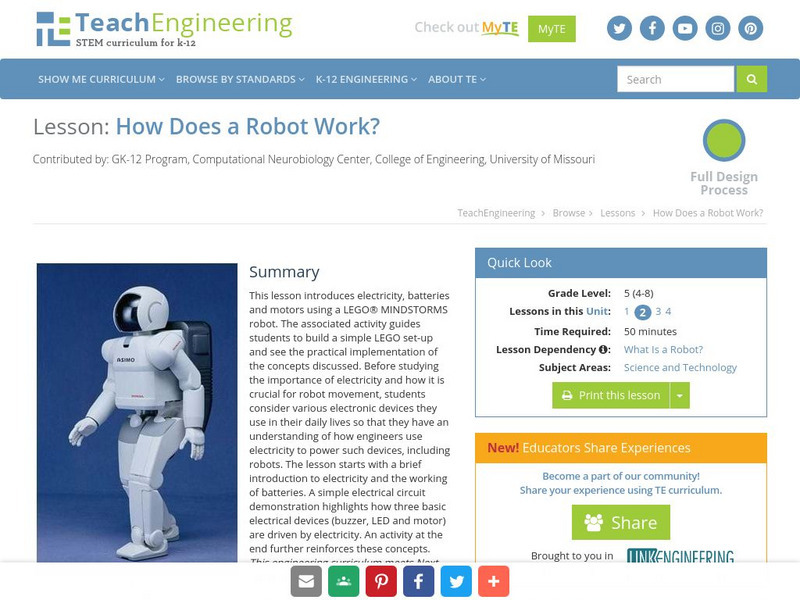
Teach Engineering: How Does a Robot Work?
This lesson plan introduces electricity, batteries and motors using a LEGO MINDSTORMS NXT robot. The associated activity guides students to build a simple LEGO NXT set-up and see the practical implementation of the concepts discussed....
TeachEngineering
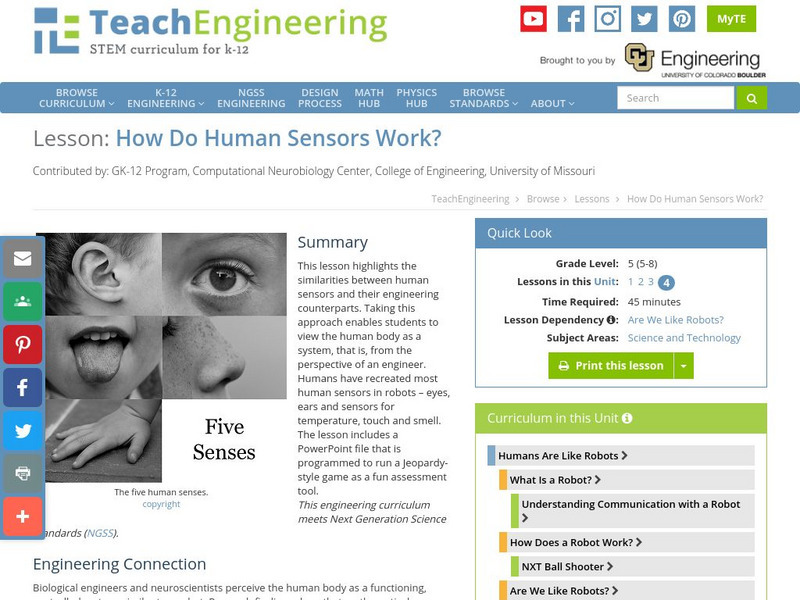
Teach Engineering: How Do Human Sensors Work?
This lesson highlights the similarities between human sensors and their engineering counterparts. Taking this approach enables students to view the human body as a system, that is, from the perspective of an engineer. Humans have...
TeachEngineering
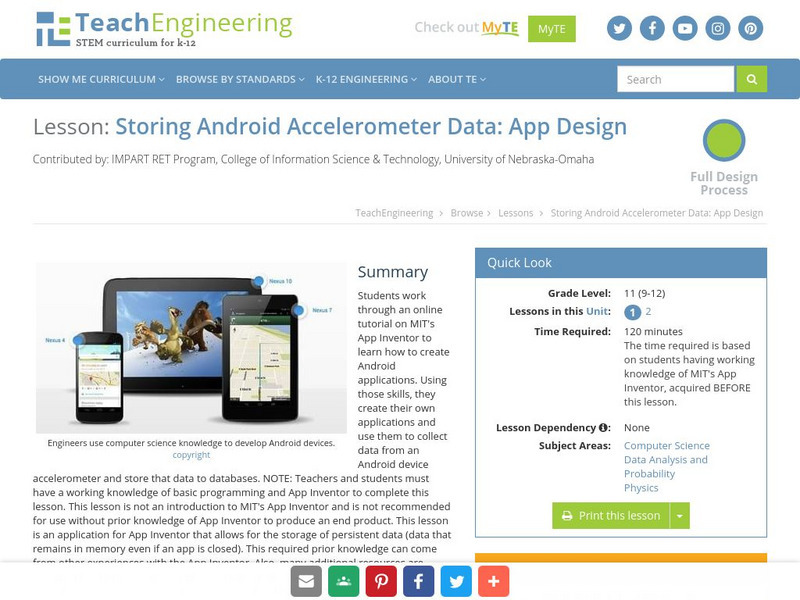
Teach Engineering: Storing Android Accelerometer Data: App Design
Young scholars work through an online tutorial on MIT's App Inventor to learn how to create Android applications. Using those skills, they create their own applications and use them to collect data from an Android device accelerometer...
TeachEngineering
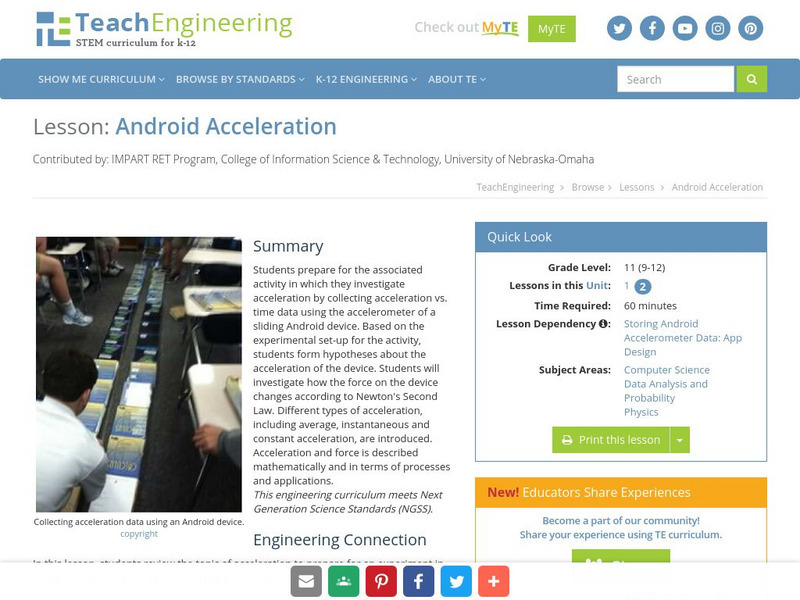
Teach Engineering: Android Acceleration
Learners prepare for the associated activity in which they investigate acceleration by collecting acceleration vs. time data using the accelerometer of a sliding Android device. Based on the experimental set-up for the activity, students...

TeachEngineering
Teach Engineering: Program Analysis Using App Inventor
In computer science, program analysis is used to determine the behavior of computer programs. Flow charts are an important tool for understanding how programs work by tracing control flow. Control flow is a graphical representation of...
TeachEngineering
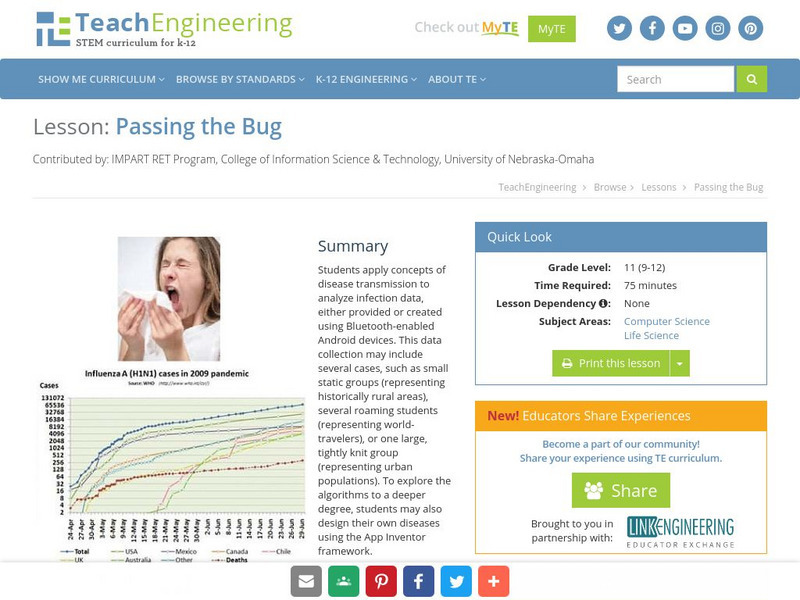
Teach Engineering: Passing the Bug
Learners apply concepts of disease transmission to analyze infection data, either provided or created using Bluetooth-enabled Android devices. This data collection may include several cases, such as small static groups (representing...
TeachEngineering
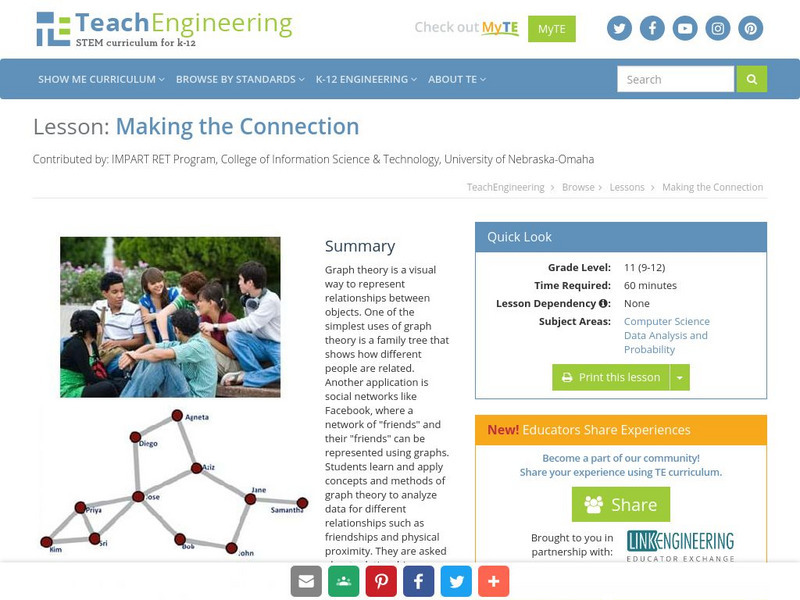
Teach Engineering: Making the Connection
Graph theory is a visual way to represent relationships between objects. One of the simplest uses of graph theory is a family tree that shows how different people are related. Another application is social networks like Facebook, where a...
TeachEngineering
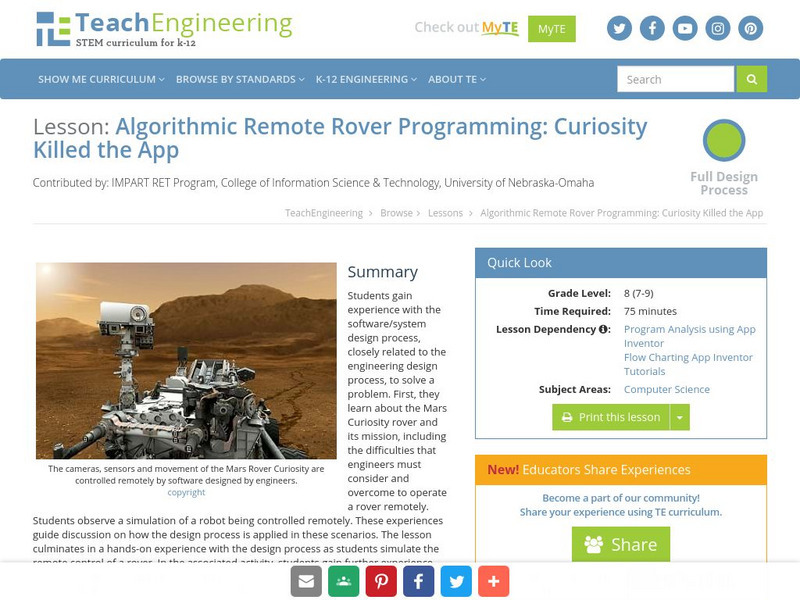
Teach Engineering: Curiosity Killed the App
Young scholars gain experience with the software/system design process, closely related to the engineering design process, to solve a problem. First, they learn about the Mars Curiosity rover and its mission, including the difficulties...
TeachEngineering
Teach Engineering: Does It Work? Test and Test Again
Testing is critical to any design, whether it be in the creation of new software or building a bridge across a wide river. Despite risking the quality of the design, the testing stage is often hurried in order to get products to market....
TeachEngineering
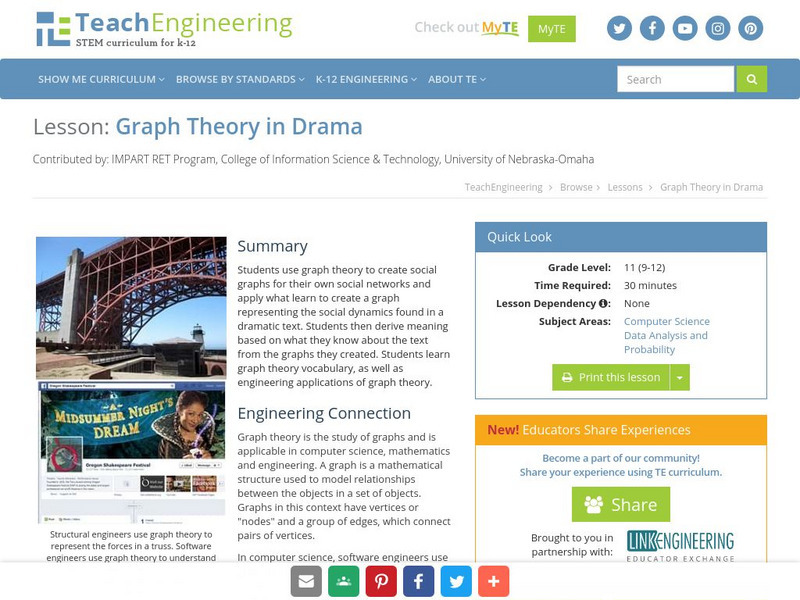
Teach Engineering: Graph Theory in Drama
Students use graph theory to create social graphs for their own social networks and apply what learn to create a graph representing the social dynamics found in a dramatic text. Students then derive meaning based on what they know about...
TeachEngineering
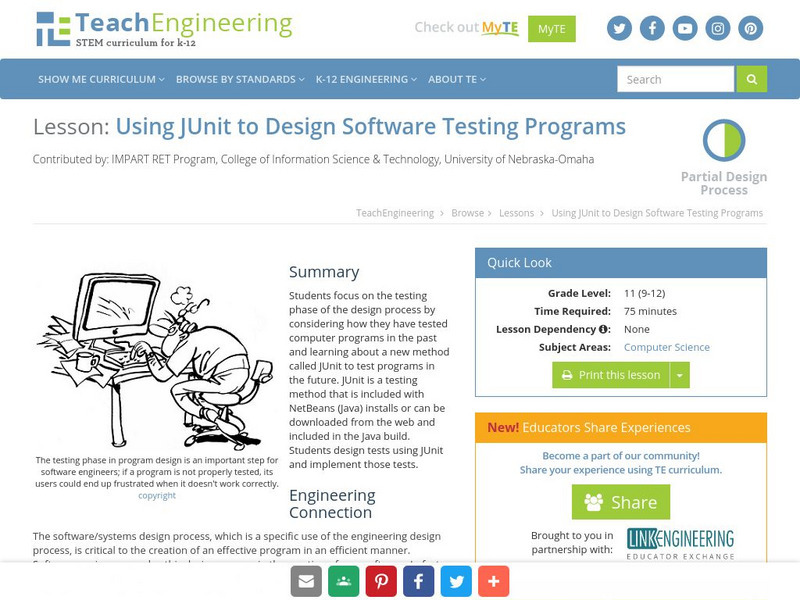
Teach Engineering: Using J Unit
Learners focus on the testing phase of the design process by considering how they have tested computer programs in the past and learning about a new method called JUnit to test programs in the future. JUnit is a testing method that is...
TeachEngineering
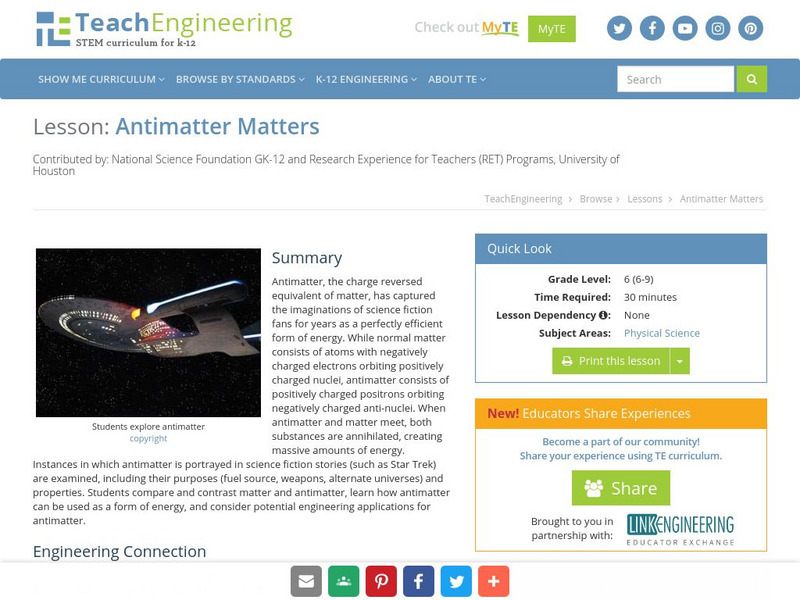
Teach Engineering: Antimatter Matters
Antimatter, the charge reversed equivalent of matter, has captured the imaginations of science fiction fans for years as a perfectly efficient form of energy. While normal matter consists of atoms with negatively charged electrons...
TeachEngineering
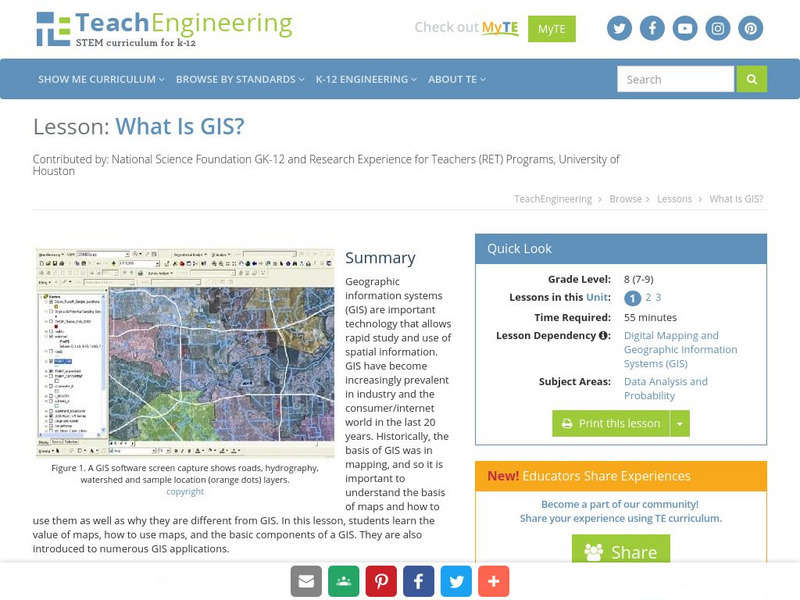
Teach Engineering: What Is Gis?
Geographic information systems (GIS) are important technology that allows rapid study and use of spatial information. GIS have become increasingly prevalent in industry and the consumer/internet world in the last 20 years. Historically,...
TeachEngineering
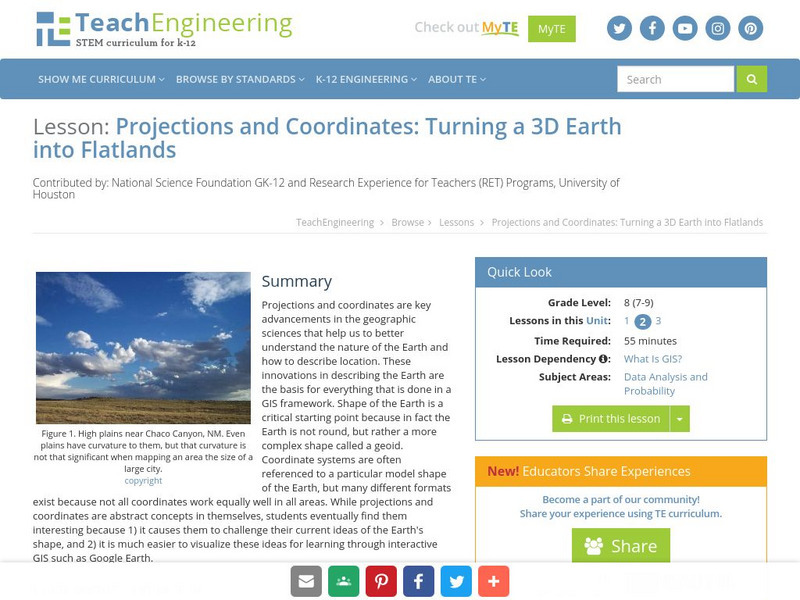
Teach Engineering: Projections and Coordinates: Turning a 3 D Earth Into Flatlands
Projections and coordinates are key advancements in the geographic sciences that allow us to better understand the nature of the Earth and how to describe location. These innovations in describing the Earth are the basis for everything...
TeachEngineering
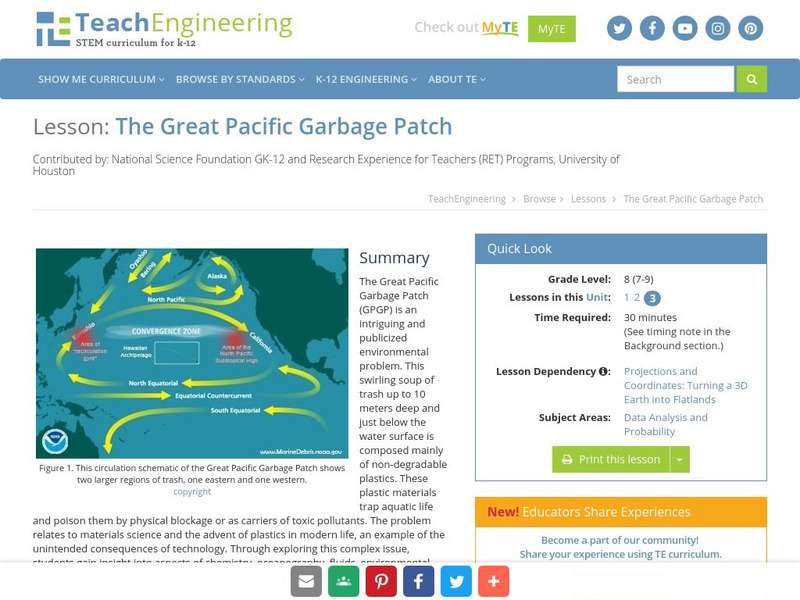
Teach Engineering: The Great Pacific Garbage Patch
The Great Pacific Garbage Patch (GPGP) is an interesting and somewhat publicized environmental problem. A swirling soup of trash up to 10 meters deep and just below the water surface is composed mainly of non-degradable plastics. These...
TeachEngineering
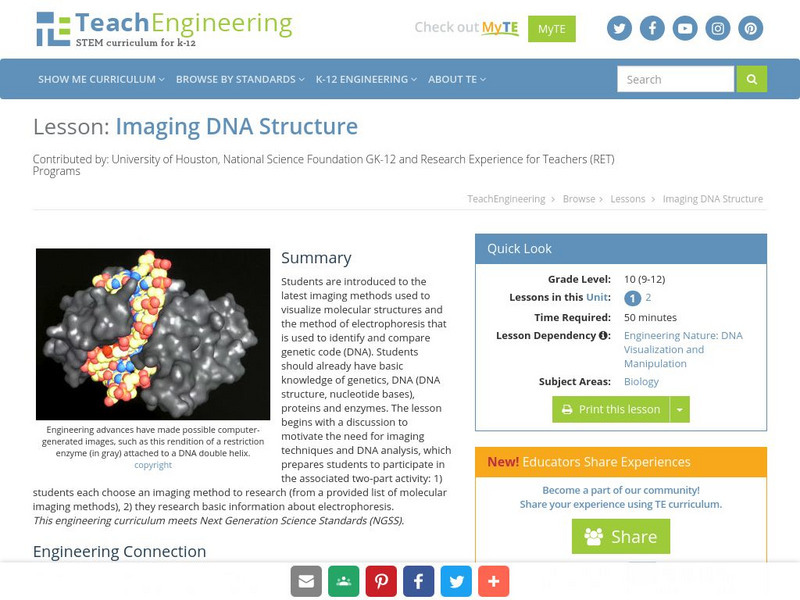
Teach Engineering: Imaging Dna Structure
Students are introduced to the latest imaging methods used to visualize molecular structures and the method of electrophoresis that is used to identify and compare genetic code (DNA). Students should already have basic knowledge of...