TeachEngineering
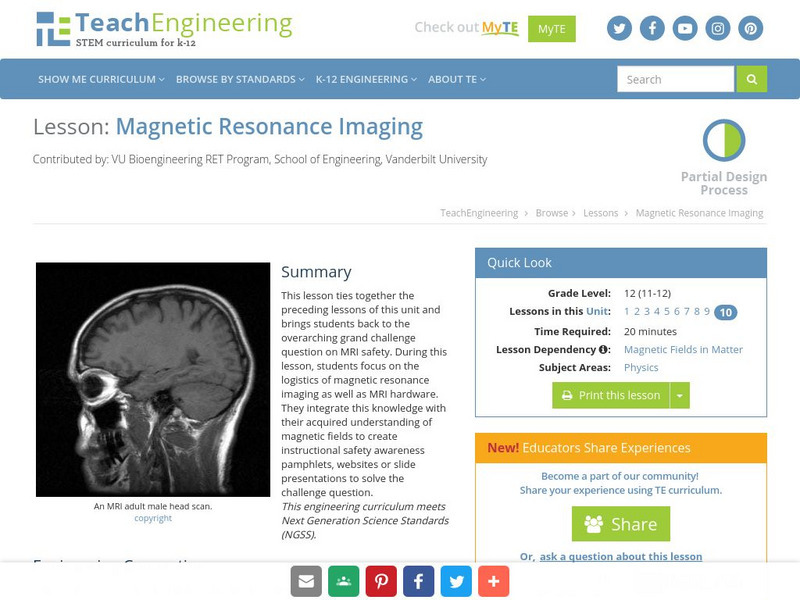
Teach Engineering: Magnetic Resonance Imaging
This lesson ties the preceding lessons together and brings students back to the grand challenge question on MRI safety. During this lesson, students focus on the logistics of magnetic resonance imaging as well as the MRI hardware....
TeachEngineering
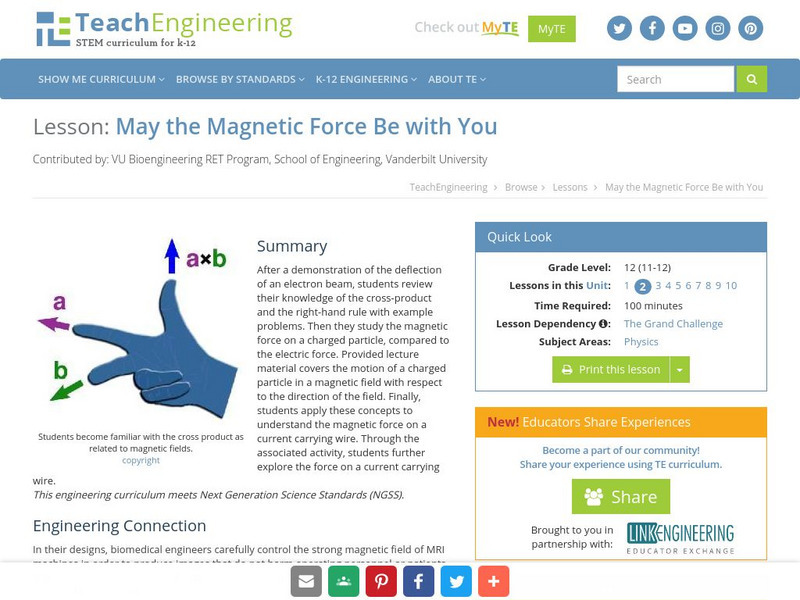
Teach Engineering: May the Magnetic Force Be With You
This lesson begins with a demonstration of the deflection of an electron beam. Learners then review their knowledge of the cross product and the right hand rule with sample problems. After which, students study the magnetic force on a...
TeachEngineering
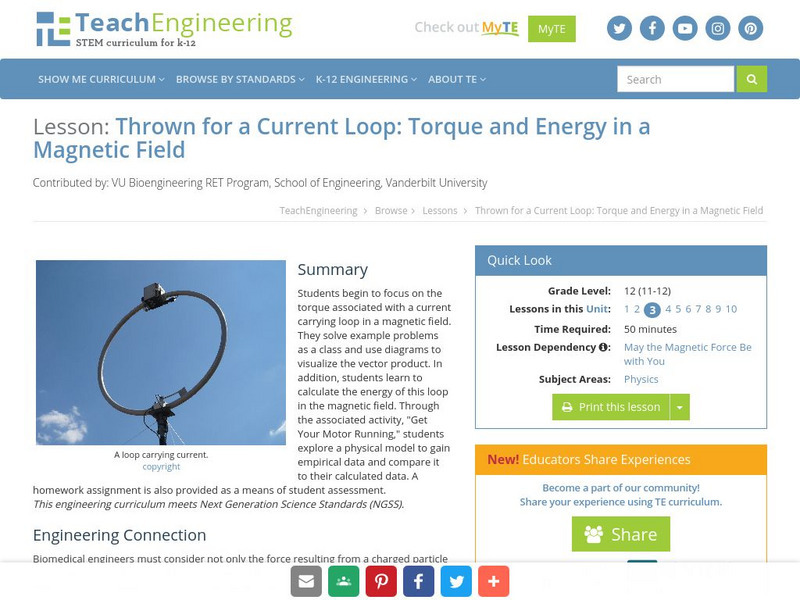
Teach Engineering: Thrown for a Loop
In this lesson, young scholars begin to focus on the torque associated with a current carrying loop in a magnetic field. Students are prompted with example problems and use diagrams to visualize the vector product. In addition, young...
TeachEngineering
Teach Engineering: Both Fields at Once?!
This lesson discusses the result of a charge being subject to both electric and magnetic fields at the same time. It covers the Hall effect, velocity selector, and the charge to mass ratio. Given several sample problems, students learn...
TeachEngineering
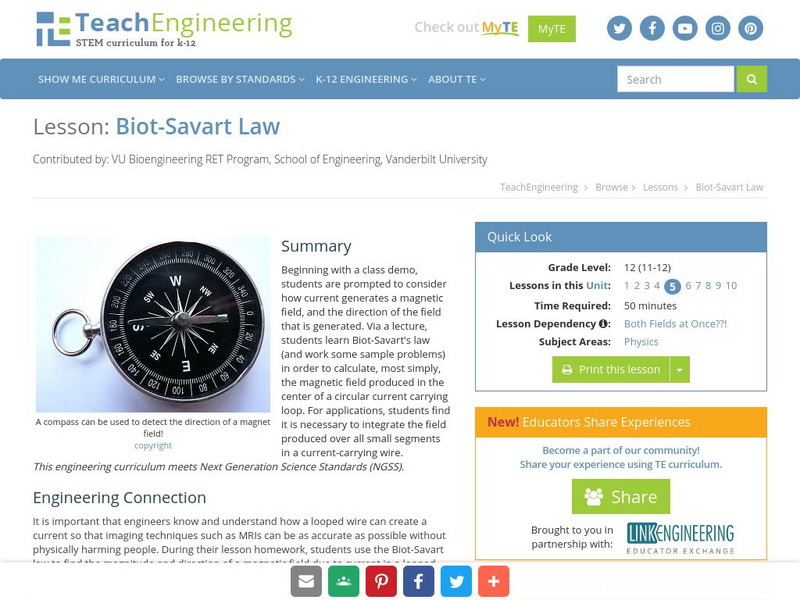
Teach Engineering: Biot Savart Law
This lesson begins with a demonstration prompting students to consider how current generates a magnetic field and the direction of the field that is generated. Through formal lecture, students learn Biot-Savart's law in order to...
TeachEngineering
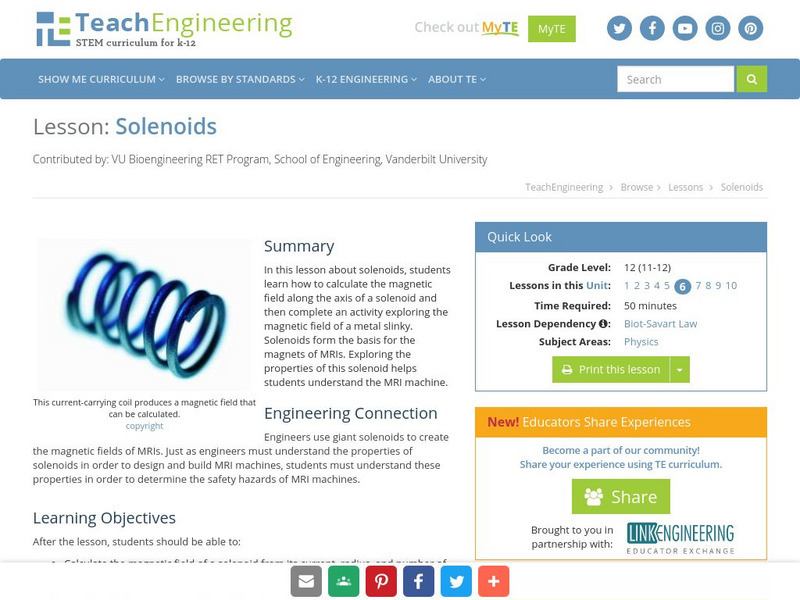
Teach Engineering: Solenoids
This instructional activity discusses solenoids. Students learn how to calculate the magnetic field along the axis of a solenoid and complete an activity exploring the magnetic field of a metal slinky. Solenoids form the basis for the...
TeachEngineering
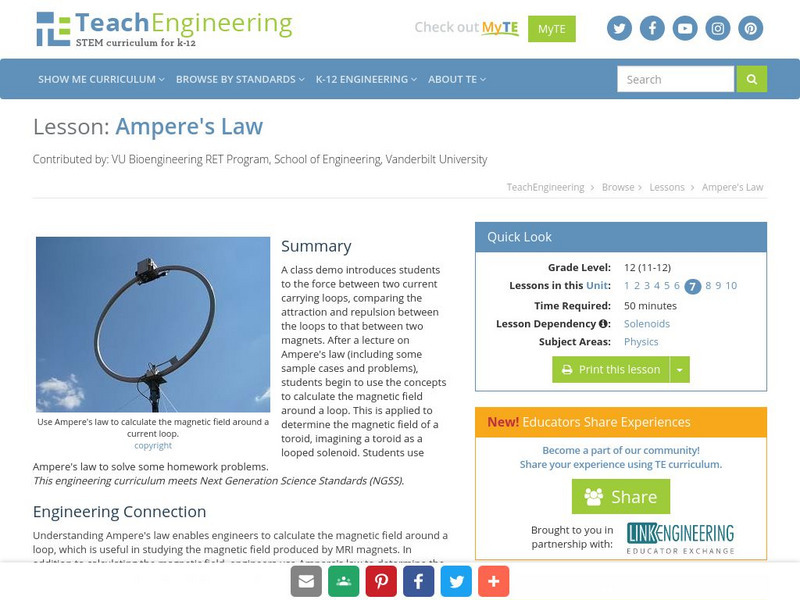
Teach Engineering: Ampere's Law
The activity begins with a demonstration introducing students to the force between two current carrying loops, comparing the attraction and repulsion between the loops to that between two magnets. After formal lecture on Ampere's law,...
TeachEngineering
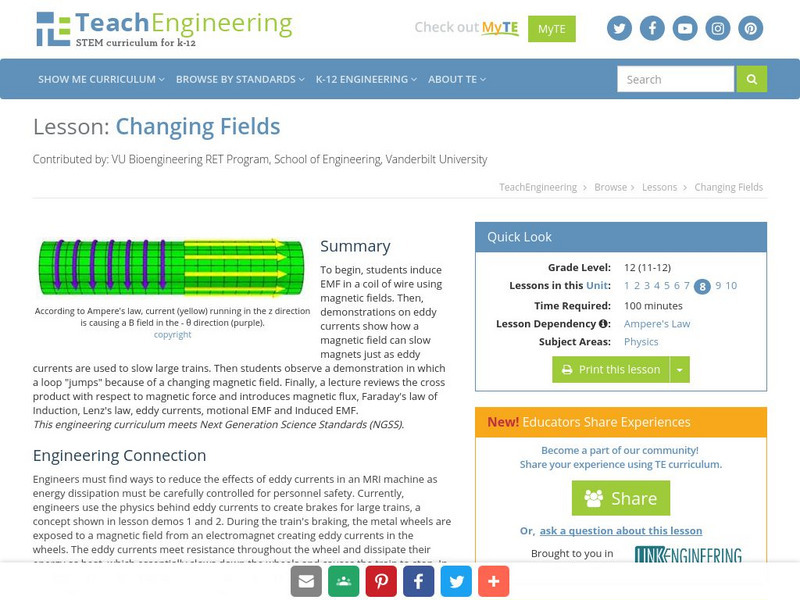
Teach Engineering: Changing Fields
This lesson begins with an activity in which learners induce EMF in a coil of wire using magnetic fields. Then, demonstrations on Eddy currents show how a magnetic field can slow magnets just as Eddy currents are used to slow large...
TeachEngineering
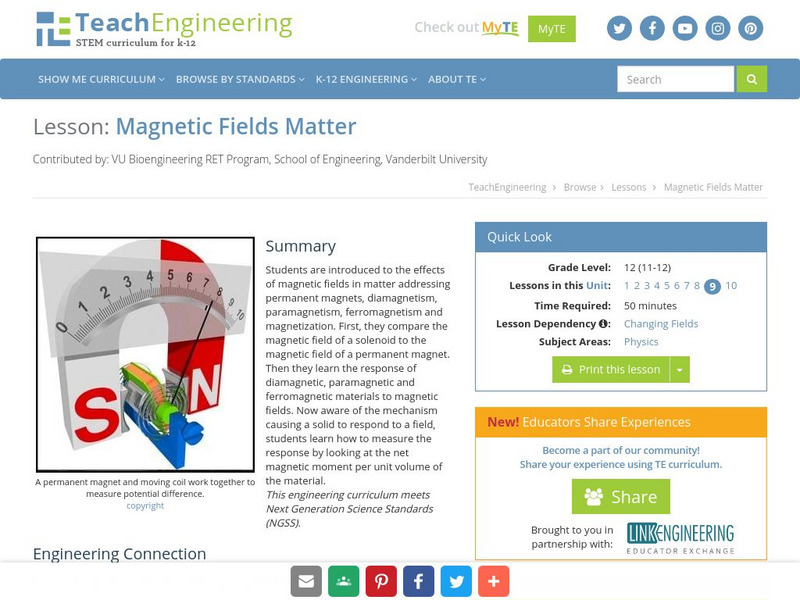
Teach Engineering: Magnetic Fields Matter
This lesson introduces students to the effects of magnetic fields in matter addressing permanent magnets, diamagnetism, paramagnetism, ferromagnetism, and magnetization. First students must compare the magnetic field of a solenoid to the...
TeachEngineering
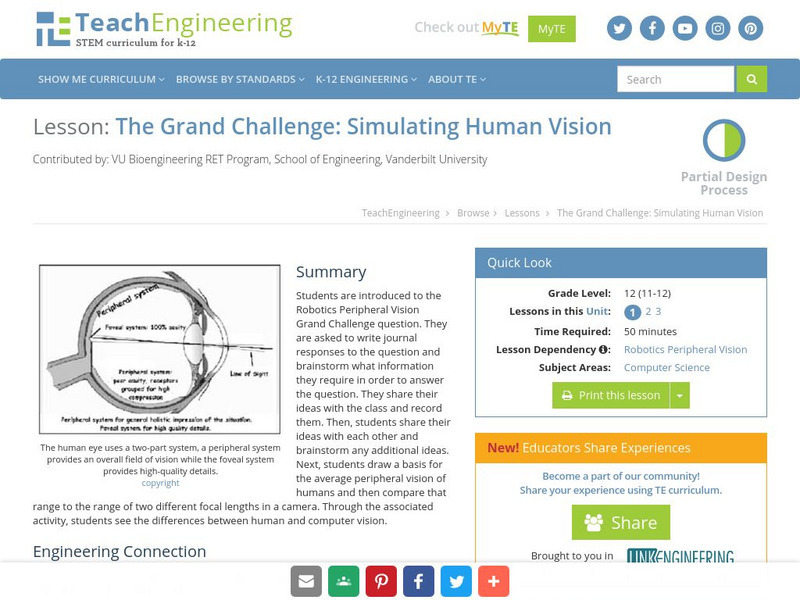
Teach Engineering: The Grand Challenge: Simulating Human Vision
Learners are introduced to the Robotics Peripheral Vision Grand Challenge question. They are asked to write journal responses to the question and brainstorm what information they require to answer the question. Their ideas are shared...
TeachEngineering
Teach Engineering: What Makes Up a Color?
As a part of the research and revise step of the Legacy Cycle, this lesson provides students with information they will need later on to be able to average pixels to simulate blurring in the peripheral plane of vision. Students learn why...
TeachEngineering
Teach Engineering: How Do You Store All This Data?
During this lesson, students start to see the data structure they will use to store their images, towards finding a solution to this unit's Grand Challenge. Students are introduced to two-dimensional arrays and vector classes. Then they...
TeachEngineering
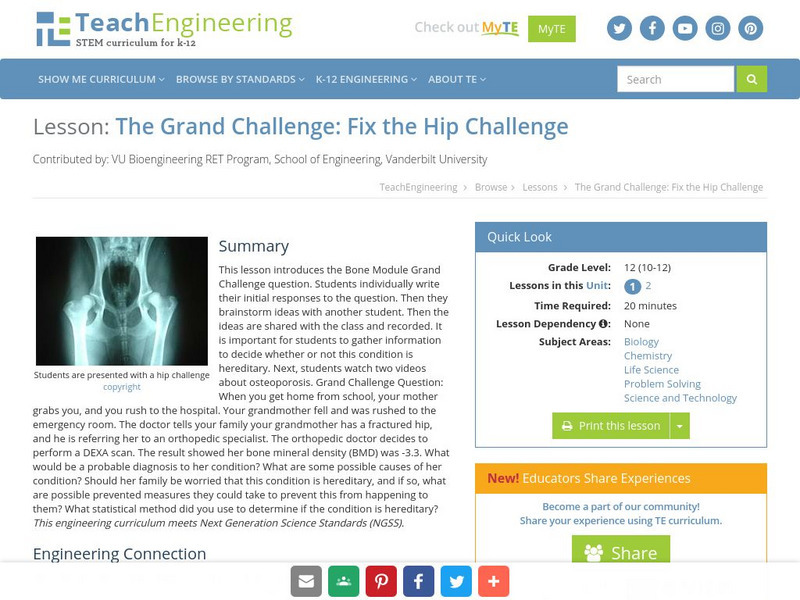
Teach Engineering: The Grand Challenge: Fix the Hip Challenge
This instructional activity introduces the Bone Module Grand Challenge question. Students are asked to write their initial responses to the question alone. They will then brainstorm ideas with one other student. Finally, the ideas are...
TeachEngineering
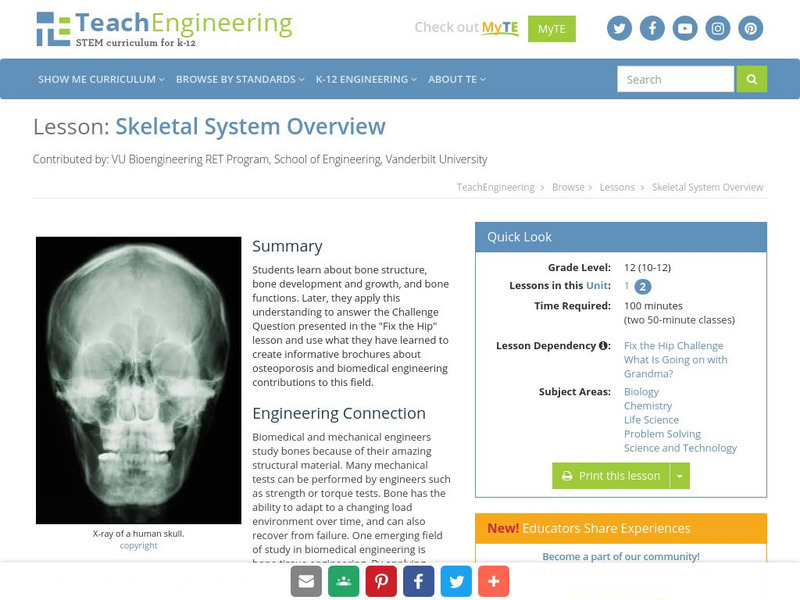
Teach Engineering: Skeletal System Overview
Students will learn about bone structure, bone development and growth, and bone functions. Later, students will apply this understanding to answer the Challenge Question presented in the "Fix the Hip" lesson and use the acquired learning...
TeachEngineering
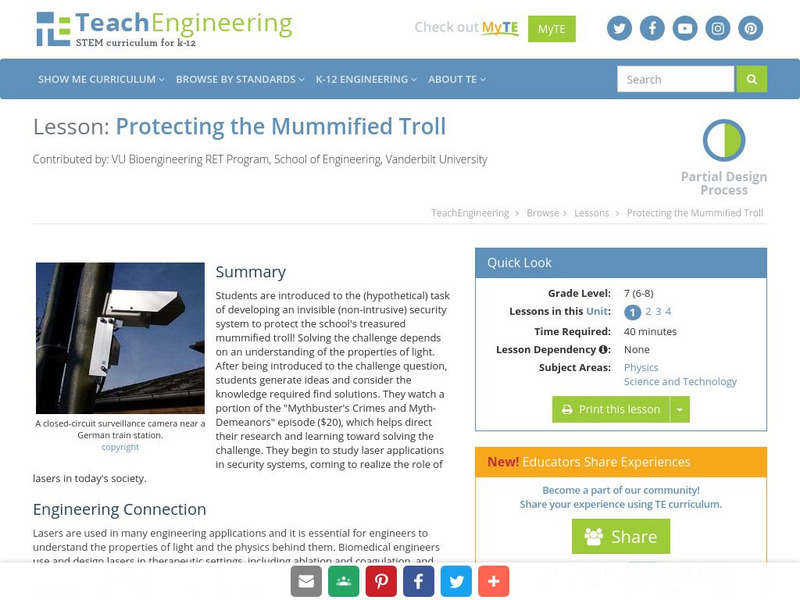
Teach Engineering: Protecting the Mummified Troll
Students are introduced to the (hypothetical) task of developing an invisible (non-intrusive) security system to protect the school's treasured mummified troll! Solving the challenge depends on an understanding of the properties of...
TeachEngineering
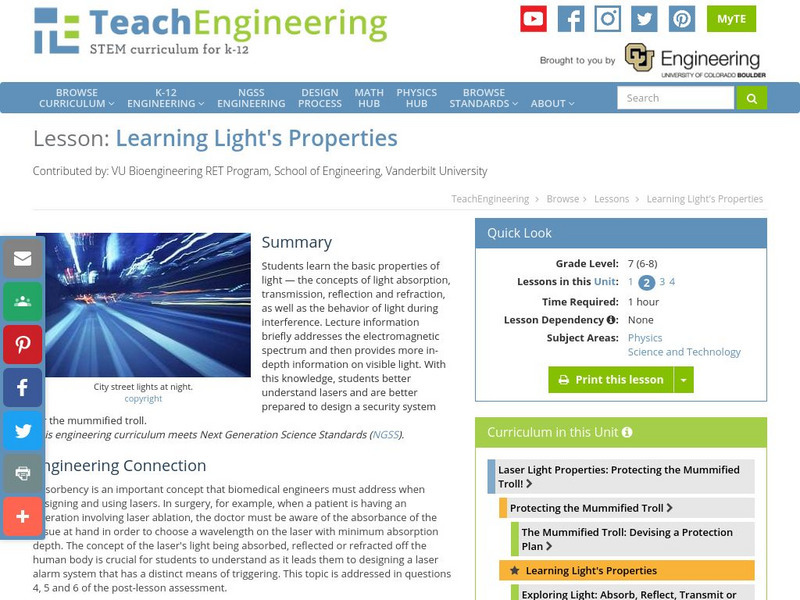
Teach Engineering: Learning Light's Properties
Young scholars learn the basic properties of light--the concepts of light absorption, transmission, reflection and refraction, as well as the behavior of light during interference. Lecture information briefly addresses the...

TeachEngineering
Teach Engineering: Laser Types and Uses
Through two classroom demos, students are introduced to the basic properties of lasers through various mediums. In the Making an Electric Pickle demonstration, students see how cellular tissue is able to conduct electricity, and how this...
TeachEngineering
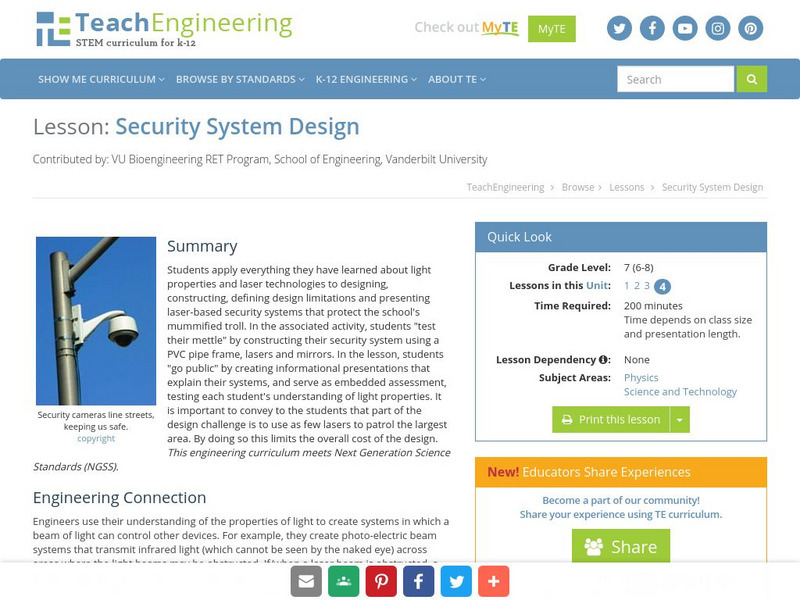
Teach Engineering: Security System Design
Students apply everything they have learned about light properties and laser technologies to designing, constructing and presenting laser-based security systems that protect the school's mummified troll. In the associated activity,...
TeachEngineering
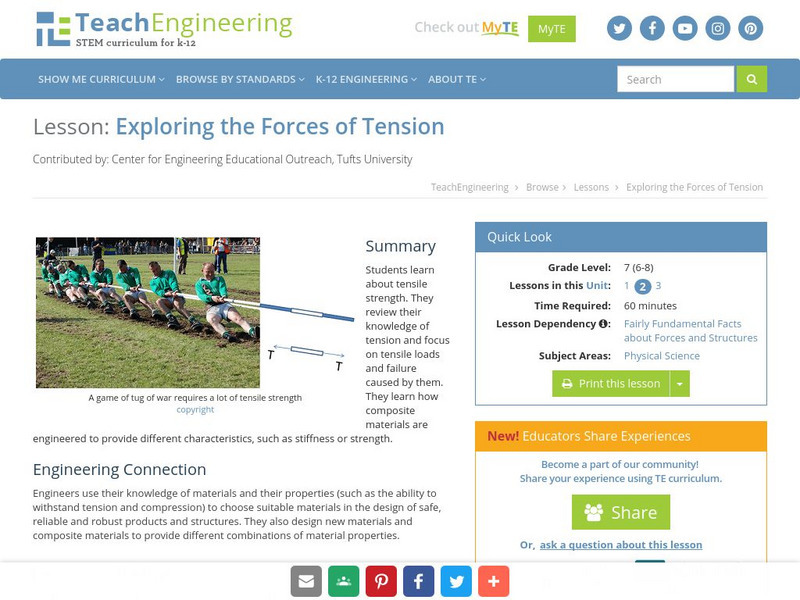
Teach Engineering: Exploring the Forces of Tension
Students will review their knowledge of tension and focus on tensile loads and failure caused by them.
TeachEngineering
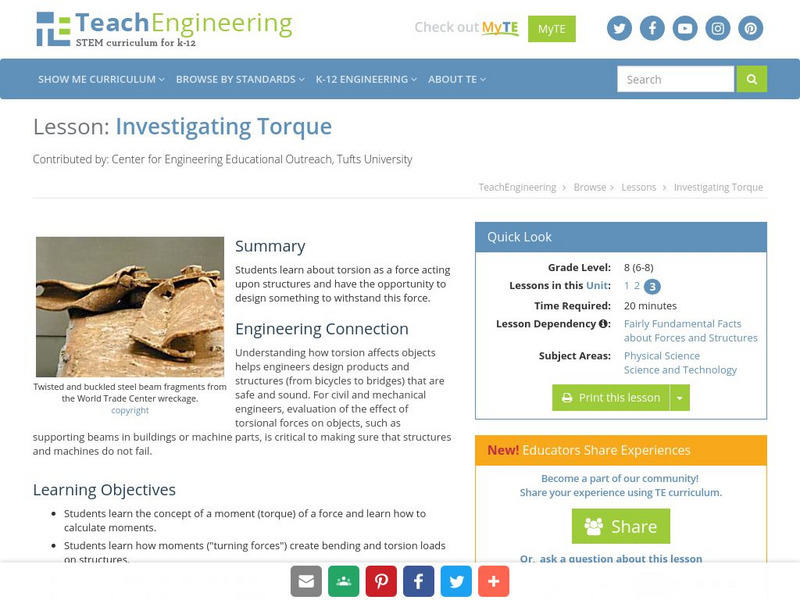
Teach Engineering: Investigating Torque
This lesson focuses on torsion as a force acting upon structures. Students will have the opportunity to design something to withstand this force.
TeachEngineering
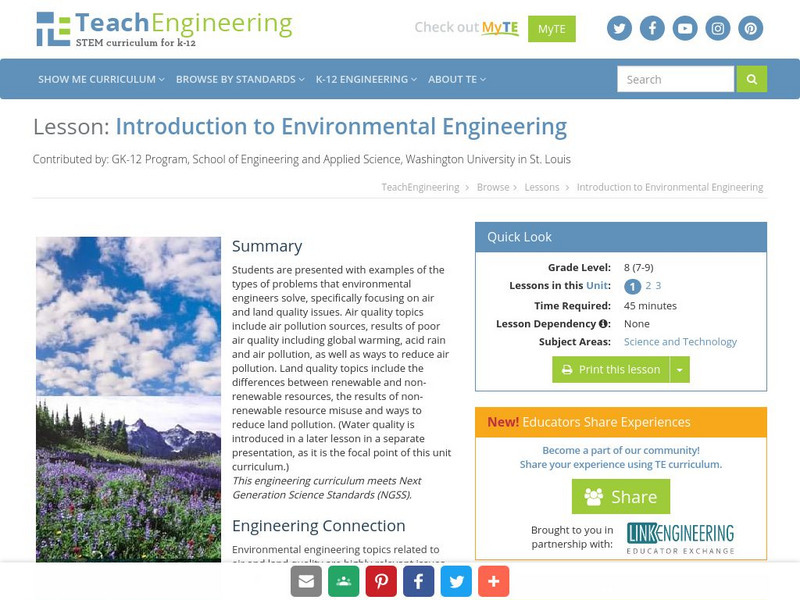
Teach Engineering: Introduction to Environmental Engineering
Students are presented with examples of the types of problems that environmental engineers solve, specifically focusing on air and land quality issues. Air quality topics include air pollution sources, results of poor air quality...
TeachEngineering
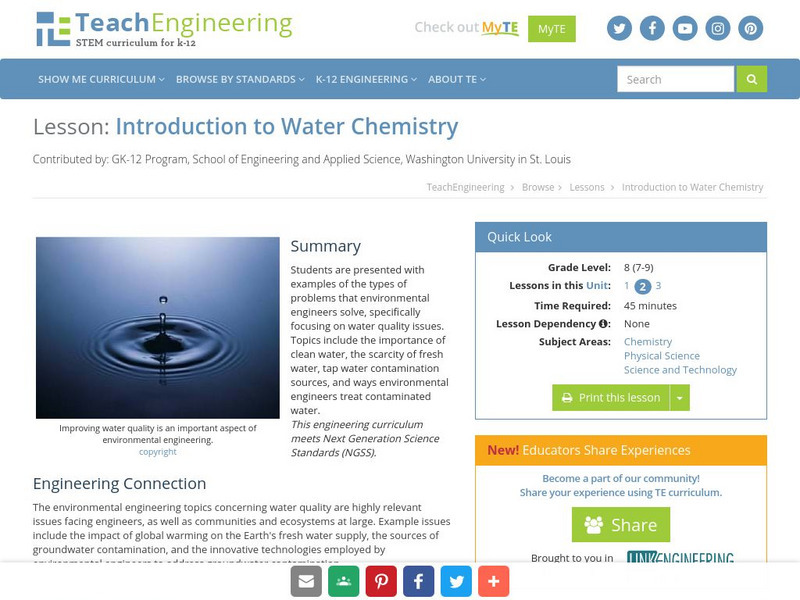
Teach Engineering: Introduction to Water Chemistry
Students are presented with examples of the types of problems that environmental engineers solve, specifically focusing on water quality issues. Topics include the importance of clean water, the scarcity of fresh water, tap water...
TeachEngineering
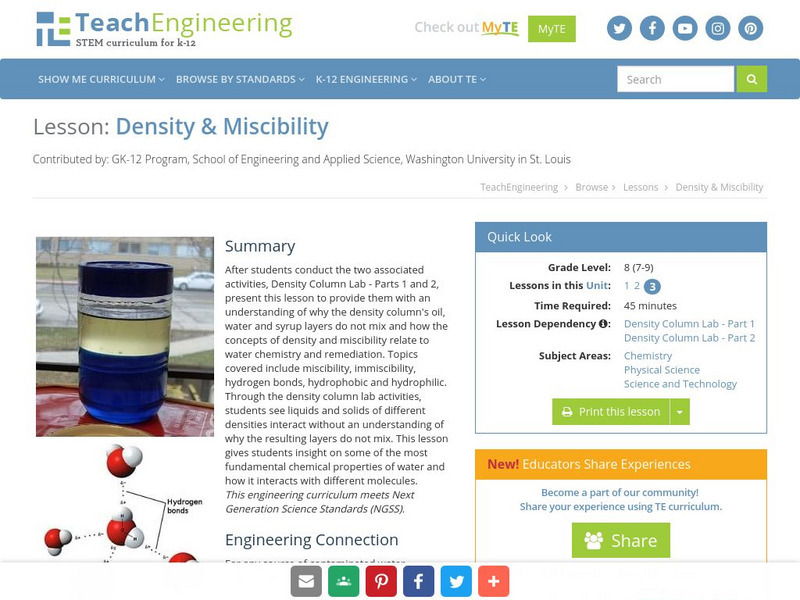
Teach Engineering: Density & Miscibility
After young scholars conduct the two associated activities, Density Column Lab - Parts 1 and 2, present this lesson to provide them with an understanding of why the density column's oil, water and syrup layers do not mix and how the...

TeachEngineering
Teach Engineering: Got Energy? Spinning a Food Web
Students learn about energy flow in food webs, including the roles of the sun, producers, consumers and decomposers in the energy cycle. They model a food web and create diagrams of food webs using their own drawings and/or images from...