Hi, what do you want to do?






Curated Video
Ordering fractions by way of a common denominator
Pupil outcome: I can compare and order fractions by converting to fractions with a common denominator. Key learning points: - When a fraction is multiplied by 1 it remains the same but may look different. - Two fractions can be written...
Curated Video
Changing ratios
Pupil outcome: I can find quantities given a change in the ratio. Key learning points: - It is important to preserve the relationship between the parts of a ratio. - Changing this relationship would change the ratio. - When the ratio...
Curated Video
Checking and securing dividing a fraction by a whole number
Pupil outcome: I can use the mathematical structures that underpin the division of fractions to divide a fraction by a whole number. Key learning points: - A diagram can help to show the underlying structure. - A fraction can be...
Curated Video
Between numbers
Pupil outcome: I can appreciate that, for any two numbers, there is always another number in between them. Key learning points: - Using a number line you can find numbers between two integers. - Using a number line you can find numbers...
Curated Video
Combining ratios
Pupil outcome: I can combine ratios. Key learning points: - There may be a relationship between quantities A and B and a relationship between quantities B and C - Therefore there is a relationship between A and C - If A : B and B : C...
Curated Video
Lowest common multiple
Pupil outcome: I can use the prime factorisation of two or more positive integers to efficiently find their lowest common multiple. Key learning points: - Common multiples can be found using the prime factorisation of numbers - The...
Curated Video
Are You Stumped by LCM? Find Out How To Ace This Ladder Method Puzzle!
Welcome to Math Defined with Mrs. C, where I simplify math concepts for you! In this video, I will guide you through the ladder method to find the Least Common Multiple (LCM) of a set of numbers. Specifically, I'll tackle the numbers...
Curated Video
Finding the Lowest Common Multiple (LCM)
This video explains how to find the lowest common multiple (LCM) of two or more numbers, using two methods: listing the multiples and using prime factorisation. Practice questions and answers are at the end of the video.
Curated Video
Exploring Lowest Common Multiples and Highest Common Factors
This video is all about Highest Common Factors and Lowest Common Multiples.
Curated Video
Exploring Multiples: Common Multiples and Lowest Common Multiples
This video is all about multiples, common multiples and lowest common multiples.
Curated Video
Mastering the Ladder Method for Finding LCM
This video demonstrates the ladder method for finding the least common multiple (LCM) of multiple numbers in a quick and easy way. By using shared factors and multiplying them outside the ladder, the LCM can be efficiently calculated....
Curated Video
How to find the Lowest Common Multiple (LCM) #6
This video covers how to find the "Lowest Common Multiple" of a group of numbers. We cover 2 methods. The first is the easier method, which involves listing out the multiples of each number and picking the lowest multiple in...
FuseSchool
Types Of Numbers
We all know what numbers are 1, 2, 3, 4, 5, …. Including negative numbers -1, -2, -3, -4, -5, ... But did you know that mathematicians classify numbers into different types… into a number system. Let’s start at the top with real numbers....
FuseSchool
Factors & Multiples
Factors & Multiples | Number | Maths | FuseSchool In this video we are going to look at factors and multiples. Multiples are the timestables of a number. What we get by multiplying that number. The multiples of 3 are 3, 6, 9, 12, 15, and...
Curated Video
GCSE Secondary Maths Age 13-17 - Number: Lowest Common Multiple - Explained
SchoolOnline's Secondary Maths videos are brilliant, bite-size tutorial videos delivered by examiners. Ideal for ages 13-17, they cover every key topic and sub topic covered in GCSE Maths in clear and easy to follow...
Brian McLogan
Learn to find the LCM or two monomials
👉 Learn how to factor polynomials by GCF. A polynomial is an expression of the form ax^n + bx^(n-1) + . . . + k, where a, b, and k are constants and the exponents are positive integers. To factor an algebraic expression means to break it...
FuseSchool
Prime Factors
Prime Factors | Number | Maths | FuseSchool
Every single positive number can be broken down into prim
e factors.
Every single positive number has a unique set of prime factors. It’s the fundamental theorem of arithmetic....
Every single positive number can be broken down into prim
e factors.
Every single positive number has a unique set of prime factors. It’s the fundamental theorem of arithmetic....
FuseSchool
Simple Interest
Interest is the amount charged by a lender to a borrower. It means that if you borrow some money from a bank, you have to pay back more than the money you borrowed. Equally, if you have a savings account and deposit some money, the bank...
Curated Video
GCSE Secondary Maths Age 13-17 - Number: Lowest Common Multiple - Explained
SchoolOnline's Secondary Maths videos are brilliant, bite-size tutorial videos delivered by examiners. Ideal for ages 13-17, they cover every key topic and sub topic covered in GCSE Maths in clear and easy to follow...

Sophia Learning
Sophia: Finding the Lowest Common Multiple: Lesson 1
This lesson demonstrates the comparison of multiples of two or more numbers to find the lowest common multiple. It is 1 of 11 in the series titled "Finding the Lowest Common Multiple."
Sophia Learning
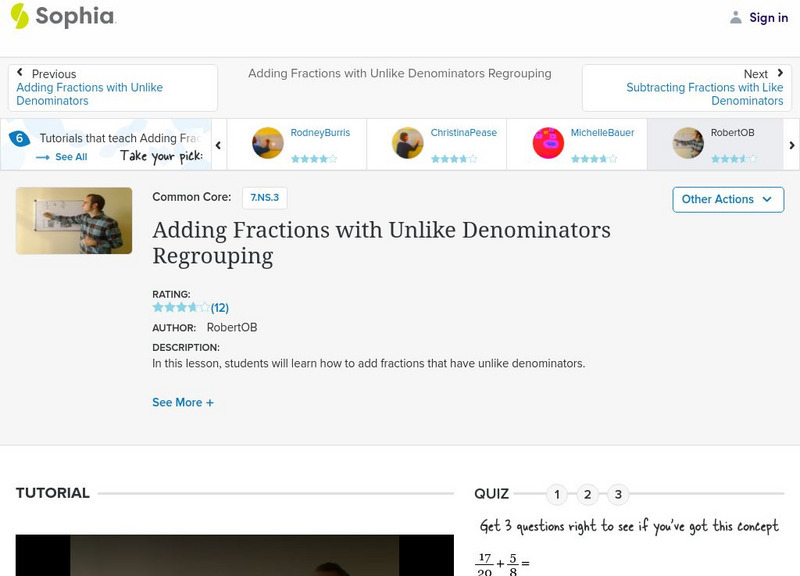
Sophia: Adding Fractions With Unlike Denominators Regrouping
Students watch a video lesson about adding fractions with unlike denominators. The tutorial includes examples and a quiz follows to test students' understanding of the skill.
Loyola University Chicago
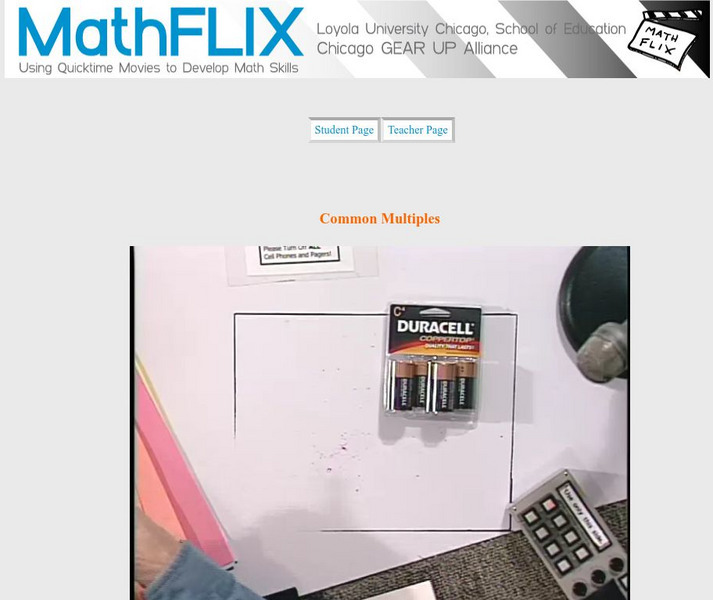
Math Flix: Common Multiples
This QuickTime movie provides an opportunity to identify common multiples. As you watch and listen to the teacher and student interact it helps clarify the thinking behind applying this concept.

Sophia Learning
Sophia: Finding the Lowest Common Multiple: Lesson 2
This lesson demonstrates the comparison of multiples of two or more numbers to find the lowest common multiple. It is 2 of 11 in the series titled "Finding the Lowest Common Multiple."

Sophia Learning
Sophia: Finding the Lowest Common Multiple: Lesson 7
This lesson demonstrates the comparison of multiples of two or more numbers to find the lowest common multiple. It is 7 of 11 in the series titled "Finding the Lowest Common Multiple."