Hi, what do you want to do?






NASA
Nasa: The Landing: Flare
Through this NASA video learn how Newton's laws apply to the landing of an airplane. Discover what happens in the final phase of landing. [3:30]

NASA
Nasa: The Landing: Summary
This NASA video demonstrates how Newton's laws apply to the landing of airplanes. Learn how the test pilot is responsible for finding the perfect landing conditions for the aircraft. [2:22]
Sophia Learning
Sophia: Physics: Newton's Second Law of Motion Tutorial
Created to teach students of the 21st century, SOPHIA is bringing Newton's Second Law of Motion straight to your fingertips. Become the commander of your own learning experiences as you learn from this interactive slideshow. [9:49]

NASA
Nasa: Force Equals Mass Times Acceleration: Newton's Second Law
This video clip discusses how Newton's second law of motion is associated with aerospace. In this video, scientists discuss how you can feel g forces on a roller coaster and how to calculate a person's mass using the law. [3:59]
PBS
Wnet: Thirteen: Circus Physics: Newton's Laws of Motion
The dog show looks like chaos in the ring, but the commotion can be explained by just three simple laws of motion. Objects in motion tend to stay in motion. Force equals mass times acceleration. And for every action, there is an equal...

Bozeman Science
Bozeman Science: Vector Sum of Forces
Paul Andersen explains how the vector sum of forces can be used to identify the net force on an object. The net force can be used to determine the overall acceleration of the object using Newton's Second Law. [6:54]

NASA
Nasa: The Landing: Rollout
This NASA video demonstrates how Newton's laws apply to landing an airplane. Learn why runway length is so important during the rollout phase of landing. [3:28]

Khan Academy
Khan Academy: Momentum: Introduction to Momentum
Explains what momentum is, and works through a simple problem involving momentum. [9:18]
Sophia Learning
Sophia: Introduction to Impulse
A screencast which provides an explanation of impulse force as it relates to Newton's laws of motion. [4:12]

Sophia Learning
Sophia: Newton's Second Law of Motion
Watch this introduction to Newton's Second Law of Motion. See example problems solved in an easy to understand format. [9:49]

The Kid Should See This
Tksst: Physics Girl: The Stacked Ball Drop (And Supernovas)
What happens when you drop a stack of bouncy balls together? Watch this classic momentum transfer demonstration, and discover how it relates to a supernova. [3:33]
Bozeman Science
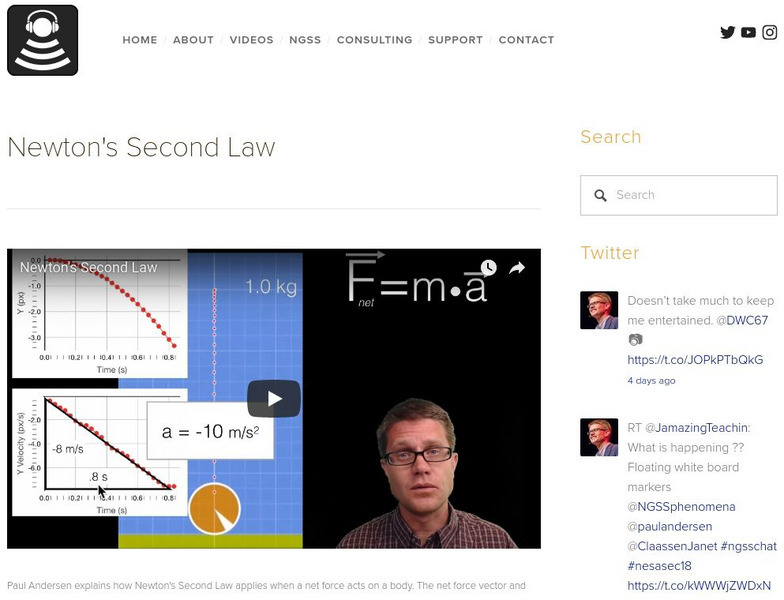
Bozeman Science: Newton's Second Law
In the following video Paul Andersen explains how Newton's Second Law applies when a net force acts on a body. The net force vector and the acceleration vector will act in the same direction. If an object acts on another object in a...

National Science Foundation
National Science Foundation: Science of the Winter Olympics: Blade Runners
Explains how Newton's Three Laws of Motion are expressed in the context of speed skating. [4:17]
Khan Academy
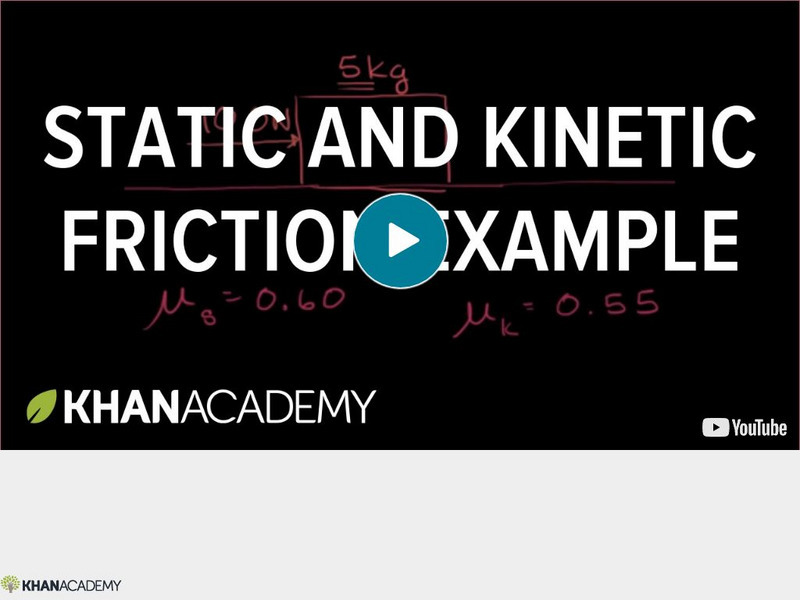
Khan Academy: Inclined Planes and Friction: Static and Kinetic Friction Example
In this video lecture, the topics of static and kinetic friction are explored with examples. The video discusses free-body diagrams and the forces that affect the movement of objects. [9:49]

Khan Academy
Khan Academy: Starting With Particles
This video [4:36] will first explore a single particle under the influence of gravity. Click the link to check out the Effects lesson.

Khan Academy
Khan Academy: Yo Yo in Vertical Circle Example
In this video, David from Khan Academy explains how to find the tension in a string that is whirling a yo-yo in a vertical circle. [10:30]

Khan Academy
Khan Academy: Mass Swinging in a Horizontal Circle
In this video, David from Khan Academy explains how to solve for the tension and speed of a mass swinging at an angle in a horizontal circle. [12:38]

Khan Academy
Khan Academy: Centripetal Force Problem Solving
In this video, David from Khan Academy gives some problem solving strategies for centripetal force problems and explains many common misconceptions people have about centripetal forces. [14:59]

Khan Academy
Khan Academy: Bowling Ball in Vertical Loop
In this video, David from Khan Academy explains how to find the normal force on a bowling ball rolling in a vertical loop. [8:48]

Khan Academy
Khan Academy: Deriving Displacement as Function of Time, Accel, Initial Velocity
Sal Khan discusses deriving displacement as a function of time, constant acceleration, and initial velocity in this video. [9:57]

Khan Academy
Khan Academy: Tension in an Accelerating System and Pie in the Face
In this video, Sal Khan figures out the tension in the wire connecting the two masses. Then he figures out how much we need to accelerate a pie for it to safely reach a man's face. [9:28]
Sophia Learning
Sophia: Mass & Acceleration: Lesson 2
This lesson explains why mass and acceleration are inversely proportional. It is 2 of 2 in the series titled "Mass & Acceleration."
Sophia Learning
Sophia: Weight & Acceleration: Lesson 2
This lesson demonstrates how to use weight to determine the acceleration of an object. It is 2 of 2 in the series titled "Weight & Acceleration."