Hi, what do you want to do?






Curated Video
Planning part one of the main body of a persuasive letter
Pupil outcome: I can plan the first main body paragraph of a persuasive letter, inspired by a text. Key learning points: - An introductory sentence indicates what the paragraph will be about. - The purpose of the main body paragraph is...
Curated Video
Generating points to use in a persuasive letter about school uniform
Pupil outcome: I can generate points to use in a persuasive letter about school uniform. Key learning points: - Persuasion is the action or process of trying to change someone’s mind or behaviour. - Persuading someone to agree with you...
Curated Video
Planning the introduction of a persuasive letter about school uniform
Pupil outcome: I can plan the introduction of a persuasive letter about school uniform. Key learning points: - A formal letter should be written using a formal tone. - Formal writing can be identified by its serious, unemotional and...
Curated Video
Reading aloud a persuasive letter, inspired by a text
Pupil outcome: I can read aloud a persuasive letter inspired by 'Front Desk'. Key learning points: - Speakers must speak audibly and fluently to communicate meaning clearly. - Speaking in an appropriate register enhances communication. -...
Curated Video
Planning the introduction of a persuasive letter, using inspiration from a text
Pupil outcome: I can plan the introduction of a persuasive letter, using inspiration from the text ‘Front Desk’. Key learning points: - The introduction must clearly communicate why the author is writing to the recipient. - This...
Curated Video
Identifying linguistic features and persuasive techniques
Pupil outcome: I can identify linguistic features and persuasive techniques in a formal persuasive letter. Key learning points: - The purpose of a persuasive letter is to persuade or convince the reader to change their mind or behaviour....
Curated Video
Planning a persuasive letter
Pupil outcome: I can plan the main paragraphs of a persuasive letter. Key learning points: - When rehearsing and planning for a persuasive letter, we do so in the first person from the character's perspective. - A plan is written in note...
Curated Video
Understanding the purpose, layout and features of a persuasive letter
Pupil outcome: I can identify the purpose and features of a persuasive letter in preparation for writing based on ‘Front Desk’. Key learning points: - To persuade is to convince someone to do something through reasoning or argument. - A...
Curated Video
The features of a persuasive letter
Pupil outcome: I can identify the layout and linguistic features of a persuasive letter. Key learning points: - The purpose of a persuasive letter is to try to convince someone to do something or to change their mind or behaviour. -...
Curated Video
Identifying features of a persuasive letter
Pupil outcome: I can identify the features of a persuasive letter. Key learning points: - The purpose of a persuasive letter is to change someone’s mind or behaviour or convince them about something. - A persuasive letter is often formal...
Curated Video
Writing the second paragraph of a persuasive letter
Pupil outcome: I can write the second paragraph of a persuasive letter. Key learning points: - Persuasive letters have distinctive linguistic features in order to achieve their purpose. - An adverbial complex sentence is a main clause...
Curated Video
Editing a persuasive letter about school uniform
Pupil outcome: I can edit a persuasive letter about school uniform. Key learning points: - Editing is the process of improving writing to ensure text flow and overall quality. - Editing involves making improvements to a piece of writing...
Curated Video
Reading aloud a persuasive letter
Pupil outcome: I can read aloud a persuasive letter using expression. Key learning points: - Reading aloud involves speaking in front of others and listening to others. - Reading aloud involves speaking at a suitable volume and pace. -...
Curated Video
Writing the introduction of a persuasive letter about school uniform
Pupil outcome: I can write the introduction of a persuasive letter about school uniform. Key learning points: - A formal letter should be written using a formal tone. - A formal letter has specific layout features. - An introduction...
Curated Video
Planning the second argument of a persuasive letter about school uniform
Pupil outcome: I can plan the second argument of a persuasive letter about school uniform. Key learning points: - A written argument tries to convince the reader of something using strong reasoning to support. - The PEPS structure stands...
Curated Video
Writing the second paragraph of a persuasive letter to Sherlock Holmes
Pupil outcome: I can write the second persuasive paragraph of a persuasive letter, giving reasons and evidence and using a range of persuasive techniques. Key learning points: - Writing is most successful when it is planned. - The...
Curated Video
Considering and using active and passive voice in persuasive letter writing
Pupil outcome: I can identify and analyse the effects of active and passive voice and consider in which circumstances which is more effective. Key learning points: - We might see active voice as more direct, concise and confident. - We...
Curated Video
Considering and using personification in persuasive letter writing
Pupil outcome: I can identify and analyse the use of personification in persuasive letter writing and emulate it in my own writing. Key learning points: - Personification can be effective in persuasive writing because it evokes an...
Curated Video
Peer editing a persuasive letter
Pupil outcome: I can edit my own and my peer's persuasive letters. Key learning points: - Editing is the process of making changes to improve our writing. - Editing can be done by oneself, with a peer or with a teacher. - When editing...
Curated Video
The Persuasive Letter
Mr. Griot teaches the elements of persuasive writing. He reads a persuasive letter written to persuade the local TV station to keep a popular show from being canceled.
Curated Video
Revising Writing
This video discusses the purpose of, and techniques for, revising writing.
Curated Video
Connecting Ideas in Writing: Using Transition Words
In this video, the teacher explains how to connect related ideas in writing by using transition words. The teacher goes through the process of identifying jumps in ideas within a paragraph and then demonstrates how to fix them using...
Curated Video
Writing a Persuasive Letter: Convincing Others of Your Great Ideas
In this video, the teacher explains how to write a persuasive letter to convince someone about a great idea. The lesson covers the format of a letter, the importance of choosing a specific person to write to, and the steps to effectively...
Imagine Learning Classroom
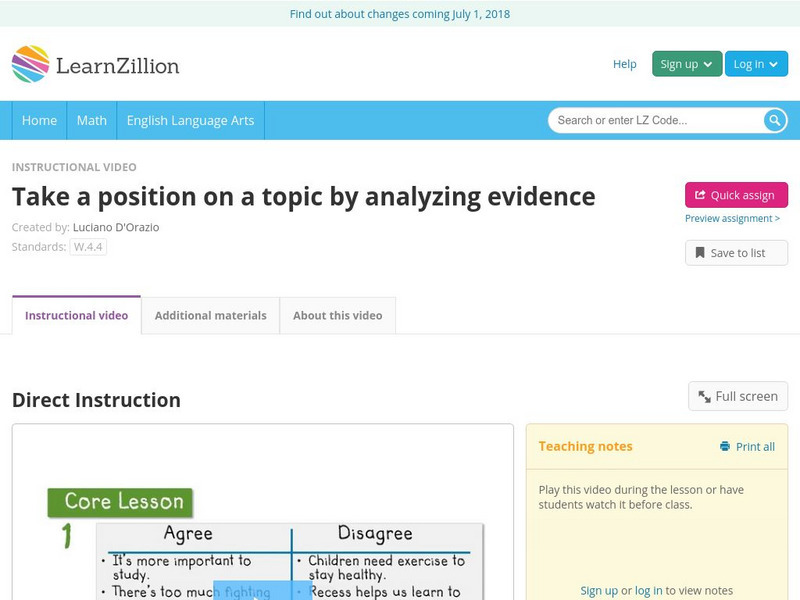
Learn Zillion: Take a Position on a Topic by Analyzing Evidence
In this lesson, you will learn how to take a position on a prompt by analyzing the evidence for each side. [5:53]