Hi, what do you want to do?






Cerebellum
Get That Job - Your Education
Land your dream job with this helpful video! This clip serves as a useful tool to describe and represent your education, and how to select your relevant attributes for a job. This is part 3 from the series 'Get That Job'.
Apalapse
Photography Tips - Five Tips for Better Landscape Photography
In this video I share five landscape photography tips that should bring your photos to a new level.

Curated OER
How To Take A Good Photograph Ð Part 3
Finally, watch this video for more tips to taking a good photo. This is the third, and last, video of a three-part series. After watching all three parts, have your class share their own photos!

Curated OER
How To Take A Good Photograph Ð Part 2
An important factor to consider when taking a good photograph is to include angles. Watch this video to learn about the various types of angles in photography. This is the second video of a three part series.

Curated OER
How To Take A Good Photograph Ð Part 1
This is the first video of a three part series that instruct how to take a good photograph. These are fantastic videos to show to your photography students.

PBS
Pbs: American Experience: Ansel Adams
This companion to the documentary film "Ansel Adams," part of the PBS series "The American Experience," looks at Adams's impact on Americans' perception of the West and on his use of photography in conservation efforts.

Khan Academy
Khan Academy: The Development of Photography and the Railroad
From the 1850s, photography and the railroad each offered new experiences to people who had never before traveled great distances. Photographs were used to allay fears of potential travelers. [3:45]
Sophia Learning
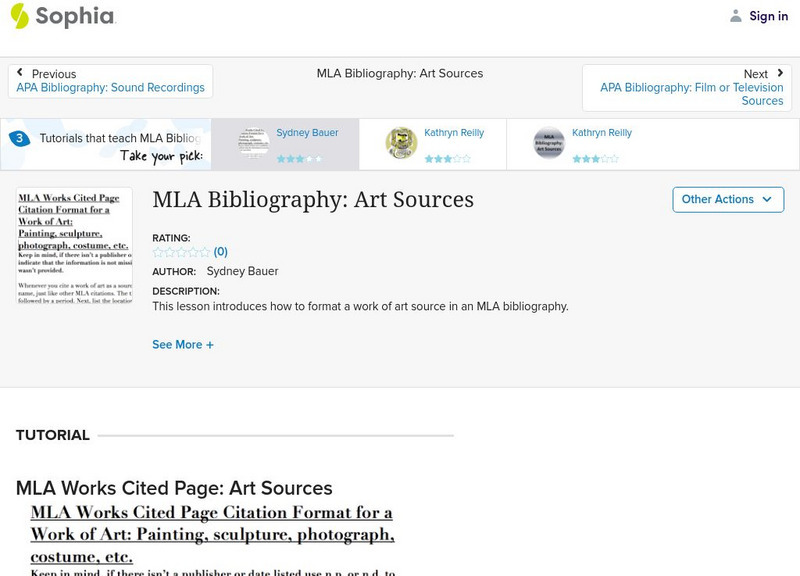
Sophia: Mla Bibliography: Art Sources: Lesson 3
This tutorial uses text and audio to introduce how to format works of art sources in an MLA bibliography. It is 3 of 3 in the series titled "MLA Bibliography: Art Sources." [3:36]

Science Friday Initiative
Science Friday: Extracting Data From Photos of Our Eyes
Researchers used photographs to recover reflected images 30,000 times smaller than the actual subject. [8 mins. 27 secs.]