Hi, what do you want to do?






Curated Video
Katherine Johnson: Trailblazing NASA Mathematician
At a time when American space exploration was dominated by men, mathematician Katherine Johnson broke through gender and racial barriers to help change our understanding of the cosmos forever.
Curated Video
Edith Maude Eaton: Fostering Cultural Understanding Through Writing
In a time when Chinese immigrants in America faced discrimination in all walks of life – simply because of their race – author Edith Maude Eaton channeled the power of the pen to help make positive change.
Curated Video
What is Martin Luther King Jr. Day?
MLK Day takes place every year on the third Monday of January. It's a time to celebrate the life and work of Civil Rights leader Martin Luther King Jr., who brought Americans together in the name of racial equality.
Curated Video
Joseph Henry Douglass: Changing America With Music
Classical violinist Joseph Henry Douglass helped empower the Black community through music and education at a time when Southern lawmakers were pushing back against the progress of Reconstruction.
Curated Video
Sasha Johnson: Oxford's Black Panther
Since the gruesome murder of George Floyd in May of 2020, major protests have been carried out by various bodies around the world especially in the United States of America and the United Kingdom.
One of the major...
One of the major...
Curated Video
Patsy Mink: Changing the Rules
The first Asian American woman ever to be elected to Congress, Patsy Mink dedicated her life to participating in the democratic process and improving the lives of others.
Curated Video
When the Youth of Birmingham Changed History
In 1963, school children from Birmingham, Alabama skipped class to demonstrate for racial equality. Met with police violence, they helped to bring about significant change. The Birmingham Children's Crusade, as it was known, has gone...
Curated Video
The Lincoln-Douglas Debates
The Lincoln Douglas Debates of 1858 were some of the most controversial in US history. Having deepened the divide between North and South – they helped bring the nation to war.

PBS
Pbs Learning Media: Civil Rights Activist, Eileen Kelley Walbert
Eileen Walbert was among the Concerned White Citizens of Alabama who took a stand for civil rights, as she describes in this oral history from the Birmingham Civil Rights Institute. [5:40]

Khan Academy
Khan Academy: Us History: 1865 1898: Black Codes and Reconstruction
In the period after the Civil War in the American South, when Southern society reorganized to account for the end of slavery. In this video, Kim discusses how many Southern governments passed laws preventing African Americans from...

Khan Academy
Khan Academy: Us History: 1865 1898: Fourteenth and Fifteenth Amendments
During Reconstruction, federal troops attempted to enforce the Fourteenth and Fifteenth Amendments in the South. [4:00]

Khan Academy
Khan Academy: Walter Isaacson President and Ceo of the Aspen Institute
An interview with Aspen Institute CEO, Walter Isaacson. [48:52]
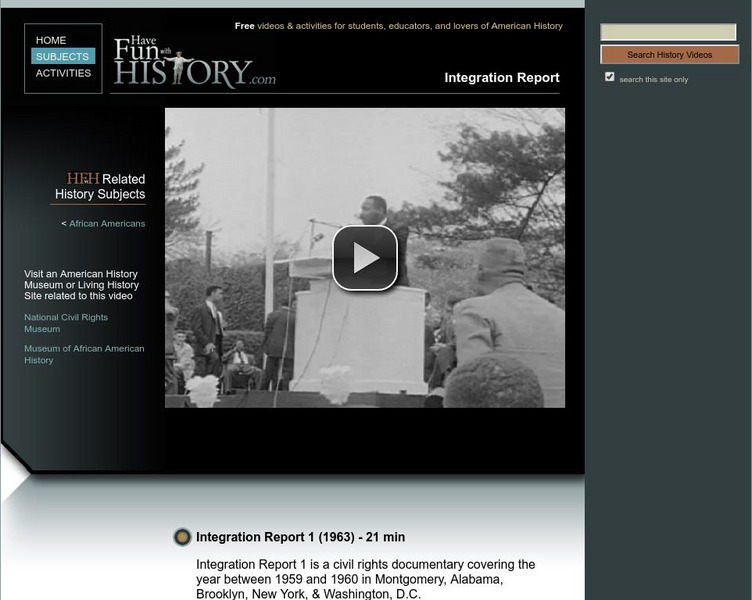
Have Fun With History
Have Fun With History: Integration Report 1
Integration Report 1 is a civil rights documentary covering the year between 1959 and 1960 in Montgomery, Alabama, in Brooklyn, New York, and in Washington, D.C..

Khan Academy
Khan Academy: Us History: 1865 1898: The Origins of Jim Crow Introduction
Who or what was Jim Crow? Kim discusses the origin of Jim Crow segregation in the American South. [6:33]

Khan Academy
Khan Academy: Us History: 1865 1898: Compromise of 1877 Plessy v. Ferguson
Federal troops left the South after the Compromise of 1877, ending Reconstruction. The Supreme Court ruled that segregation did not violate the Fourteenth Amendment in the Plessy v. Ferguson decision of 1896. [7:58]