Hi, what do you want to do?






Curated Video
Writing Detailed Sentences with Supporting Evidence
In this video, the teacher explains how to write detailed sentences to support an answer. Using the example of the Declaration of Independence, the teacher guides students through the process of finding evidence, making a plan, and...
Curated Video
Calculating the Constant Rate of Change
In this video, the teacher explains how to calculate the constant rate of change in a linear function using the four representations of a function: verbal, algebraic, numeric, and graphical.
Curated Video
Understanding Box Plots: When and Why to Use Them
This video explains when and why a box plot is an accurate representation of a given set of data. It discusses the structure of a box plot, including the 5 number summary, and demonstrates how to create one using math scores as an example.

Crash Course
Crash Course Media Literacy #5: Media and Money
Media isn't just movies and newspapers and TV shows, it's also a part of society that involves a lot of money. And all that money has implications for the media that gets created. Media is created by people -- a range of people, making a...

Khan Academy
Khan Academy: The Constitution and Proportional Representation
This video is a discussion about the Constitutional Convention of 1787 and how the delegates compromised on state representation by dividing the legislative branch between the Senate, in which every state has two representatives...

PBS
Pbs Learning Media: Crash Course Us History: Taxes and Smuggling Prelude to Revolution
John Green teaches you that the Revolution did not start on July 4, 1776. The Revolutionary War didn't start on July 4 either. The shooting started on April 19, 1775, at Lexington and/or Concord, MA. Or the shooting started with the...
Center For Civic Education
60 Second Civics:the Elements of Democracy Part 36: Delegates or Trustees?
Do you prefer your representatives to do your bidding or to think for themselves? We examine the issue on today's podcast.
Center For Civic Education
60 Second Civics: Episode 198 Right to Vote in Early America
Today we discuss representation and the right to vote in early American state constitutions.
Center For Civic Education
60 Second Civics: Representation, Separation of Powers and Checks and Balances
Today we examine the concepts of representation, separation of powers, and checks and balances in early state governments.
Center For Civic Education
60 Second Civics: Episode 294: Crisis Over Representation
On today's episode, we explore the crisis over representation at the Philadelphia Convention.
Sophia Learning
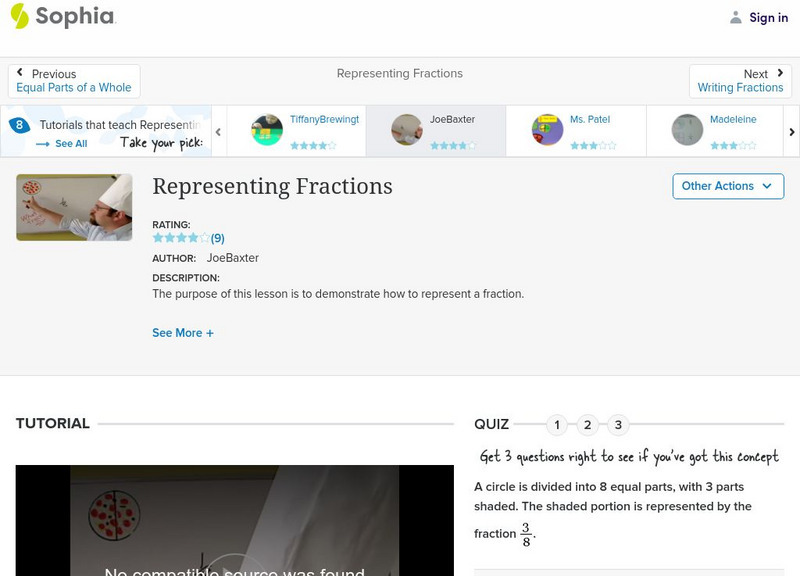
Sophia: Representing Fractions: Lesson 7
The purpose of this lesson is to demonstrate how to represent a fraction. It is 7 of 15 in the series titled "Representing Fractions."
Sophia Learning
Sophia: Form and Shape: Lesson 2
This lesson will explore form and shape as elements of composition and of the analysis of works of art. It is 2 of 3 in the series titled "Form and Shape."
Sophia Learning
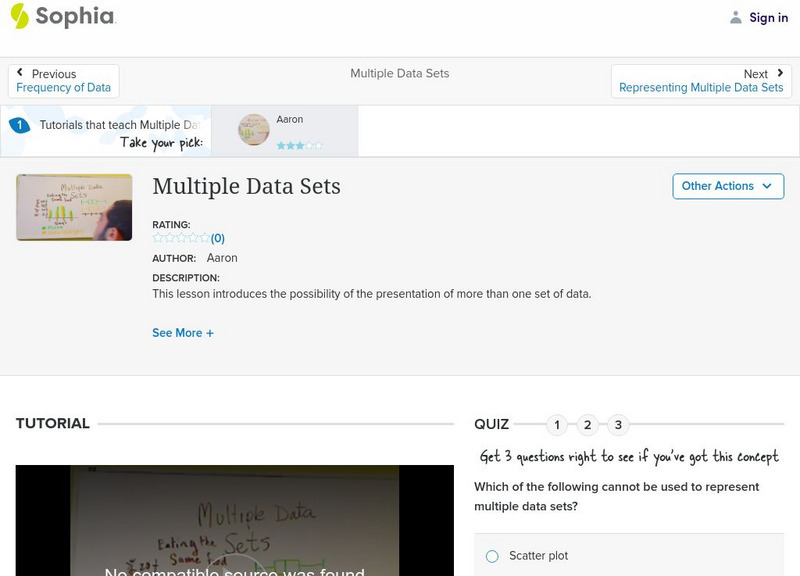
Sophia: Multiple Data Sets: Lesson 5
This lesson introduces the possibility of the presentation of more than one set of data. It is 5 of 5 in the series titled "Multiple Data Sets."
Sophia Learning
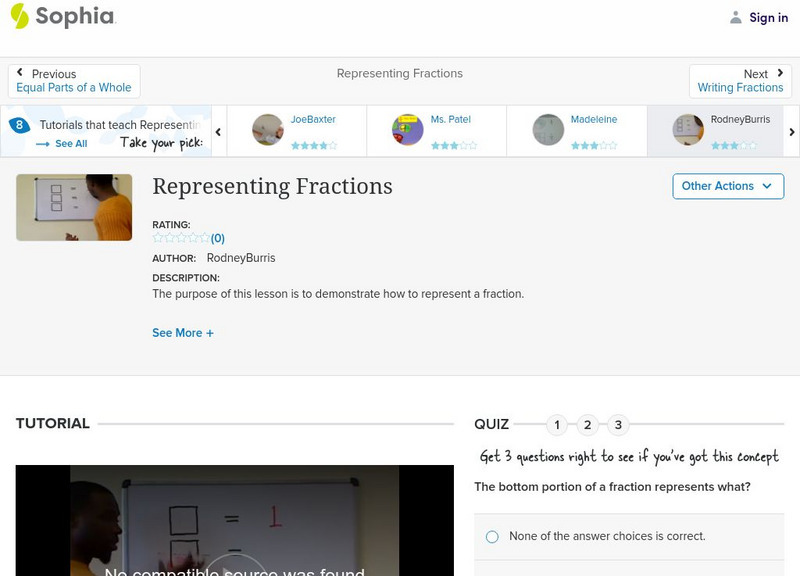
Sophia: Representing Fractions: Lesson 12
The purpose of this lesson is to demonstrate how to represent a fraction. It is 12 of 15 in the series titled "Representing Fractions."
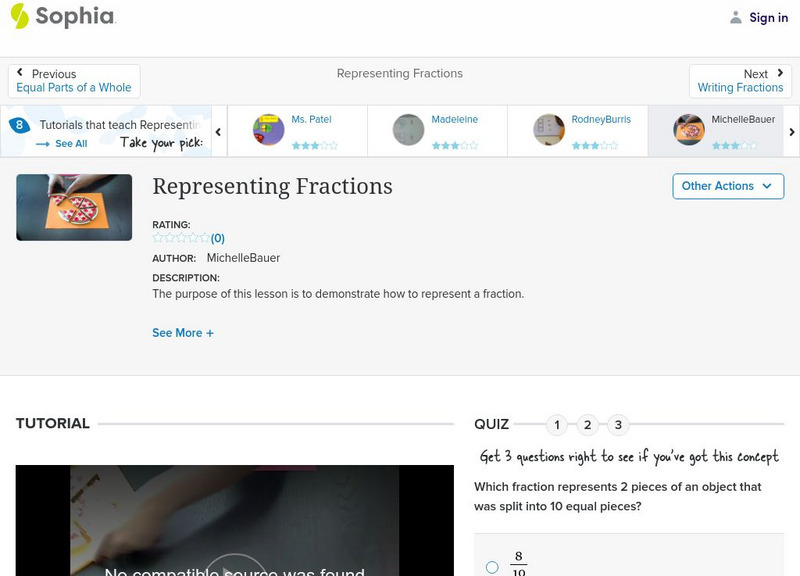
Sophia Learning
Sophia: Representing Fractions: Lesson 13
The purpose of this lesson is to demonstrate how to represent a fraction. It is 13 of 15 in the series titled "Representing Fractions."
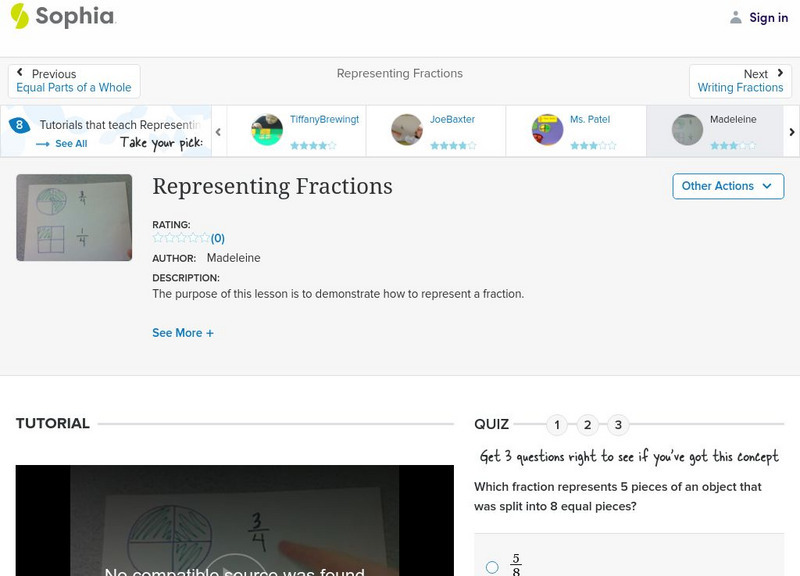
Sophia Learning
Sophia: Representing Fractions: Lesson 1
The purpose of this lesson is to demonstrate how to represent a fraction. It is 1 of 15 in the series titled "Representing Fractions."
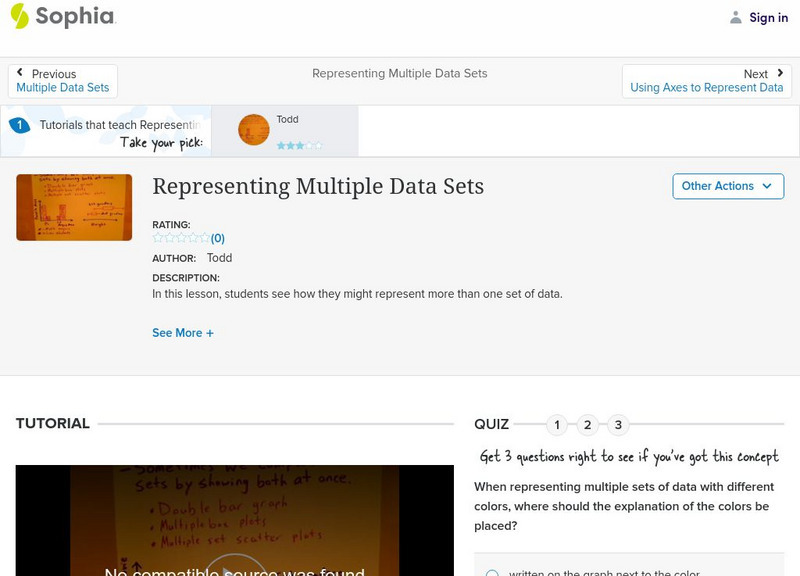
Sophia Learning
Sophia: Representing Multiple Data Sets: Lesson 3
In this lesson, students see how they might represent more than one set of data. It is 3 of 7 in the series titled "Representing Multiple Data Sets."
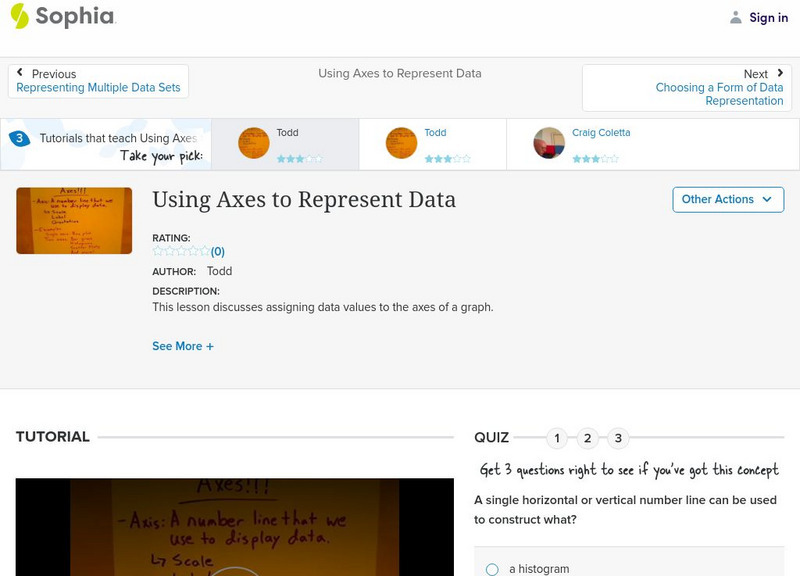
Sophia Learning
Sophia: Using Axes to Represent Data: Lesson 4
This lesson discusses assigning data values to the axes of a graph. It is 4 of 7 in the series titled "Using Axes to Represent Data."
Sophia Learning
Sophia: Using Axes to Represent Data: Lesson 5
This lesson discusses assigning data values to the axes of a graph. It is 5 of 7 in the series titled "Using Axes to Represent Data."
Sophia Learning
Sophia: Using Axes to Represent Data
This lesson discusses assigning data values to the axes of a graph.
Sophia Learning
Sophia: Representing Fractions: Lesson 10
The purpose of this lesson is to demonstrate how to represent a fraction. It is 10 of 15 in the series titled "Representing Fractions."
Sophia Learning
Sophia: Representing Fractions: Lesson 11
The purpose of this lesson is to demonstrate how to represent a fraction. It is 11 of 15 in the series titled "Representing Fractions."
Sophia Learning
Sophia: Representing Fractions: Lesson 14
The purpose of this lesson is to demonstrate how to represent a fraction. It is 14 of 15 in the series titled "Representing Fractions."
Sophia Learning
Sophia: Representing Fractions: Lesson 9
The purpose of this lesson is to demonstrate how to represent a fraction. It is 9 of 15 in the series titled "Representing Fractions."