Hi, what do you want to do?






PBS
How the Egg Came First
The story of the egg spans millions of years, from the first vertebrates that dared to venture onto land to today’s mammals, including the platypus, and of course birds. Like chickens? We’re here to tell you: The egg came first.
SciShow
6 Sleeper-Agent Pathogens That Can Make You Sick
Your body usually does a great job defending you from all kinds of viruses, fungi, and bacteria. However, there are some pathogens out there that can hide from your immune system and stay dormant in your body, waiting for their...
SciShow
4 Ways CRISPR Is More Than Just Gene Editing
While it’s probably most famous for its role in gene editing, CRISPR does more than just that: its ability to precisely cut and alter DNA could lead to new antibiotics, faster diagnosis tools, and more.
SciShow
The Viruses That Changed Our World
While viruses can be deadly and completely wreak havoc on humanity, they can also sometimes change our world for the better. Join Hank Green for a new episode of SciShow and learn the truth about the viruses that have shaped humanity...
SciShow
4 Ways CRISPR Is More Than Just Gene Editing
While it’s probably most famous for its role in gene editing, CRISPR does more than just that: its ability to precisely cut and alter DNA could lead to new antibiotics, faster diagnosis tools, and more. Chapters CREATING ANTIBIOTICS 1:07...
SciShow
The Viruses That Shaped Humanity
You might get the impression that all viruses are terrible, awful, no-good things that just wreak havoc on humanity. But, surprise: The truth is way more interesting!
SciShow
How a Sick Chimp Led to a Global Pandemic: The Rise of HIV
In the first video in our two part series on HIV and AIDS, we explain how scientists figured out what HIV is, when the infection morphs into AIDS, and where they think the virus originated.
Bozeman Science
Viral Replication
Paul Andersen explains how viruses reproduce using the lytic cycle. He also shows how viruses can pick up new genetic material and how retroviruses (like HIV) can enter into the lytic cycle. He also describes the lysogenic cycle and...
Curated Video
VIH/sida: el evasor del sistema inmunitario
¿Por qué el VIH es el virus más mortal del mundo? Su capacidad de evolucionar constantemente y de atacar al sistema inmunológico del organismo son las principales razónes de su naturaleza letal.
Twig - Biología -...
Twig - Biología -...
Independent Producers
Sea Slug: Animal or Plant?
Small green sea slugs puzzle scientists because they can photosynthesize energy, just like plants. These Eastern Emerald Elysia sea slugs also appear to have several different types of DNA. Scientists are hopeful these sea slugs might...
Professor Dave Explains
Human Immunodeficiency Virus (HIV)
Human Immunodeficiency Virus (HIV) is quite the infamous virus, which rose to notoriety in the 1980s once it was discovered to be the cause of AIDS, a terrible disorder of the immune system. HIV is a retrovirus, so what does that mean,...
Professor Dave Explains
Gene Therapy
When we looked at some areas of biotechnology earlier in the series, we briefly touched on gene therapy, without saying much about what it is. Now we are ready to dive into this topic and see what it is all about. If a person has a...
Professor Dave Explains
Viruses: Molecular Hijackers
Most of us know about viruses, and that they spread disease. But what is a virus exactly? Is it alive? How does it infect a host? There's a lot to discuss here! Take a look.


Sophia Learning
Sophia: Hiv and Aids
An illustrated presentation describing the transmission and treatment HIV and AIDS. [6:44]
Bozeman Science
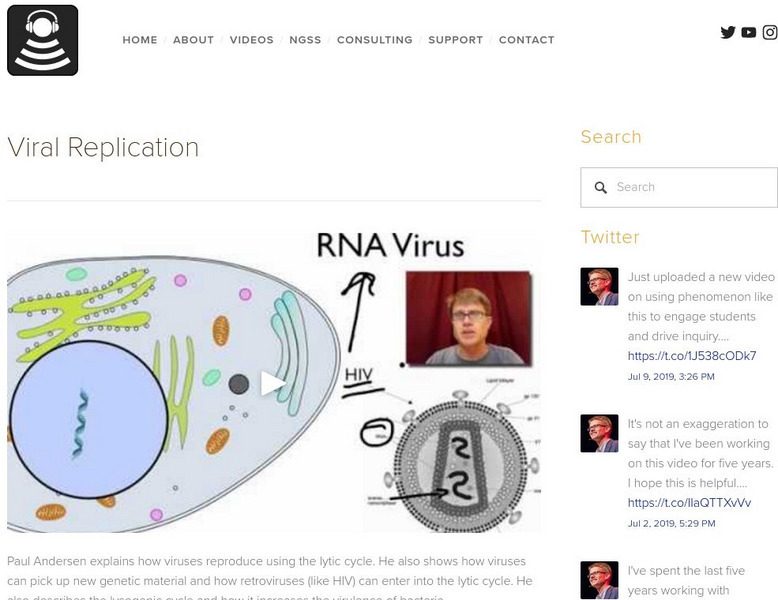
Bozeman Science: Viral Replication
Paul Andersen explains how viruses reproduce using the lytic cycle. He also shows how viruses can pick up new genetic material and how retroviruses (like HIV) can enter into the lytic cycle. He also describes the lysogenic cycle and how...

Howard Hughes Medical Institute
Hhmi: Bio Interactive: Retroviruses and Viral Diversity
A concise summary of the main differences between retroviruses and those which use DNA in their genome. A few examples of each type of virus are shown.