Hi, what do you want to do?






SciShow
The 7 Weirdest Jaws in the Water
Great white sharks have nothing on these terrifying jaws. Some marine animals have adaptations that turn their jaws into harpoons, fishing nets, claw machines, and more.<b<br/>r/>
Hosted by: Savannah Geary (they/them)
Hosted by: Savannah Geary (they/them)
SciShow
Wolves Have Taken Over a Marine Ecosystem
Wolves are amazing hunters, so they tend to be apex predators wherever you find them...including one region in Alaska where these land-based predators sit atop a marine food web.
PBS
How the Starfish Got Its Arms
The story of how the starfish got its arms reminds us that even animals that might be familiar to us today can have incredibly deep histories - ones that stretch back almost half a billion years.
TED Talks
TED: The ocean's glory -- and horror | Brian Skerry
Photographer Brian Skerry shoots life above and below the waves -- as he puts it, both the horror and the magic of the ocean. Sharing amazing, intimate shots of undersea creatures, he shows how powerful images can help make change.
Bozeman Science
Biodiversity
Paul Andersen explains the importance of biodiversity. He starts by describing how biodiversity can be species, genetic or ecosystem diversity. He explains the importance of keystone species in an environment and gives two examples;...
TED-Ed
TED-ED: The science of symmetry - Colm Kelleher
When you hear the word symmetry, you might think generally of triangles, butterflies, or even ballerinas. But defined scientifically, symmetry is _a transformation that leaves an object unchanged." Huh? Colm Kelleher unpacks this...
Professor Dave Explains
Echinoderm Diversity Part 3: Classes Echinoidea and Holothuroidea (Sea Urchins and Sea Cucumbers)
To finish things up with Echinodermata, we will look at class Echinoidea, the sea urchins, and class Holothuroidea, the sea cucumbers. What are these spiny things we call urchins? What is their anatomy like? What the heck is a sea...
Professor Dave Explains
Phylum Echinodermata Part 2: Body Systems
Continuing our study of the echinoderms, let's take a look at their body systems, especially the water vascular system and endoskeleton. What else can we say about their general anatomy and physiology? How do sea stars and sea urchins...
Professor Dave Explains
Phylum Echinodermata Part 1: Form and Function
With the hemichordates covered let's check out the echinoderms. Echinodermata is the other phylum in the clade Ambulacraria, and they are found all around the world. The most familiar organisms in this clade are starfish or sea stars,...
Curated Video
Sea otters
The vital role of sea otters in maintaining a food web.
<
br/>
Life processes - Living things in their environmen
t
s - Food webs
Learning Points
Omnivores
e
at both plants and other...
<
br/>
Life processes - Living things in their environmen
t
s - Food webs
Learning Points
Omnivores
e
at both plants and other...
Brave Wilderness
IT'S HUGE! And Covered in WARTS!
On this episode of Beyond the Tide, Coyote and the crew go tide pooling at night and discover three different species of HUGE Sea Cucumbers! There are many species of Sea Cucumbers that can be found all over the world but it isn’t every...
Curated Video
I WONDER - Where Do Invertebrates Live?
This video is answering the question of where do invertebrates live.
Science360
Ocean Acidification -- Changing Planet
As higher amounts of carbon dioxide become absorbed by the oceans, some marine organisms are finding it's a struggle to adjust.
The Changing Planet series explores the impact that climate change is having on our planet, and...
The Changing Planet series explores the impact that climate change is having on our planet, and...
Brave Wilderness
Making a Tide Pool Aquarium
On this episode, Mark takes you tide pooling for #CampYouTube! Watch as Mark shows you how to build a tide pool aquarium full of brittlestars, sea stars, and more! Get ready to meet some super cool Tide Pool creatures!

California Academy of Science
Spiky Sight
Can an organism with no eyes still see? As it turns out for the purple sea urchin, the answer is yes. In a short video, scientists explain why they believe that some sea urchins can use their spikes to visually sense the environment.
Sea Studios Foundation
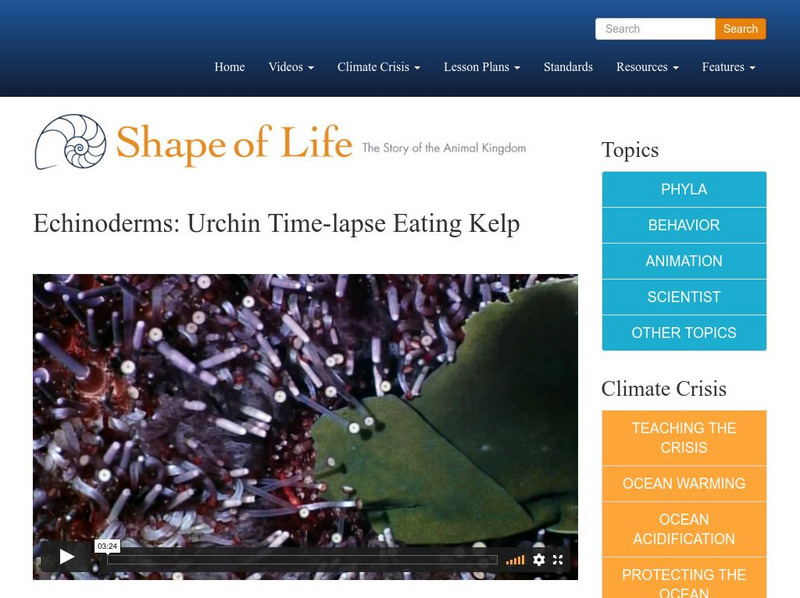
Shape of Life: Echinoderms: Urchin Time Lapse Eating Kelp
Want to learn more about how a sea urchin eats? Watch this video to see a sea urchins using their sensory tube feet to catch drifting kelp and carry it to its mouth on the underside. Also view how the sea urchin uses its five-part jaw to...
California Academy of Sciences
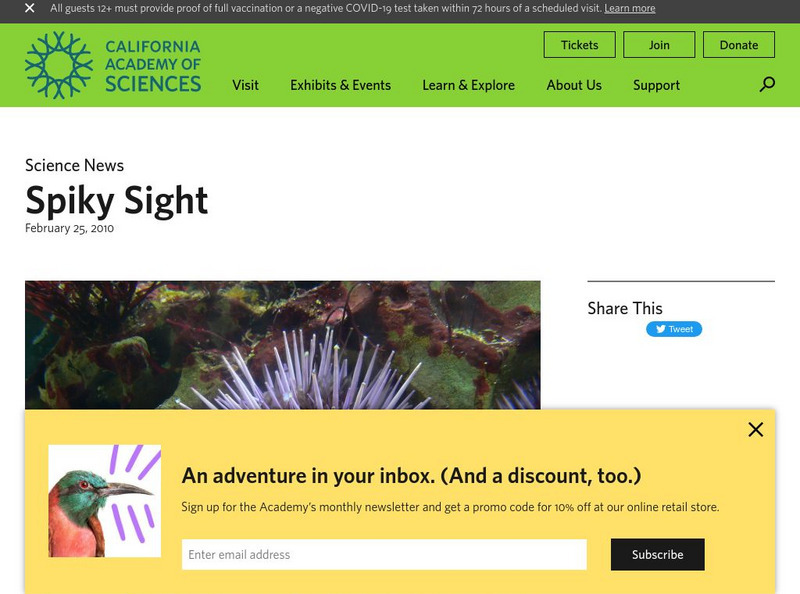
California Academy of Sciences: Spiky Sight
Sea urchins have no eyes or visual organs, but researchers are proving that they do, in fact, see. [1:36]