Hi, what do you want to do?






Professor Dave Explains
Chemical Equilibria and Reaction Quotients
Many chemical reactions don't just go one way, they go forwards and backwards. Once there is balance between the two, this is an equilibrium. And we need to be able to predict how much stuff there will be at equilibrium! Get ready to...
Bethany Thiele, Art Teacher
Paper Molas - full length tutorial on how to create a paper mola similar to molas from Panama!
I'm Mrs. Thiele, a middle school art teacher! In this video you will learn step by step how to create a paper mola. This project is excellent for 6th graders but could be adapted for any grade 4-8. <b<b<br/>r/>r/>
KEEP CREATING! :)
KEEP CREATING! :)
FuseSchool
What Is Avogadro's Number - The Mole
Learn the basics about Avogadro's Number, as a part of chemical calculations. Avogadro’s Number or the Avogadro Constant is 6.02 X 10²³ Mol-1. It is the number of atoms per mole of the carbon-12 isotope. For atoms, the mass of Avogadro’s...
FuseSchool
Avogadro's Number - The Mole
Learn the basics about Avogadro's number - The Mole. What is Avogrado's number? Why is it called like that and what relation does it have to the mole? Find more in this video!
FuseSchool
What Are Serial Dilutions
We have already seen what dilutions are, and how to calculate them using the simple M1V1 = M2V2 equation. We are now going to look at serial dilutions. These are just multiple dilutions, and we can still use our same equation. Serial...
FuseSchool
How To Use Moles - Part 2
Carry on learning about using moles in this part 2 of 3 parts. Avogradro’s number describes what is known as 1 mole, or 12 g of carbon atoms. This is used in chemical calculations. For any element, the relative atomic mass is the weight...
FuseSchool
Moles In Equations
Learn the basics about Moles in equations. How do you calculate a mole? How do moles work in equations? Find out more in this video!

TED-Ed
How Big is a Mole? (Not the Animal, the Other One)
Who was Lorenzo Romano Amedeo Carlo Avogadro? He was the guy who suggested that equal volumes of gases at the same temperature and pressure should contain equal numbers of molecules. This eventually led to a new quantity for the number...
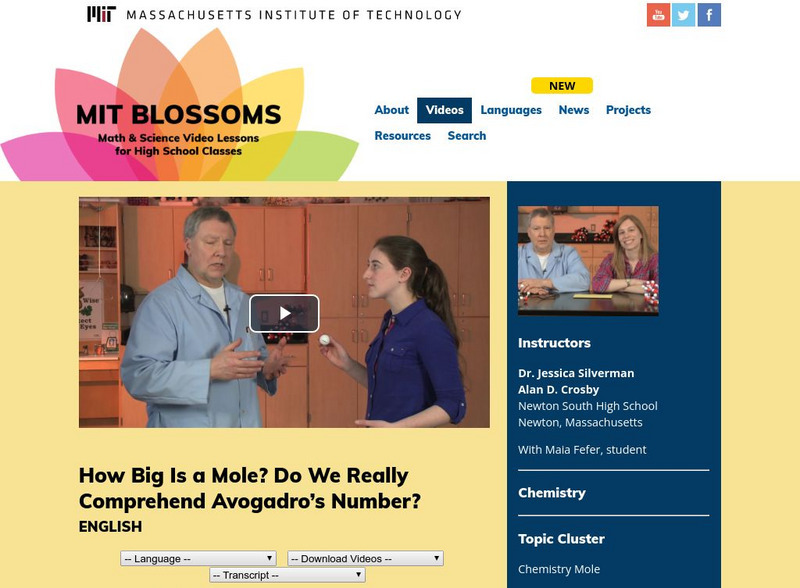
Massachusetts Institute of Technology
Mit: Blossoms: How Big Is a Mole? Do We Really Comprehend Avogadro's Number?
The goal of this lesson is for students to understand just how many particles Avogadro's Number truly represents, or, how big a mole really is. [19:02]
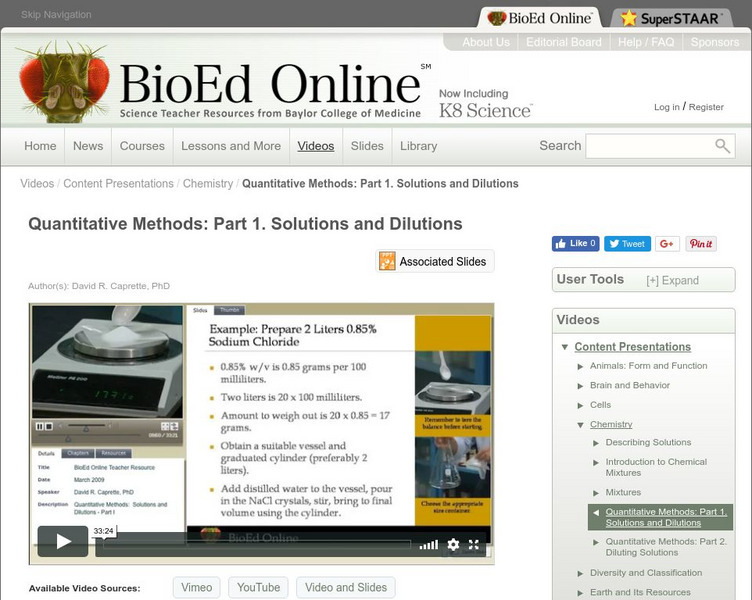
BioEd Online
Bio Ed Online: Quantitative Methods: Part 1. Solutions and Dilutions
In this video David Caprette, PhD, discusses the types and properties of mixtures prepared and/or encountered in a biological laboratory. He also introduces basic lab equipment, terms and concepts related to formulas, and the concept of...
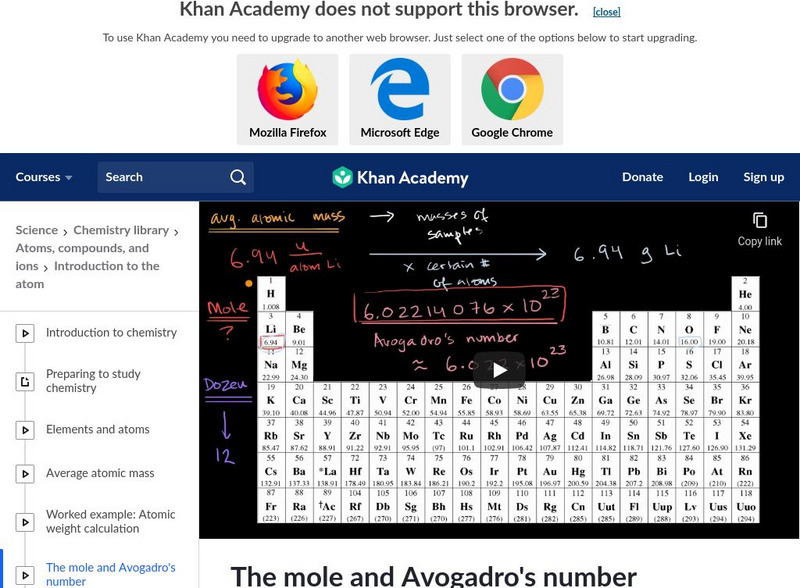
Khan Academy
Khan Academy: Chemistry: The Mole and Avogadro's Number
An introduction to the number mole, or 6.02 times 10 to the 23rd degree, also known as Avogadro's Number. [9:44]
Sophia Learning
Sophia: Converting From Grams to Moles: Lesson 1
This lesson demonstrates how to convert from grams to moles. It is 1 of 2 in the series titled "Converting from Grams to Moles."
Sophia Learning
Sophia: Converting From Grams to Particles: Lesson 1
This lesson demonstrates how to convert from grams to particles (molecules, atoms, ion). It is 1 of 2 in the series titled "Converting from Grams to Particles."
Sophia Learning
Sophia: Converting From Grams to Volume
This lesson will provide examples of converting from grams of a gas to volume of a gas.
Sophia Learning
Sophia: Converting From Moles to Particles: Lesson 1
This lesson demonstrates how to convert from moles to particles (molecules, atoms, ion). It is 1 of 2 in the series titled "Converting from Moles to Particles."
Sophia Learning
Sophia: Converting From Particles to Grams: Lesson 1
This lesson demonstrates how to convert from particles to grams (molecules, atoms, ion). It is 1 of 2 in the series titled "Converting from Particles to Grams."

Sophia Learning
Sophia: Converting From Particles to Moles: Lesson 1
This lesson demonstrates how to convert from particles to moles (molecules, atoms, ion). It is 1 of 2 in the series titled "Converting from Particles to Moles."
Other
Mad Penguin Films: A Mole Is a Unit
Watch this short video to get an idea of just how big Avogadro's number is. The examples are certainly clear, and the little tune is catchy. [3:49]
Crash Course
Crash Course Chemistry #6: Stoichiometry
Chemists need stoichiometry to make the scale of chemistry more understandable - Hank is here to explain why, and to teach us how to use it. [12:48]

Khan Academy
Khan Academy: Chemistry: Stoichiometry of a Reaction in Solution
A video lecture investigating how to solve problems using stoichiometry. The lecture shows viewers step-by-step how to solve for the mass needed of a substance in order for it to completely react with a solution. [10:18]

Khan Academy
Khan Academy: Thermodynamics: Thermodynamics (Part 4)
An introduction to the concept of a mole and its role in the field of thermodynamics. Using a periodic table, one learns how to calculate the number of moles a quantity of an element has, based on its atomic mass. Goes on to explain how...

Khan Academy
Khan Academy: Lab Values and Concentrations: What Is an Equivalent?
A video lecture showing how to figure out how to calculate an equivalent and how it relates to a mole. Lecture takes the viewer through several calculations. [10:18]
Sophia Learning
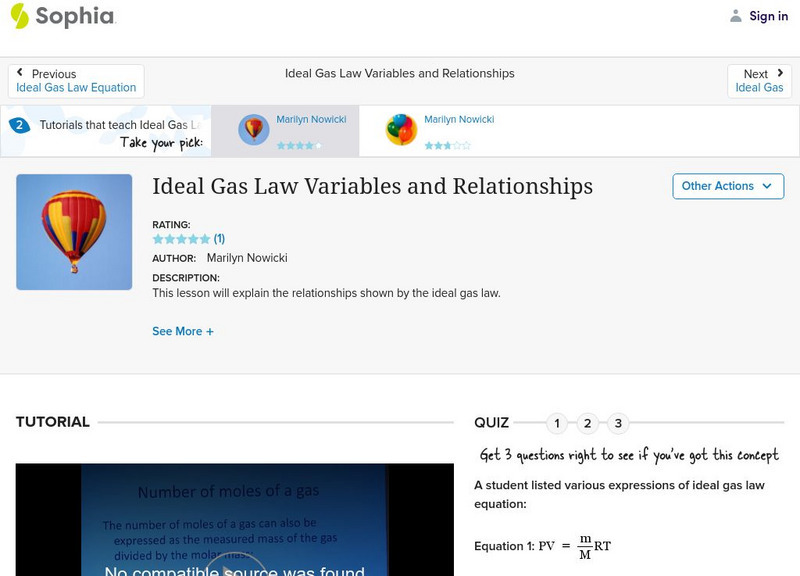
Sophia: Ideal Gas Law Variables and Relationships
This narrated screencast illustrates the relationships shown by the ideal gas law. [4:00]
Tyler DeWitt, PhD
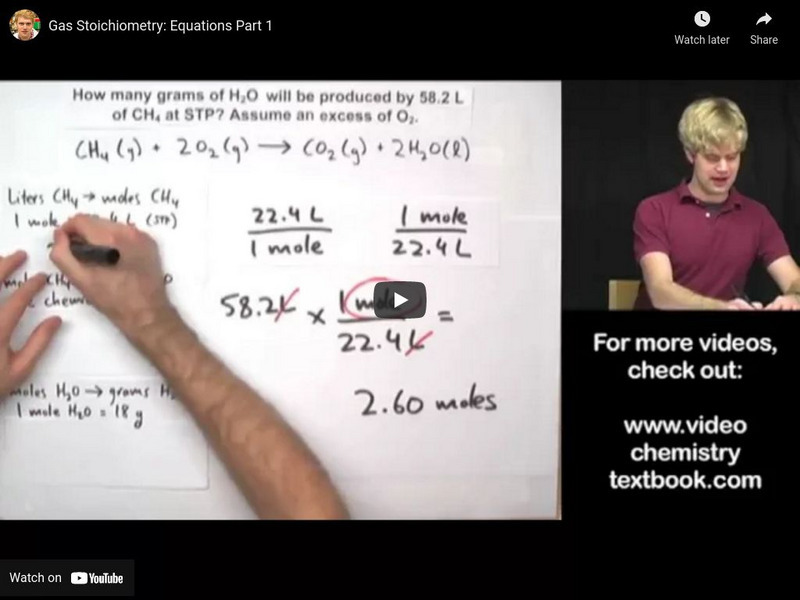
Tyler De Witt: Gas Stoichiometry: Equations Part 1
Examples and practice problems of solving equation stoichiometry questions with gases. [5:38]