Hi, what do you want to do?





Chemistry Collective
Chem Collective: Dna Binding Problem
In this activity, students explore equilibrium constants in biochemical systems by measuring the binding constant of a DNA-Dye reaction.
Chemistry Collective
Chem Collective: Temperature and the Solubility of Salts
Examine the solubilities of salts based on temperature.
Chemistry Collective
Chem Collective: Determining the Solubility Product
Determine the solubility product constatnt (Ksp) for various solids with this virtual lab.
Chemistry Collective
Chem Collective: Determining the Solubility of Copper Chloride
Given the solubility of CuCl at two different temperatures, predict its solubility at a third temperature. Then test your prediction by creating the solution in the virtual lab.
Chemistry Collective
Chem Collective: Determining the Heat of Reaction in Aqueous Solution
In this activity, students perform an experiment to determine the heat of a reaction.
Chemistry Collective
Chem Collective: Coffee Problem
Use the virtual lab to determine how much milk to add to hot coffee to reach the desired temperature
Chemistry Collective
Chem Collective: Measuring the Heat Capacity of an Engine Coolant.
As an analytical chemist at a company developing new engine coolants your task is to determine the heat capacity of a newly developed product and then to determine if its heat capacity is greater of less than that of ethylene glycol.
Chemistry Collective
Chem Collective: Measuring the Heat Capacity of an Engine Coolant Ii
Measure and compare the heat capacity of an unknown liquid with an unknown density.
Chemistry Collective
Chem Collective: Camping Problem I
In this part of the MRE scenario, students measure the enthalpy of a reaction.
Chemistry Collective
Chem Collective: Camping Problem Ii
In this part of the MRE scenario, students determine change in the enthalpy of a reaction as the concentration of reactants are varied.
Chemistry Collective
Chem Collective: Camping Problem Iii
In this part of the MRE scenario, students create solutions that when mixed, increase to a certain temperature.
Chemistry Collective
Chem Collective: Atp Reaction: Thermochemistry and Bonding
Determine the enthalpy of the ATP reaction.
Chemistry Collective
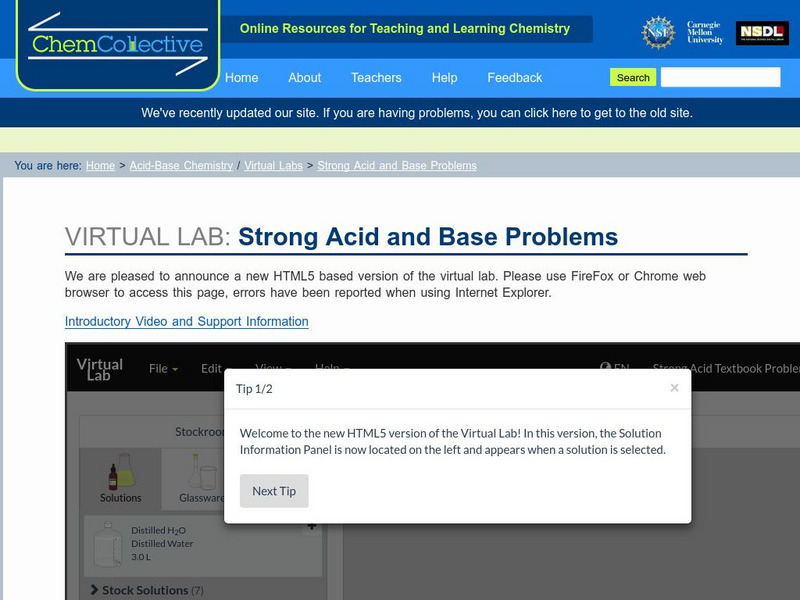
Chem Collective: Strong Acid and Base Problems
Textbook-style strong acid and base problems that can be checked using the Virtual Lab.
Chemistry Collective
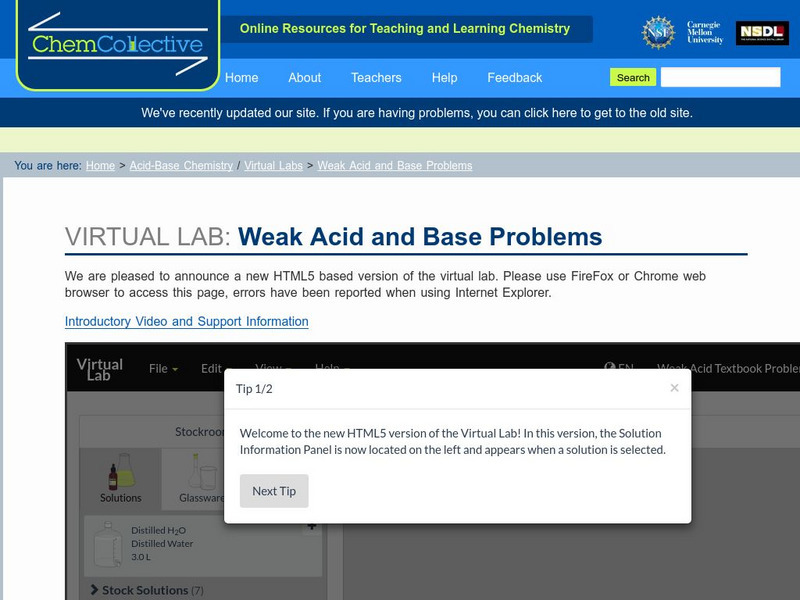
Chem Collective: Weak Acid and Base Problems
Textbook-style weak acid and base problems that can be checked using the Virtual Lab.
University of Utah
University of Utah: Learn Genetics: Click and Clone
Practice the steps of cloning in this interactive animation. Using what you know about somatic cell nuclear transfer, your mission is to create a genetically identical clone of Mimi, a brown female mouse. You'll answer a few questions at...
Concord Consortium
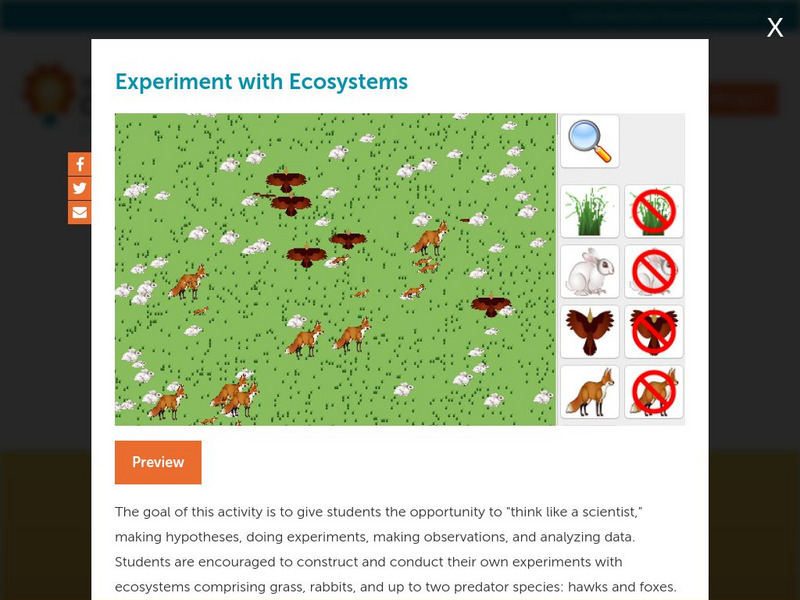
Concord Consortium: Stem Resources: Experiment With Ecosystems
Learn what happens to different populations of organisms as their ecosystem changes. Design your own experiment and make your own guesses with what the result will be with this virtual ecosystem. Also experiment with producer/consumer...
Concord Consortium
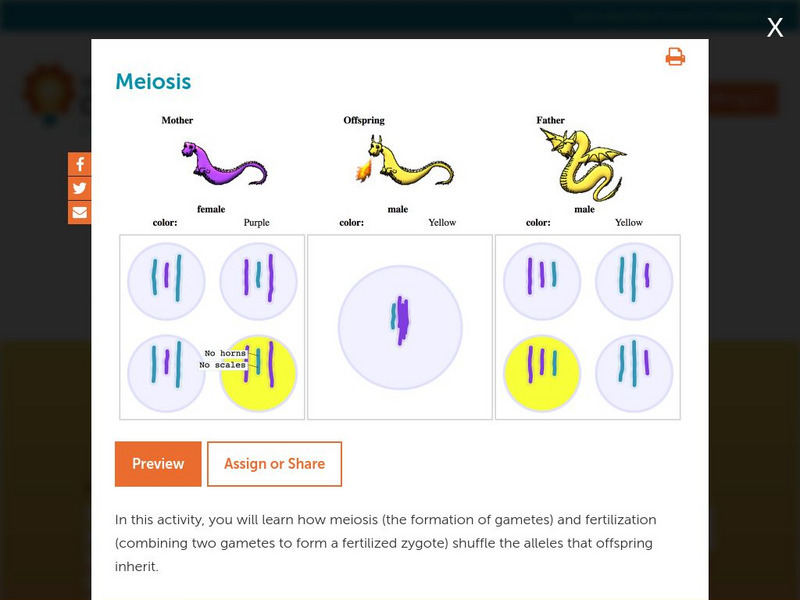
Concord Consortium: Stem Resources: Meiosis
Why don't you look exactly like your brother or sister? Meiosis involves the reducing of genetic material and chromosome shuffling which results in different genetic combinations. In this activity, students will view a computer model of...
Concord Consortium
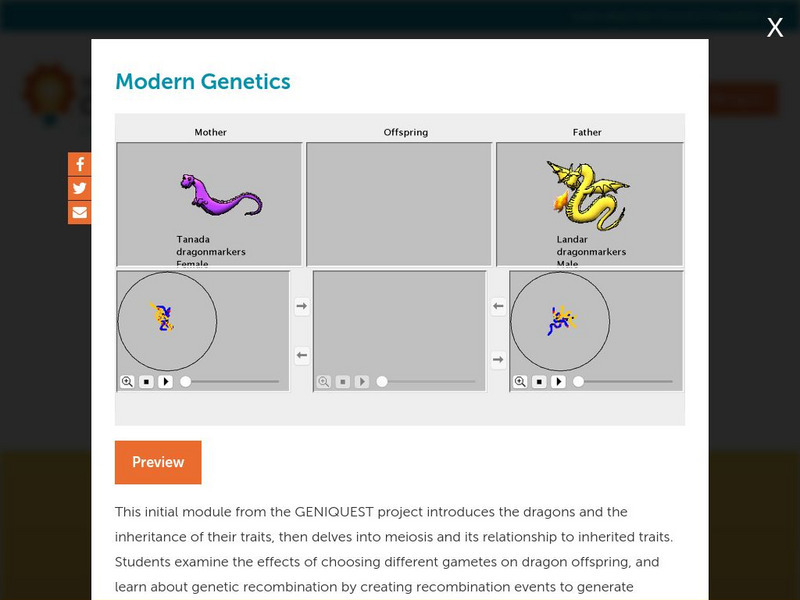
Concord Consortium: Stem Resources: Modern Genetics
Try your hand at mating dragons to learn about genetic recombination, meiosis, and inherited traits. Understand how chromosomes separate in meiosis with a science animation. Then change alleles for the dragons to see what happens to...

Concord Consortium
Concord Consortium: Stem Resources: Predators and Prey
Did you ever want to be a hawk? In this virtual ecosystem, students will take on the role of a hawk and try to catch rabbits on a snowy field. Students will see which rabbits have adaptations that allow them to blend into the environment...

Howard Hughes Medical Institute
Hhmi: Biointeractive: The Virtual Neurophysiology Lab
Investigate the nervous system by looking at nerve cells in this virtual lab. This lab exercise allows students to experience a virtual dissection of a leech to use electronic equipment to explore the electrical activity of nerve cells....

Concord Consortium
Concord Consortium: Stem Resources: Confliction Selection Pressures
Investigate how selection pressures and natural selection influence populations growth with this computer model. Understand how a population changes when selection pressures are in conflict. Perform the virtual lab to see what happens to...
Concord Consortium
Concord Consortium: Geniverse Software
A collection of virtual labs focusing on genetic activities relating to a made up dragon genome. Students explore how inheritance works by studying different cases and running breeding experiments. By changing alleles, students perform...
Discovery Education
Discovery Education: Young Scientist Lab
Explore innovations, complete a virtual lab or travel through time with this website. Content on this page allows users to understand how products are developed.
Stanford University
Stanford University: Our Acidifying Ocean
A virtual lab activity that investigates the life cycle of the sea urchin. As part of the lab activity, understand how the larval development is affected by the increasing acidity of the ocean.