Hi, what do you want to do?






PBS
Can We Hear Shapes?
Mathematician Mark Kac asked the question "Can we hear the shape of a drum?" It was a question that took over 20 years to answer. Sine waves, fundamental frequencies, eigenvalues, this episode has got it all!
Bozeman Science
Wavelength
In this video Paul Andersen explains how the wavelength is the distance between oscillations in a wave. In a longitudinal wave this might be the distance between areas of compression. In a transverse wave it might be the distance between...
TED Talks
Clifford Stoll: The call to learn
Clifford Stoll captivates his audience with a wildly energetic sprinkling of anecdotes, observations, asides -- and even a science experiment. After all, by his own definition, he's a scientist: "Once I do something, I want to do...
Bozeman Science
Wave Period and Frequency
In this video Paul Andersen explains how the period is the time between wave and the frequency is the number of waves per second. Period is measured in seconds and frequency is measured in Hertz. Wave period and wave frequency are...
Bozeman Science
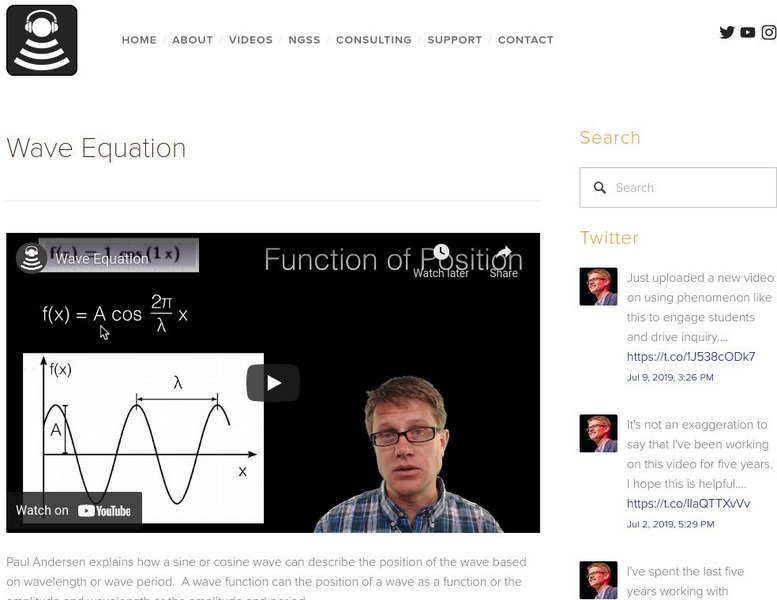
Wave Equation
In this video Paul Andersen explains how a sine or cosine wave can describe the position of the wave based on wavelength or wave period. A wave function can the position of a wave as a function or the amplitude and wavelength or the...
Curated Video
How Everything Acts Like a Spring: A Physics Perspective
SUMMARY:
Why Everything in the universe is a spring (kind of). Why everything is a spring. Classical springs like you might have in your mattress have a harmonic oscillation. And this behavior has a quantum...
Why Everything in the universe is a spring (kind of). Why everything is a spring. Classical springs like you might have in your mattress have a harmonic oscillation. And this behavior has a quantum...
Curated Video
De Broglie's Equation: Wave-Particle Duality
De Broglie's equation, formulated by Louis de Broglie in 1924, introduces the concept of wave-particle duality, suggesting that all matter exhibits both wave-like and particle-like properties. The equation is expressed as λ=h/p; λ is...
Professor Dave Explains
Quantum Mechanics and the Schrodinger Equation
Okay, it's time to dig into quantum mechanics! Don't worry, we won't get into the math, we just want to understand what the math represents, and come away with a new and improved view of the electron as both a circular standing wave and...
Virtually Passed
Vibrating String Summary
Many vibrating systems oscillate according to the wave equation. A string fixed at both ends is just one example. In general, a vibrating string will consist of an infinite number of natural frequencies and an infinite number of...
FuseSchool
Wave Equation
Wave Equation | Waves | Physics | FuseSchool Waves have a frequency (the number of complete waves passing a point every second and measured in Hertz), wavelength (the distance between two consecutive points on a wave) and amplitude - the...
Physics Girl
Waves, Light and Sound - Physics 101 / AP Physics 1 Review with Dianna Cowern
Lesson 17 (Waves, Light, and Sound) of Dianna's Intro Physics Class on Physics Girl. Never taken physics before? Want to learn the basics of physics? Need a review of AP Physics concepts before the exam? This course is for you! Exercises...
Virtually Passed
Wave equation: Vibrating String Proof
The 1 dimensional wave equation is solved here using the separation of variables technique (assuming u(x,t) = phi(x) q(t).
I simplify the formula further using the boundary c
onditions:
u(0,t) = 0
...
I simplify the formula further using the boundary c
onditions:
u(0,t) = 0
...
Bozeman Science
Bozeman Science: Wave Equation
In the following video Paul Andersen explains how a sine or cosine wave can describe the position of the wave based on wavelength or wave period. A wave function can the position of a wave as a function or the amplitude and wavelength or...