Hi, what do you want to do?






Curated Video
Reading 'Propping Up the Line', a short story about World War One by Ian Beck
Pupil outcome: I can explain what happens in ‘Propping Up The Line’, including commenting on some of the choices Beck made. Key learning points: - ‘Propping Up The Line’ is a short story by Ian Beck written using a third person narrative...
Curated Video
Vivid descriptive writing using Ian Beck's ‘Propping Up The Line’ as stimulus
Pupil outcome: I can write a vivid description inspired by Ian Beck's 'Propping Up The Line' which captures some of Alfred’s experiences and memories of the front line. Key learning points: - Many writers use vivid description to convey...
Curated Video
The presentation of trauma in Ian Beck's short story, 'Propping Up the Line'
Pupil outcome: I can explore Ian Beck’s presentation of the character of Alfred’s trauma in 'Propping Up The Line'. Key learning points: - Beck is interested in exploring both the physical and psychological effects of World War One on...
Curated Video
World War One: propaganda and trench warfare
Pupil outcome: I can explain why propaganda about World War One was so effective, and understand the differences between this wartime propaganda and the realities of trench warfare. Key learning points: - Wartime propaganda was used to...
Curated Video
Debating different interpretations of Katherine Mansfield’s ‘The Fly’
Pupil outcome: I can present a convincing argument about how to interpret Katherine Mansfield’s short story, ‘The Fly’ (1922). Key learning points: - You could argue that Mansfield is critical of the older generation in ‘The Fly’. - At...
Curated Video
Using sentence structure to create rhythm in writing about World War One
Pupil outcome: I can explore how Ian Beck and Wilfred Owen use sentence structure to give their writing rhythm and, inspired by them, craft a creative paragraph with engaging rhythm. Key learning points: - Writers spend time crafting the...
Curated Video
Skim reading and close reading: Wilfred Owen’s 1917 letter to his mother
Pupil outcome: I can show a thorough understanding of a 1917 letter that Wilfred Owen sent to his mother from the trenches of World War One. Key learning points: - Wilfred Owen (1893-1918) was a British poet and soldier. - Owen is best...
Oxford Comma
The Old Lie: Reading, Summary, and Analysis of Owen's "Dulce et Decorum Est"
From the trenches of the Great War, Wilfred Owen composed some of the most haunting poetry of the 20th century. The war would eventually take hiss life, but not before he penned a warning for his and future generations about the...
Oxford Comma
What War Leaves Unsaid. A Reading, Summary, and Analysis of "my sweet old etcetera"
Most students know e.e. cummings for his distinct and unusual writing style. No where is that style on better display than in his great antiwar poem, "my sweet old etcetera."
Favorite Poem Project
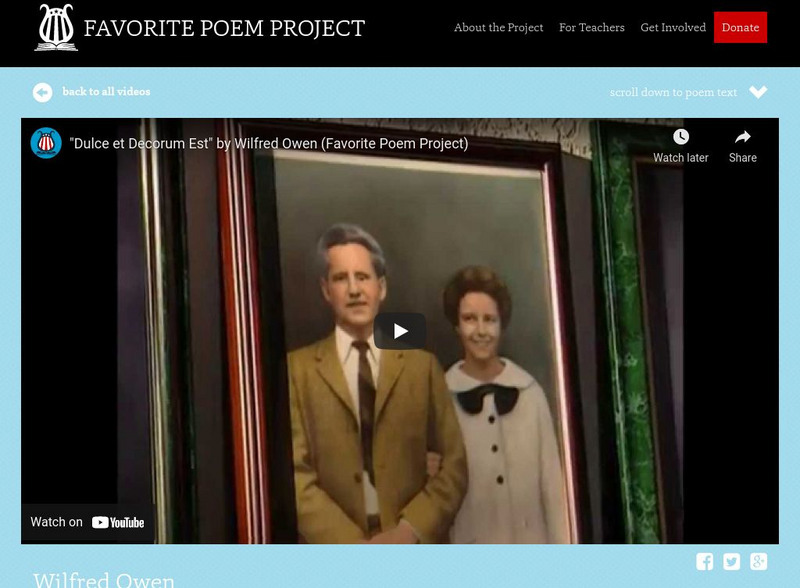
The Favorite Poem Project: "Dulce Et Decorum Est" by Wilfred Owen
In this video episode [5:33] from The Favorite Poem Project, Mary McWhorter, an accounting manager from California, describes herself and explains why Wilfred Owen's poem entitled "Dulce et Decorum Est" helped her realize her father's...

British Library
British Library: 20th Century: Wilfred Owen, 'Dulce Et Decorum Est'
Dr. Santanu Das explores the manuscript for Wilfred Owen's 'Dulce et Decorum Est', revealing new insights into the composition of one of World War One's most well-known poems. [9:34]