Hi, what do you want to do?






DoodleScience
Atomic Structure _ GCSE Physics
Doodle Science teaches you high school physics in a less boring way in almost no time!
Science360
Science Now ep1
This first episode of Science Now explores extremes environments, an eco friendly ATM, and a new supercomputer called Yellowstone.. check it out.
Visual Learning Systems
The Theory of Continental Drift
The video discusses the theory of continental drift proposed by Alfred Vagner in 1912. The video explores the evidence that Vagner compiled to support his theory, including the geographic fit of the continents, fossil evidence, and rock...
EarthEcho International
STEM Career Closeup: A Day in the Life of a NASA Scientist
This video features a scientist from NASA's Jet Propulsion Laboratory who studies water resources and measures the water content in snowpacks and mountains for drinking, farming, and watering purposes. She talks about her love for water...
The Backyard Scientist
Best Fire Tornado - DIY - no moving parts!
The best way to make a fire tornado (in my opinion!) All you need are 2 glass half-cylinders. No moving parts, no fans, no squeaky bearings, just fire and forget!<br/>
The Backyard Scientist
Can a Magnesium fire be put out?
Ive always been curious to what happens if you light one of these whole blocks of magnesium on fire. I remember spending hours in boyscouts trying to shave off as much as I could!

Curated OER
Oceanographic Scientist
Dive into this great video! An oceanographic scientist shares what she does as a scientist. She tells viewers what they can do to also prepare for a job in the ocean.

Nobel Media AB
Chemistry Matters: The Life of a Chemist
Are scientists really the stereotypical, crazy-haired, self-isolated characters depicted in movies? Far from it! They are a group of different types of personalities with a variety of interests who collaborate on projects and together...

Nobel Media AB
Chemistry Matters: Eureka!
While making a new scientific discovery is an exhilarating experience, it has its challenges as well. A discovery needs to be proven, which can be painstaking, and the scientific community may not easily accept the theory at first. Hear...
Science Friday Initiative
Science Friday: Neil De Grasse Tyson on Exploring Cosmic Frontiers
Listen to astrophysicist Neil deGrasse Tyson talk about how space exploration, especially human voyages, can profoundly inspire scientists and technologists of the future, and charts the path for missions to Mars and beyond.
American Museum of Natural History
American Museum of Natural History: O Logy: Meet the Paleont O Logist: John Flynn
An inquiry-oriented look at the work and personal interests of a paleontologist. Includes advice to kids who don't like science. Click on the starred words to learn more about the topic on the interactive flashcards.
American Museum of Natural History
American Museum of Natural History: O Logy: Meet the Paleont O Logist: Ross Mac Phee
An inquiry-oriented look at the work and personal interests of a paleontologist from Ross MacPhee. Click on the starred words to learn more about the topic on the interactive flashcards.
American Geosciences Institute
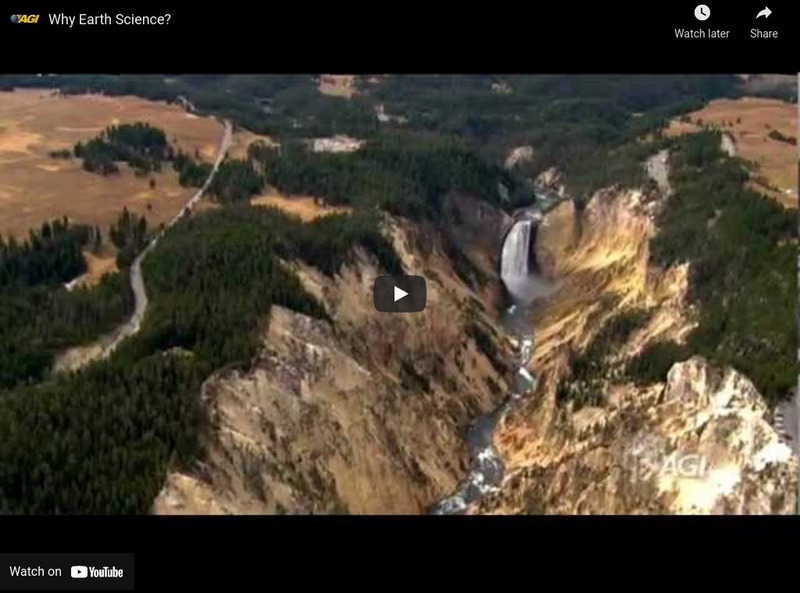
American Geosciences Institute: Why Earth Science?
Stunning video sequences and images illuminate the importance of knowing how Earth works and illustrate opportunities for careers in the Earth sciences. [6:36]

PBS
Pbs Learning Media: Atoms: The Space Between
This video segment adapted from A Science Odyssey takes a look at the scale of the atom and the tremendous amount of space between the electrons and the nucleus. If all this empty space exists in matter, how can any substance be solid?...
Science Friday Initiative
Science Friday: Science Diction: Scientist
Before the 1830s, there were no scientists -- the word scientist didn't exist. We'll talk about the word's origins and history.