Hi, what do you want to do?






SciShow
We Can't Find the Most Important Fossils Ever
About 360-ish million years ago, some tetrapods moved onto land and changed the course of history. So we'd love to know more about these guys, and what it took to get there. But the thing is, the fossils we need to understand this...
PBS
Why We Only Have Ten Toes (It's a Long Story)
Today, all mammals from humans to bats have five fingers or fewer. Yes, even whales, whose finger bones are hidden in their fins. Birds have four or fewer and amphibians get the best of both worlds, often having four digits on their...
PBS
When Giant Scorpions Swarmed the Seas
Sea scorpions thrived for 200 million years, coming in a wide variety of shapes and sizes. Over time, they developed a number of adaptations--from crushing claws to flattened tails for swimming. And some of them adapted by getting so big...
PBS
When Trees Took Over the World
420 million years ago, the forest floor of what's now New York was covered with a plant that didn’t look like a tree at all, except its roots were made of wood. Instead of looking up to learn about the evolution of trees, it turns out...
PBS
Our Ancient Relative That Said 'No Thanks' To Land
Around the time that some of our fishapod relatives were crawling out of the water, others were turning around and diving right back in.
PBS
How Vertebrates Got Teeth... And Lost Them Again
As revolutionary as teeth were, they would go on to disappear in some groups of vertebrates. But why?
SciShow
It Seems like Trees Caused a Mass Extinction
When it comes to mass extinctions, you probably imagine giant volcanic eruptions or asteroids raining fire from the sky, but sometimes these events can have some unexpected causes. Hosted by: Michael Aranda
SciShow
A Brief History of Life: When Life Exploded
Right at the beginning of the Paleozoic, there was a huge explosion of more complex life. And that’s when things started to get really interesting. This is our second installment on the history of life, but you can watch in any order you...
PBS
When Fish Wore Armor
420 million years ago, some fish were more medieval. They wore armor, sometimes made of big plates, and sometimes made of interlocking scales. But that armor may actually have served a totally different purpose, one that many animals...
PBS
From the Cambrian Explosion to the Great Dying
The first era of our current eon, the Paleozoic Era, is probably the most deceptively fascinating time in Earth's history. With near constant revolutions in life, punctuated by catastrophic extinctions, it is also one of the most chaotic.
Wonderscape
Exploring the Paleozoic Era: From Cambrian Explosion to the Great Dying
Journey through the Paleozoic era, a transformative period in Earth's history marked by the emergence of complex life and culminating in the largest mass extinction ever. Learn about the rise of diverse life forms, from the Cambrian...
Next Animation Studio
Ozone depletion may have sparked prehistoric extinction event: study
Ozone depletion may have triggered a mass die-off of ancient fish and plants by ultraviolet ray exposure 358 million years ago.
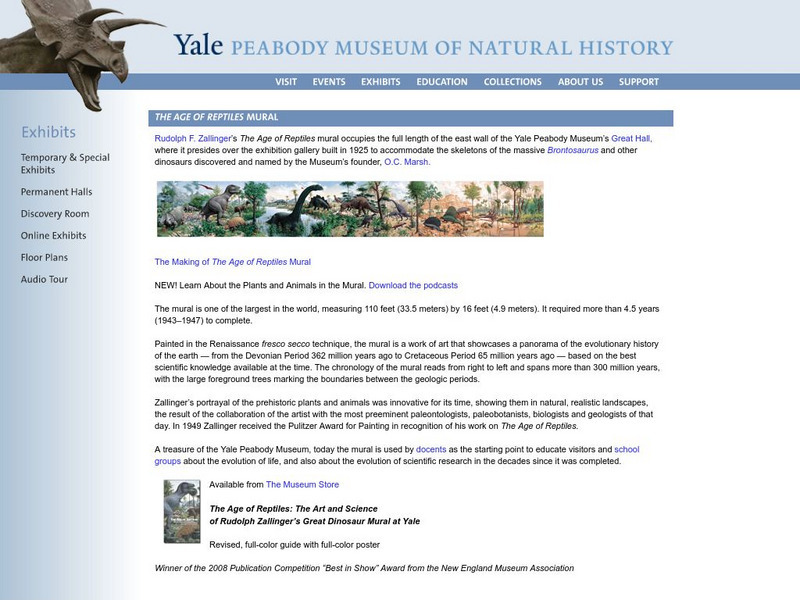
Yale University
Yale Peabody Museum: Age of Reptiles Mural
View the Age of Reptiles murals and learn more about the Cretaceous, Jurassic, Triassic, Permian, Carboniferous and Devonian periods. [6:45]