Hi, what do you want to do?






Cerebellum
The American Civil War And Reconstruction: 1862-1869 - Post Civil War Laws And Constitutional Amendments
American democracy has a lineage of written records that we can trace to show the development of our nation, and how each document builds on those before it to make our foundation of freedom stronger. This video looks at the 13th...

Khan Academy
US History Overview 2 - Reconstruction to the Great Depression
Ambitiously spanning American history from 1865 to 1941, this video discusses and clarifies topics such as women's suffrage, the sinking of the Maine, and the development of America as a world empire. Maps and photographs will engage...

Curated OER
American Civil War, 1861-1865
The American Civil War tore the country in two. What made tension grow between the North and the South? How did the war finally begin? What artillery was used? Answer some of these basic questions using this resource. Consider choosing a...
Annenberg Foundation
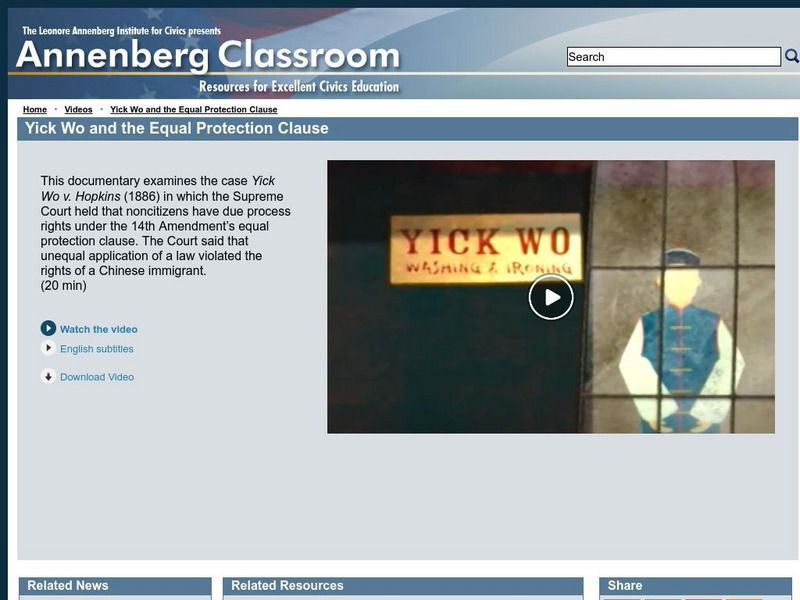
Annenberg Classroom: Yick Wo and the Equal Protection Clause
A documentary that looks at the Supreme Court decision in the case Yick Wo v. Hopkins from 1886. The decision upheld the right of a noncitizen Chinese immigrant to equal protection under the 14th Amendment. [20:00]

Gilder Lehrman Institute of American History
Gilder Lehrman Institute: The Slaughterhouse Cases
The first major post-Civil-War Supreme Court decision, popularly know as the Slaughterhouse Cases, resulted in a pivotal interpretation of the relatively new Fourteenth Amendment. Larry Kramer, Dean at Stanford Law School, discusses why...

Gilder Lehrman Institute of American History
Gilder Lehrman Institute: History Now: The Legal Battle for Racial Equality, 1787 1954
[Free Registration/Login Required] Larry Kramer, Stanford Law School, offers thorough insight into the advancement of Civil Rights. The pursuit of racial equality surfaces during the Civil War and builds through the Civil Rights Movement...
PBS
Pbs Learning Media: Crash Course Government and Politics: Discrimination
In this episode, we wrap up our discussion of discrimination by looking more closely at those discrete and insular minorities referenced in the 14th Amendment. We'll talk about instances of discrimination of Asian, European, and Latino...
Annenberg Foundation
Annenberg Learner: America's History in the Making: Reconstructing a Nation
This video delves into the challenges and opportunities that arose during the Reconstruction period following the Civil War and, in particular, re-unifying the states. [28:25]
Center For Civic Education
60 Second Civics: Rights of African Americans Pt. 3: The Civil War Amendments
On today's podcast we learn about the Civil War Amendments and why they were not effective.
Center For Civic Education
60 Second Civics: Rights of African Americans Pt. 12: Passage of 14th Amendment
It wasn't easy to pass the Fourteenth Amendment. Even the President was against it.
Center For Civic Education
60 Second Civics: Equal Protection: Introduction
An introduction to the equal protection clause in the Fourteenth Amendment and what it covers.
Center For Civic Education
60 Second Civics: Equal Protection Clause
The Supreme Court decision in the case of Yick Wo v. Hopkins (1886) held that a San Francisco ordinance against Chinese laundries violated the equal protection clause.
Center For Civic Education
60 Second Civics: Creating Bill of Rights Pt. 7: The Bill of Rights Is Adopted
On December 15, 1791, the Bill of Rights was finally ratified by the states. It wasn't until the Fourteenth Amendment that citizens would be protected by the Constitution against violation of their rights by state governments.
Center For Civic Education
60 Second Civics: We the People Lesson 27 Part 1: Due Process of Law
Today we learn about due process of law.
Center For Civic Education
60 Second Civics: The Thirteenth and Fourteenth Amendments
The Thirteenth and Fourteenth Amendments made critical changes to the Constitution, such as the abolition of slavery, that addressed issues not settled at the Constitutional Convention or by the Civil War.
Center For Civic Education
60 Second Civics: The Fourteenth Amendment
After the Civil War, Congress passed the Civil Rights Act of 1866 and the Fourteenth Amendment. These were efforts to protect the rights of African Americans.
Center For Civic Education
60 Second Civics: Equal Protection of the Laws
An early Supreme Court decision in the case of Strauder v. West Virginia (1880) concluded that West Virginia violated the equal protection of the law rights in the Fourteenth Amendment.
Center For Civic Education
60 Second Civics: Equal Protection: Strict Scrutiny
Laws that can potentially violate a person's equal protection under the laws are the subject of strict judicial scrutiny by the courts.
Center For Civic Education
60 Second Civics: Equal Protection and the States
The due process clause in the Fifth Amendment can be invoked if the parties feel they have not been given equal protection under the laws, and want to mount a court challenge against the national government.
Center For Civic Education
60 Second Civics: Woman Suffrage: Part 2
Leaders in the women's suffragette movement tried to win the right to vote with the passing of the 14th Amendment, but were denied it.
Center For Civic Education
60 Second Civics: Native Americans and Voting: Part 2
Even with the passing of the Fourteenth Amendment, Native Americans were not recognized as full citizens of the United States, so still could not vote.
Annenberg Foundation
Annenberg Classroom: One Person, One Vote Video
In this documentary, Justices Sandra Day O'Connor and Stephen G. Breyer and other experts discuss how the principle of one person, one vote emerged from a series of landmark decisions in the 1960s, including Baker v. Carr and Reynolds v....
Crash Course
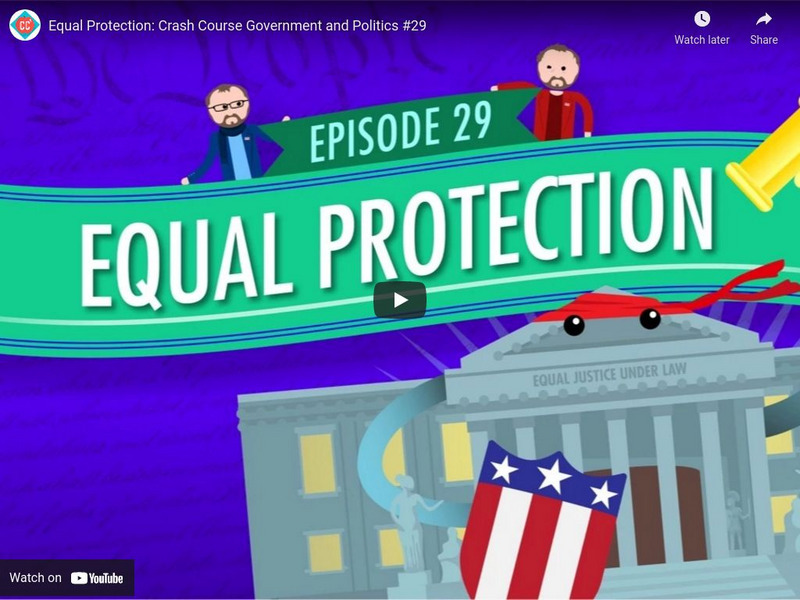
Crash Course Government and Politics #29: Equal Protection
Crash Course video in which Craig Benzine discusses civil rights, civil liberties and the importance of the 14th Amendment's and the Equal Protection Clause. [8:15]
Center For Civic Education
60 Second Civics: Bill of Rights Pt. 23: Incorporation
The passage of the Bill of Rights had little impact on most people. In 1833, the Supreme Court ruled that it applied only to the federal government. The provisions in the Bill of Rights were incorporated later through the 14th Amendment...