Hi, what do you want to do?






PBS
Nautiloids Thrived For 500 Million Years Until These Guys Showed Up
Around 30 million years ago, a new group of predators began to push nautiloids from their former global range into a single remaining refuge. But who were these predators?
PBS
How the Squid Lost Its Shell
The ancestors of modern, squishy cephalopods like the octopus and the squid all had shells. In ancient times, their shell was their greatest asset but it eventually proved to be their biggest weakness.
SciShow
The Story of the World's Favorite Fossil
What is the world's favorite fossil? Why the orthoceras of course! Hank will tell why that is in this episode of SciShow. Find out how you can get your very own orthoceras fossil.
SciShow
Sparkling Clouds and Other Wild Ways Cephalopods Use Ink
Octopuses and other cephalopods can squirt ink when threatened, but the forms the ink takes can go way beyond your typical smokescreen.
Bizarre Beasts
The Only Octopus With a Shell
The octopus is a pretty odd animal under even the most ordinary circumstances – or ordinary by octopus standards, at least. So when folks start calling out one type of octopus as the strangest, there’s probably something special about...
Professor Dave Explains
Phylum Mollusca Part 4: Class Cephalopoda (Squids, Nautiluses, Cuttlefish, and Octopuses)
We now arrive at the most famous of the mollusks, the cephalopods. These include squids, nautiluses, cuttlefish, and the fascinating octopuses. These creatures are the largest and most intelligent invertebrates on Earth. Let's learn all...
Professor Dave Explains
Phylum Mollusca Part 1: General Introduction
We've covered most of Spiralia, but now it's time to dive into the final subclade, Lophotrochozoa. This contains several phyla, the most diverse of which is Mollusca. This phylum includes snails, slugs, octopuses, squids, oysters,...
Bizarre Beasts
A Feast of Bones
Deep in the ocean, resting on the seafloor, there is a strange ecosystem – one built on the bodies of the dead. Join us on a tour of a whale fall.
Bethany Thiele, Art Teacher
Colorful Nautilus Shell with Watercolor Pencils | Grabie Product Review and Demo
Colorful Nautilus Shell with Watercolor Pencils | Grabie Product Review and Demo
Science360
NERD STUFF
In episode 25, Charlie and Jordan examine a rare nautiluses (not seen in 30 years), how to fold a shell and enrolling more girls in computer science classes.
Vlogbrothers
The Cutest Octopus
The Dumbo Octopus is very good and mysterious. I love them a lot and I want everyone to know it.

Sea Studios Foundation
Shape of Life: Molluscs: Nautilus Regulates Its Buoyancy
A nautilus' shell, when x-rayed, reveals the many chambers, which the nautilus uses to regulate buoyancy as it moves up and down in the ocean. Observe this process with this video! [1:54]
Sea Studios Foundation
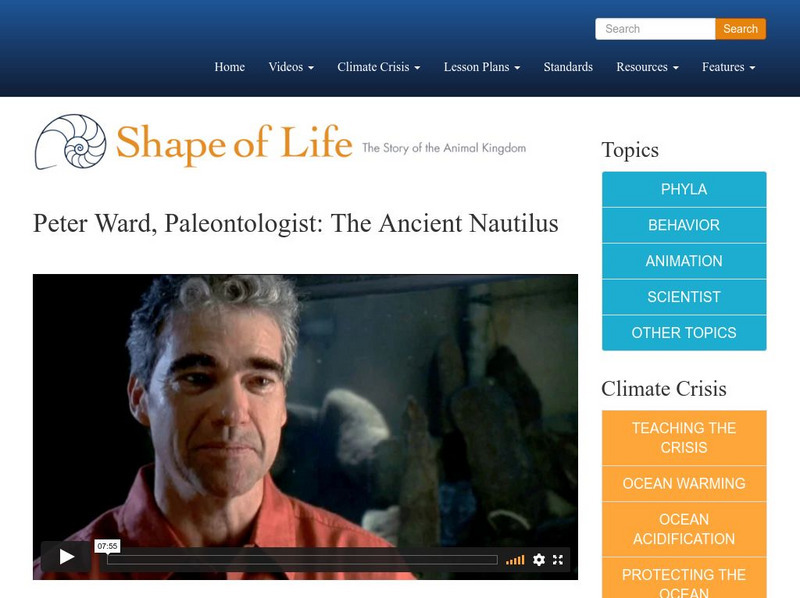
Shape of Life: Peter Ward, Paleontologist: The Ancient Nautilus
Watch the adventures of Peter Ward in this video. As a paleontologist Peter Ward studied fossil nautiloids for years before he went to New Caledonia to see and trap living nautiloids. He's interested in the adaptations that allowed this...
Sea Studios Foundation
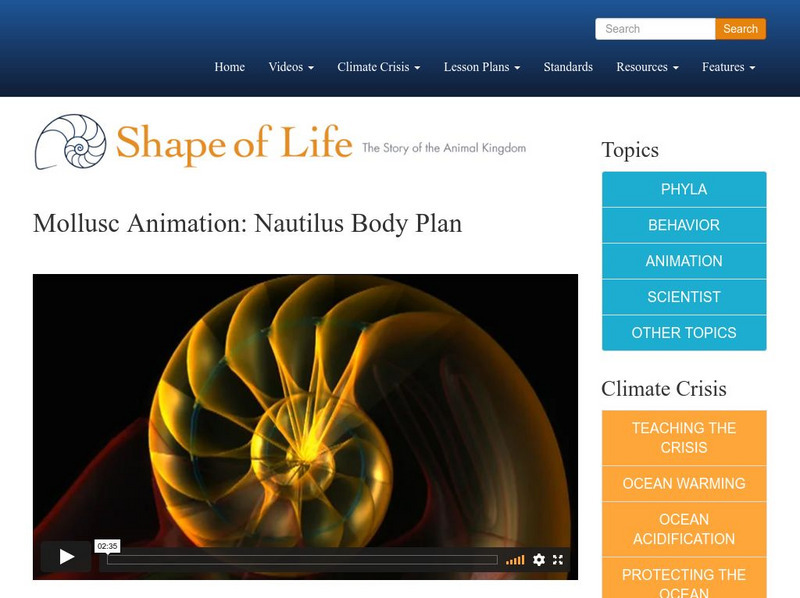
Shape of Life: Mollusc Animation: Nautilus Body Plan
Numerous tentacles, a funnel that evolved from the foot, a mantle that secretes the shell, and a pair of jaws with a radula- these all clearly show the nautilus mollusc design. Spiraling through the shell, a tube called the siphuncle...