Hi, what do you want to do?






PBS
Why Only Earth Has Fire
To get fire, which exists only on Earth, it took billions of years of photosynthesis – which means fire can’t exist without life. And fire and life have been shaping each other ever since.
PBS
When Giant Scorpions Swarmed the Seas
Sea scorpions thrived for 200 million years, coming in a wide variety of shapes and sizes. Over time, they developed a number of adaptations--from crushing claws to flattened tails for swimming. And some of them adapted by getting so big...
PBS
When Giant Millipedes Reigned
This giant millipede was the largest known invertebrate to ever live on land. So how did it get so big??
PBS
When the Rainforests Collapsed
The Carboniferous Rainforest Collapse set the stage for a takeover that would be a crucial turning point in the history of terrestrial animal life. If it weren’t for that time when the rainforests collapsed - in an extinction event that...
PBS
How Vertebrates Got Teeth... And Lost Them Again
As revolutionary as teeth were, they would go on to disappear in some groups of vertebrates. But why?
SciShow
Our Entire Society is Built on a Geological Fluke
If a tree falls into the forest and doesn't decompose, what happens to it?
SciShow
A Brief History of Life: When Life Exploded
Right at the beginning of the Paleozoic, there was a huge explosion of more complex life. And that’s when things started to get really interesting. This is our second installment on the history of life, but you can watch in any order you...
SciShow
Three MORE Things You Missed Because of COVID
This year, science news has understandably focused a lot on COVID-19. But other science has carried on, and there have been plenty of amazing discoveries this year that we think deserve a spotlight, too!
SciShow
The Biggest Sloth That Ever Lived, and 6 Other Gigantic Animals
Sometimes it seems like the past favored large animals, but it turns out that each one on this list has a different reason for its size.
Cha
pters
View all
Carboniferous & Permian periods 360 251...
Cha
pters
View all
Carboniferous & Permian periods 360 251...
PBS
History's Most Powerful Plants
Fossil fuels are made from the remains of extinct organisms that have been exposed to millions of years of heat and pressure. But in the case of coal, these organisms consisted largely of some downright bizarre plants that once covered...
PBS
The Age of Giant Insects
Insects outnumber humans by a lot and we only like to think we're in charge because we're bigger than they are. But insects and other arthropods weren't always so small. About 315 million years ago during the Carboniferous Period, they...
PBS
From the Cambrian Explosion to the Great Dying
The first era of our current eon, the Paleozoic Era, is probably the most deceptively fascinating time in Earth's history. With near constant revolutions in life, punctuated by catastrophic extinctions, it is also one of the most chaotic.
Crash Course
Plant Cells: Crash Course Biology
Hank describes why plants are so freaking amazing - discussing their evolution, and how their cells are both similar to & different from animal cells.
Curated Video
Limestone: Uses
From English farmland to Egyptian tombs, Limestone is a distinctive rock with many uses. Learn about the formation of different limestone types and the landscapes these form. Earth Science - Geology - Learning Points. There are three...
Weird History
Meganeura, The Prehistoric Dragonfly
Three hundred million years ago, the largest insect ever known to humankind hunted in fern jungles and boasted an enormous wingspan of nearly 2.5 feet. Different from modern dragonflies in its size and other attributes, the Meganeura...
Professor Dave Explains
History of the Earth Part 2: Phanerozoic Eon – Paleozoic Era
We just cruised through the Hadean, Archean, and Proterozoic eons. That brings us all the way to the Phanerozoic eon, which is the one we are still living in today. This is split up into the Paleozoic, Mesozoic, and Cenozoic eras, so...
Learning Mole
What do Insects Eat?
This episode will take students through what insects eat and the different eating habits of different types of insects
Learning Mole
How do Insects Move?
This video will take students through how insects move their limbs in different ways to humans.
Visual Learning Systems
Gymnosperms and Angiosperms: Vascular Seed Plants
Everyday we use products or eat foods derived from vascular seed plants. In this series of videos the wide variety of non-flowering seed plants, gymnosperms, are described and characterized through vivid footage gathered from around the...
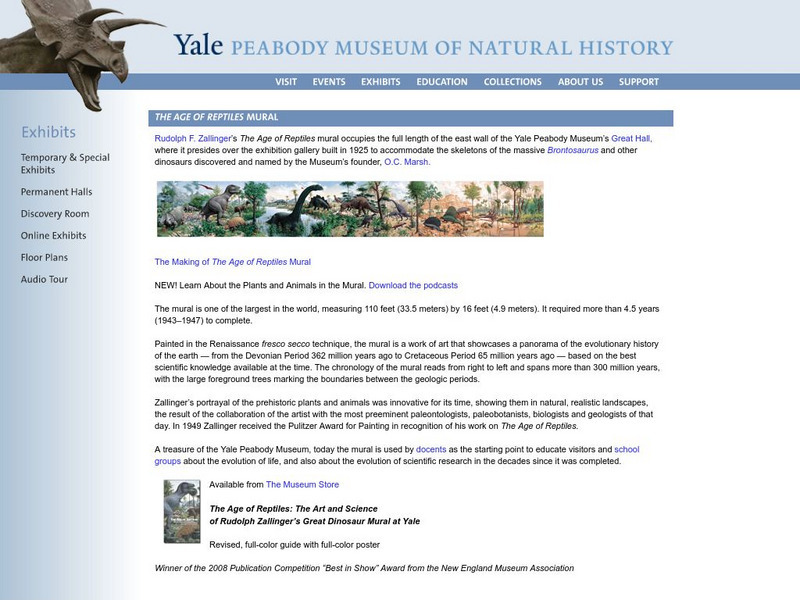
Yale University
Yale Peabody Museum: Age of Reptiles Mural
View the Age of Reptiles murals and learn more about the Cretaceous, Jurassic, Triassic, Permian, Carboniferous and Devonian periods. [6:45]