Hi, what do you want to do?






Amoeba Sisters
Hardy-Weinberg Equilibrium
Explore the Hardy-Weinberg Equilibrium equations with The Amoeba Sisters! Learn why this equation can be useful, its five assumptions, and how to calculate genotype and allele frequencies with p and q values! This video does assume the...
Bozeman Science
Unit 1 Review - Natural Selection
Paul Andersen reviews the major within the first unit on natural selection. He starts by defining evolution and explaining how evolution can occur in a population. He reviews the population genetics and camouflage lab. He reviews...
Bozeman Science
AP Biology Lab 8: Population Genetics and Evolution
Mr. Andersen explains Hardy-Weinberg equilibrium and describes the bead lab.
Bozeman Science
Microevolution
Paul Andersen defines microevolution as any change in the frequency of the allele pool. He then explains the five mechanisms of evolution; small sample size, non-random mating, mutations, gene flow and natural selection.
Crash Course
Population Genetics: When Darwin Met Mendel - Crash Course Biology
Hank talks about population genetics, which helps to explain the evolution of populations over time by combing the principles of Mendel and Darwin, and by means of the Hardy-Weinberg equation.
Bozeman Science
Hardy-Weinberg Equation
In this video Paul Andersen explains the elements in the Hardy-Weinberg equation; including the allele frequency and phenotype frequency. He begins with a brief explanation of phenotypes and genotypes. A sample problem is worked out...
Bozeman Science
Solving Hardy Weinberg Problems
Paul Andersen shows you how to solve simple Hardy-Weinberg problems. He starts with a brief description of a gene pool and shows you how the formula is derived. He then shows you how to solve a couple of sample problems.
Bozeman Science
Genetic Drift
Paul Andersen describes genetic drift as a mechanism for evolutionary change. A population genetics simulator is used to show the importance of large population size in neutralizing random change. The near extinction of the northern...
Bozeman Science
Population Variation
Paul Andersen explains the importance of genetic variation within a population. He begins with a discussion of the devil facial tumor that is a form of cancer transferred between Tasmanian devils. He then explains how a decrease in...
Bozeman Science
Natural Selection
Paul Andersen explains how natural selection is a major mechanism in evolution. The video begins with a discussion of Charles Darwin and the details of natural selection. The data of the peppered moth during the industrial revolution...
Howard Hughes Medical Institute
Hhmi: Bio Interactive: Natural Selection Adaptation
Classroom resources paired with a ten-minute video highlight the groundbreaking research of physical and genetic evolutionary changes in rock pocket mouse populations. [10:31]
Bozeman Science
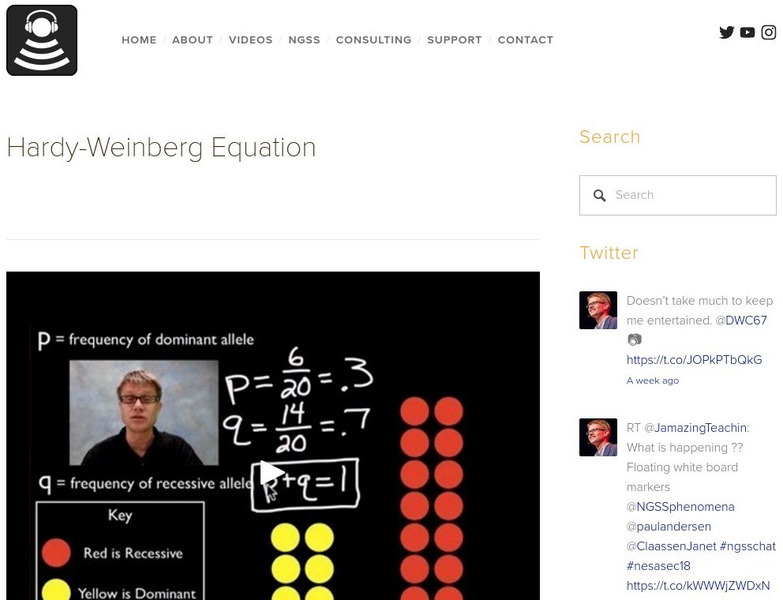
Bozeman Science: Hardy Weinberg Equation
In this video, Paul Andersen explains the elements in the Hardy-Weinberg equation; including the allele frequency and phenotype frequency. He begins with a brief explanation of phenotypes and genotypes. A sample problem is worked out and...