Hi, what do you want to do?






Curated Video
Circular Motion Physics: The 3 Equations of Circular Motion
Understand the physics of uniform circular motion, its requirements, and key formulas like centripetal acceleration. Learn real-world examples, distinctions from non-uniform motion, and the derivation of UCM equations
Curated Video
Vector Addition and Subtraction
Learn the basics of vector physics, including how to add vectors and interpret their graphical representation. Understand the difference between scalar and vector quantities with real-world examples.
Virtually Passed
cuvilinear n t coordinate systems example
If you're given the parametric equations describing the path of a particle. How do you find out the accelerations in the normal and tangential direction? Find the velocity and you know the tangential direction. Find the acceleration and...
Virtually Passed
Curvilinear motion example 2
What is the magnitude of the acceleration of a ball traveling around a circular path if it's constrained to have a constant vertical velocity? Always start these problems by doing a velocity analysis, then finish it by doing an...
Virtually Passed
Acceleration Vector Summary
Acceleration is a vector that describes the rate of change of velocity of a particle. Part of the acceleration of the particle will be tangential to the path, the rest will be normal to the path. The acceleration of the particle is...
Virtually Passed
Dynamics Formula Sheet
In this video I cover some of the main formulas used for a standard dynamics course:
1) Plane m
otion
2) Project
ile motion
3)
Circular motion
4) Dry Friction
(static and dynamic)
5) Relative motion (for no
n...
1) Plane m
otion
2) Project
ile motion
3)
Circular motion
4) Dry Friction
(static and dynamic)
5) Relative motion (for no
n...
Virtually Passed
Relative motion (with rotating axes) Summary
The equations for NON rotating reference axes are:
Va = Vb + Va/b
and
a_a = a
_b + a_a/b
But these equations are only true if the relative axes are not rotating. If the relative frame of reference xy is...
Va = Vb + Va/b
and
a_a = a
_b + a_a/b
But these equations are only true if the relative axes are not rotating. If the relative frame of reference xy is...
Virtually Passed
polar equation of motion
Here I derive the most generic equations of motion (position, velocity & acceleration) for a continuous curve. The calculus is pretty involved so I definitely recommend you hit up your math textbook first!
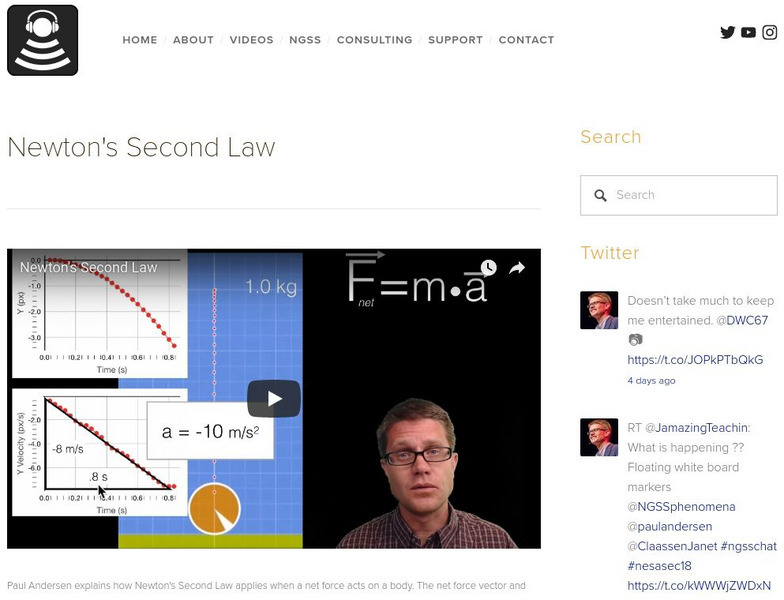
Bozeman Science
Bozeman Science: Newton's Second Law
In the following video Paul Andersen explains how Newton's Second Law applies when a net force acts on a body. The net force vector and the acceleration vector will act in the same direction. If an object acts on another object in a...

Khan Academy
Khan Academy: Calculus Proof of Centripetal Acceleration Formula
Watch as Khan Academy completes a calculus proof of the famous Centripetal Acceleration Formula. This video proves that a = v^2/r. [14:21]

Khan Academy
Khan Academy: Visual Understanding of Centripetal Acceleration Formula
This video gives a visual understanding of how centripetal acceleration relates to velocity and radius. [9:47]