
Curated OER
"The Good, The Bad, and The Smelly."
Students explore insects' use of pheromones and beneficial insects versus insect pests.

Curated OER
Guess What?! (a lesson about atoms)
Young scholars investigate atoms as particles that make up all matter. They examine the mass of matter.

Curated OER
Barn Owl Pellet Lab
In this lab worksheet, high schoolers dissect a barn owl pellet then identify the different small animals found in the owl pellet. Using class data they calculate percentage present as well as complete 8 post lab questions.

Curated OER
Punctuation Review
In this punctuation review worksheet, students rewrite 8 sentence using the proper punctuation as well as capital letters. Students then write their own original sentences.

Curated OER
Guess What?!
Students explore how scientists work. In this scientific method lesson, students use their senses to identify objects they cannot see. Students are asked to think like scientists and make observations, comparisons, and interferences, as...

Curated OER
Primary Biological Content Area Covered
Students use the scientific method to make predictions about mold growth. For this fungus lesson, students use worksheets to help them illustrate predictions and graph mold growth from white to wheat bread. Students first...

Curated OER
The Ogre Bully
Second graders read the story The Ogre Bully and complete language arts activities connected to the story. In this language arts lesson plan, 2nd graders complete activities including discussion, reading, writing, sequencing, analyzing,...

Curated OER
Moving Objects
Students discover the history of the United States by examining the Great Migration. In this U.S. History lesson, students research the immigration movement on the Internet and complete a worksheet about the large population...

Curated OER
Looking into Space
Students explain how telescopes work and how they can contribute to our knowledge of the universe.

Curated OER
What are Quarters Made of?
Students study the meaning, symbolism, and value of U.S. coins,
especially the quarter. They l research why in 1965 the U.S. Mint decided to
change the metal composition of the quarter to copper coated with zinc. In addition, they...

Curated OER
Digital Photography
High schoolers take digital pictures of themselves in class. Using a software program, they change their hair, clothing and background to convince others they are in a different place. They discuss the differences between erasing,...

Curated OER
Traditional Uses of Wood
First graders explore properties of wood used to make cultural items and make a ring and stick game.

Curated OER
All Hands On Deck
Young scholars study estuaries and are able to define one, and describe its features. In this investigative lesson students participate in an activity that shows them the importance of estuaries.

Curated OER
You Are Where You Live
Students explore where insects live and how they have adapted to their environment.

Curated OER
You Are Where You Live
Third graders observe insects in a number of habitats. They recognize which insect characteristics are adaptations to their habitats.

Curated OER
Our Schoolsyard is Full of Biology
Students study the habitats found in their schoolyard. They apply firsthand, what they have learned in the classroom to something familiar to them. Students look at biotic, abiotic habitats. Small groups will present their findings to...

Curated OER
Merriam Webster: Visual Dictionary Online: Magnifying Glass
Illustration of a magnifying glass.
Science Education Resource Center at Carleton College
Serc: Magnify It
In this lesson, students will view their finger from various viewing distances to discover that their visual field is limited and a magnifying glass is a tool that can help make something look bigger. Students will record what they see...

PBS
Pbs Kids: Elinor Wonders Why: Elinor's Nature Adventure
Come explore with Elinor! Use the tools provided to observe your environment as you take a nature walk. What will you find?
Other
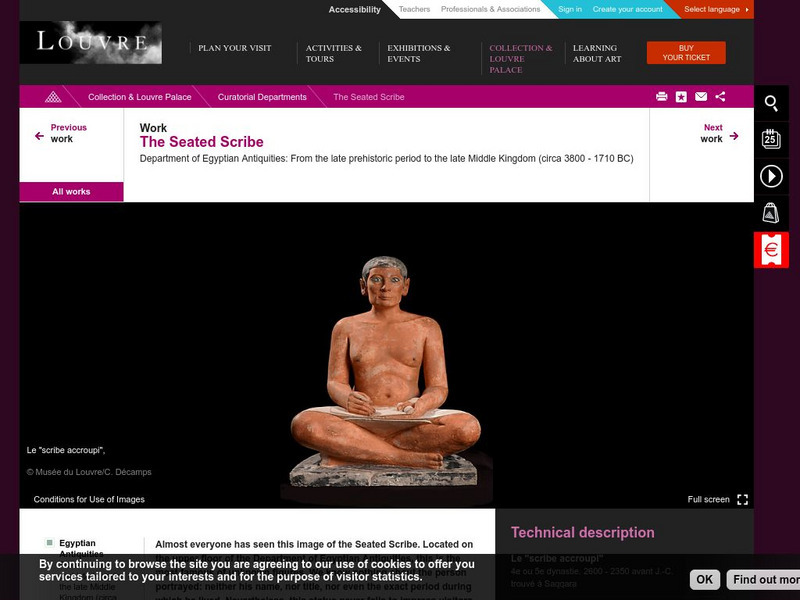
Louvre Museum: A Closer Look at the Seated Scribe
Take a closer look at a work of Egyptian sculpture wherein you can see details of the work through a virtual magnifying glass. Accompanying commentaries and animations provide historical and artistic analysis. Useful in-context tools...