Hi, what do you want to do?





BioEd Online
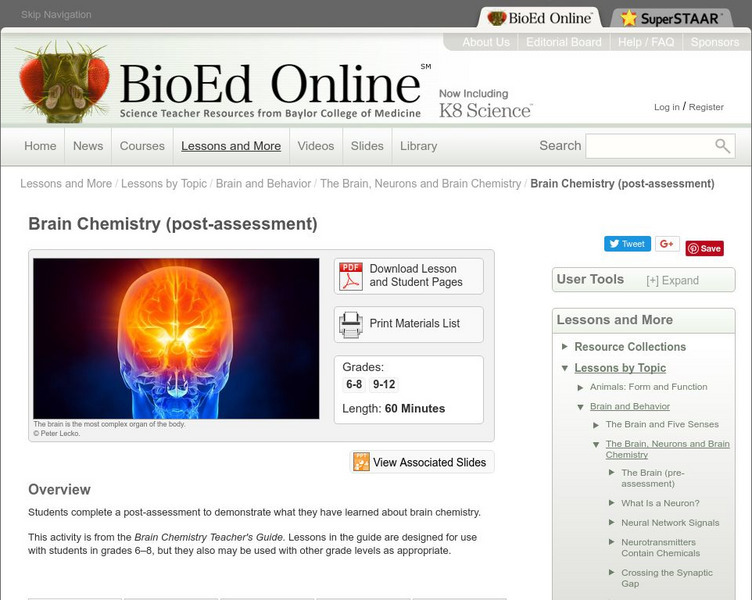
Bio Ed Online: Brain Chemistry Post Assessment
The human brain is complex. Messages within the brain and the rest of the nervous system are conducted by cells called neurons. Drugs and other substances can interfere with or modify the transmission of messages between neurons. In this...

PBS
Pbs Learning Media: The Adolescent Brain
In this transcript from FRONTLINE: "Inside the Teenage Brain," neuroscientist Dr. Jay Giedd discusses new research on brain development in teenagers.
Science Buddies
Science Buddies: The Brains Behind 'Where's Waldo?'
What makes you notice someone in a crowd? Why do some things stand out, while others melt into the background? In this experiment you can investigate the psychology of how things get noticed, by studying how our brains perform a visual...
Science Buddies
Science Buddies: Multitasking: Brain Drain or Boost in Efficiency?
Think it's a good idea to plug into iTunes, surf the Web, or watch TV while doing homework or trying to read? Many people do it and claim that jumping from one activity to another keeps their attention level up and even gives their brain...
National Cancer Institute at the National Institutes of Health
Seer Training Modules: Introduction to the Nervous System
Self-guided learning activity where students learn about the structure and function of the human nervous system. There is a short quiz at the end of the lesson to check for understanding.
Gateway Community College
James Crimando: Nervous System
Learn about the anatomy of the human brain.
Science Buddies
Science Buddies: Are You Left or Right Sided?
Our brains are split into two parts, right inside our head. One half is the left brain and the other half is the right brain. Each side of your brain controls different parts of your body and most people are more dominant controlling one...
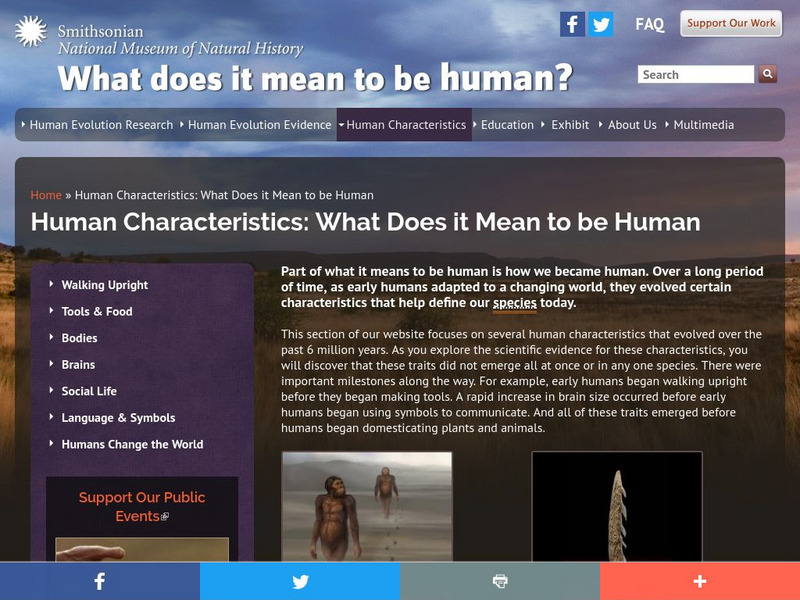
Smithsonian Institution
National Museum of Natural History: What Does It Mean to Be Human, Human Characteristics
Explore walking upright, tools and food, bodies, brains, social life, language and how humans ultimately changed the world. Excellent charts, pictures and videos accompany easy-to-understand text on the earliest humans.
Cosmo Learning
Cosmo Learning: The Future of Human Health
Series of seven video lectures delivered by Standford University professors on the future and frontiers of human health. Videos vary in length. Comments sections at the bottom of the page.
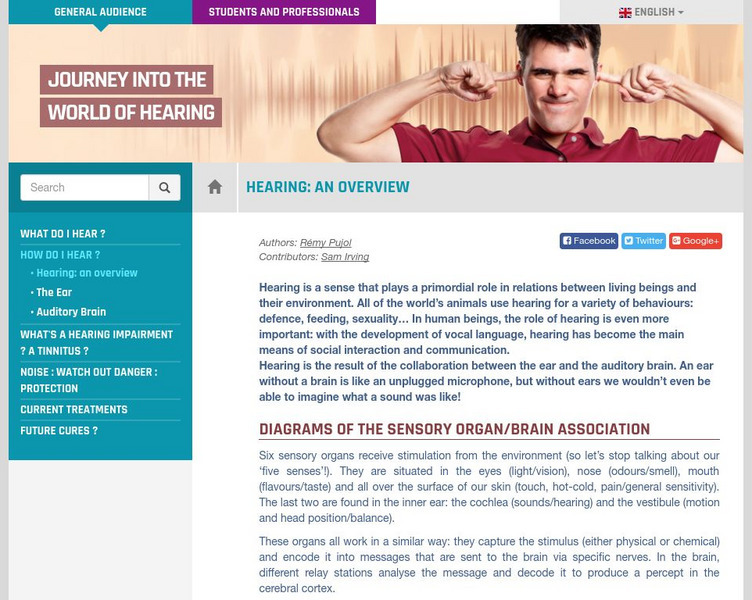
NeurOreille
Neur Oreille: Journey Into the World of Hearing: How Do I Hear?
See how the human ear senses a sound, and how that stimulus is transmitted to the brain for interpretation and response.
Science Buddies
Science Buddies: Warped Words and the Stroop Effect
The Stroop effect describes an experiment about the time it takes to name the color of printed words. When you try to name the color in which color words are printed, it takes longer when the color word differs from the ink color than...

TED Talks
Ted: Ted Ed: Can You Solve the Passcode Riddle?
In a dystopian world, your resistance group is humanity's last hope. Unfortunately, you've all been captured by the tyrannical rulers and brought to the ancient coliseum for their deadly entertainment. Will you be able to solve the...
Science Buddies
Science Buddies: Shaping Your Thoughts?
This is an experiment that explores certain aspects of how your brain pays attention. In this project, you'll have to recruit volunteers to take a simple test: naming a list of printed shapes. What makes the test tricky is that words...

CPALMS
Florida State University Cpalms: Florida Students: Climbing Around the Hominin Family Tree
Identify basic trends in the evolutionary history of humans, including walking upright, brain size, jaw size, and tool use.
Science Buddies
Science Buddies: Think Fast: Do Video Game Players Have Faster Reaction Time
Are you an avid video game player? Do you think this helps you have fast reaction times? This Science Buddies science project lays out an experiment to help you test your hypothesis. The Science Buddies project ideas are set up...
Science Buddies
Science Buddies: What Conflicting Mental Tasks Reveal About Thinking
Can you pat your head with one hand while you rub your stomach with the other? This experiment is kind of like that, but it can actually give you some insight into how your mind works. The task is to name colors. It sounds simple enough,...
Other
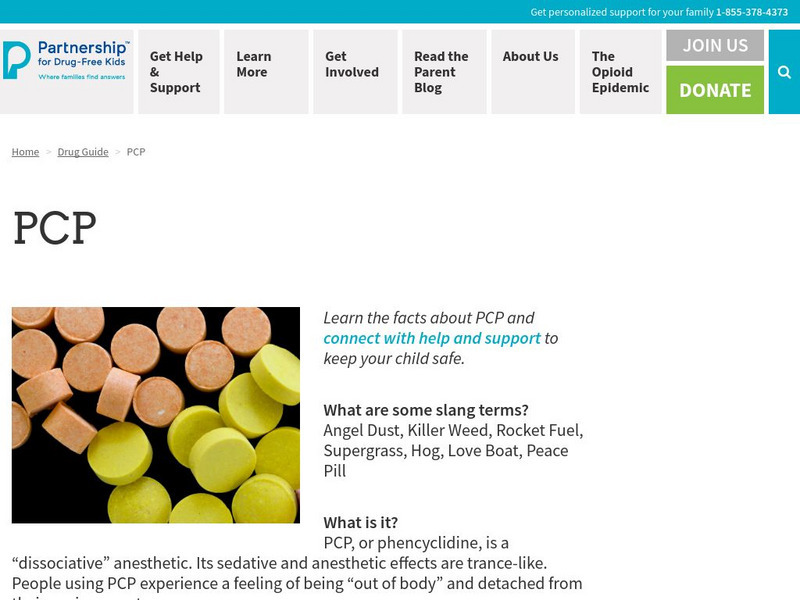
Partnership for a Drug Free America: Pcp
This site from the Partnership for a Drug-Free America is organized in question/answer format, this website provides a good introduction for students wanting to know about PCP and its hazardous effects on the human body and brain.
TeachEngineering
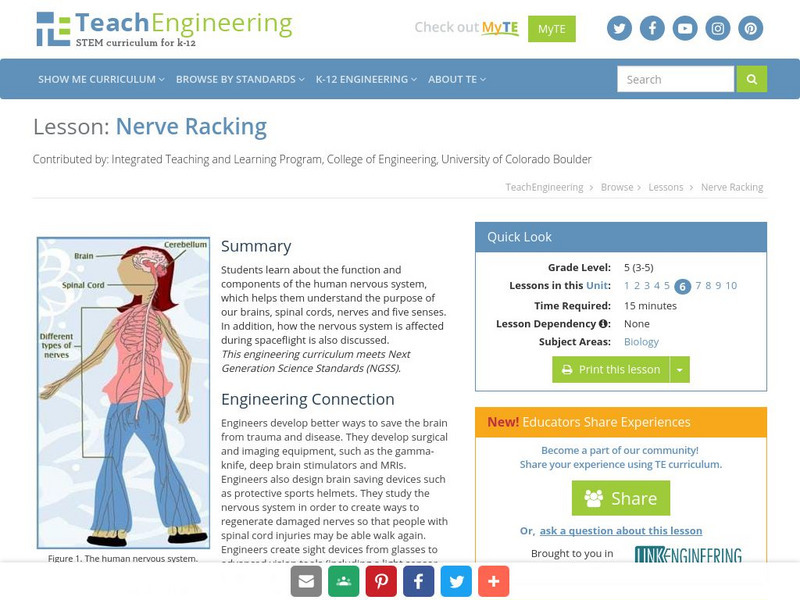
Teach Engineering: Nerve Racking
This lesson describes the function and components of the human nervous system. It helps students understand the purpose of our brain, spinal cord, nerves and the five senses. How the nervous system is affected during spaceflight is also...

TED Talks
Ted: Ted Ed: How Do We Smell?
An adult human can distinguish up to 10,000 odors. You use your nose to figure out what to eat, what to buy and even when it's time to take a shower. But how do the molecules in the air get translated into smells in your brain? This...