Hi, what do you want to do?






Countries and Their Cultures
Countries and Their Cultures: Gusii
The Gusii are divided into seven clan clusters: Kitutu (Getutu), North Mugirango, South Mugirango, Majoge, Wanjare (Nchari), Bassi, and Nyaribari. Gusiiland is located in western Kenya, 50 kilometers east of Lake Victoria. Since...
Countries and Their Cultures
Countries and Their Cultures: Iraqw
The Iraqw are an agrico-pastoral people who live in north-central Tanzania. With the expansion of their territory, the Iraqw have come to interact and coexist with other ethnic groups. Maize is the staple crop of the Iraqw; it is...
Countries and Their Cultures
Countries and Their Cultures: Anuak
The Anuak live in a region straddling the border of the southern Sudan and Ethiopia. The Anuak language is most closely related to Shilluk. Together, the two languages comprise a subfamily within the larger classification of Nilotic....
Countries and Their Cultures
Countries and Their Cultures: Acholi
The name "Acholi" is used for peoples living in the former Acholi District of northern Uganda and the adjoining area of the southern Sudan. The primary language of Acholi today is Luo, a Western Nilotic language spoken by groups...
Countries and Their Cultures
Countries and Their Cultures: Lobi Dagarti Peoples
The terms "LoDagaa" and "Lobi-Dagarti" (or Dagara) are used for a cluster of peoples situated across the frontier of Burkina Faso and Ghana. Hoe farming of cereals (sorghum, pennisetum [pearl millet], maize), together with some yams are...
Countries and Their Cultures
Countries and Their Cultures: Luba of Shaba
The patrilineal Luba of Shaba differ in their descent system from the Eastern Luba by their culture and language, they are distinct from the Western Luba. Most live in southern Zaire. The Luba practice slash-and-burn agriculture; fields...
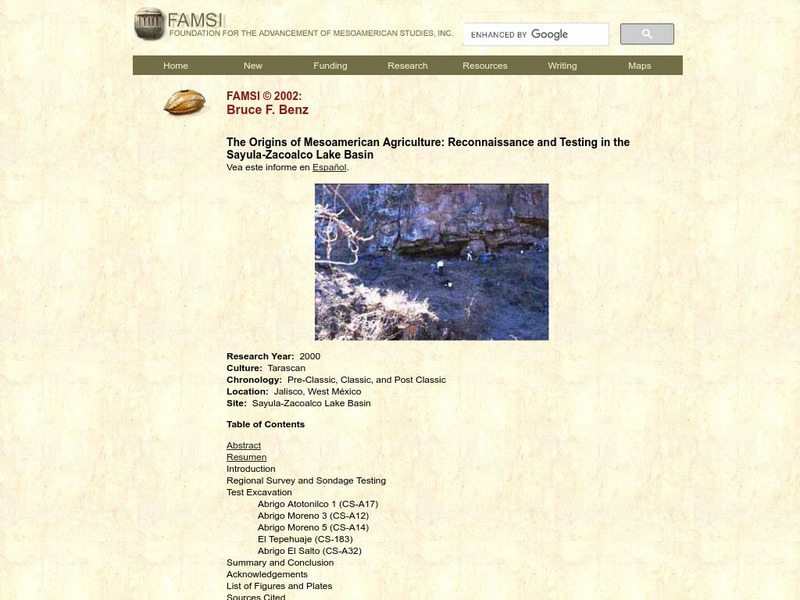
Foundation for the Advancement of Mesoamerican Studies
Famsi: Origins of Mesoamerican Agriculture (2000)
Objective of this research was to investigate the cultivation of corn and squash from Archaic period. Human selection transformed teosinte, a weed, into earliest form of maize.
Countries and Their Cultures
Countries and Their Cultures: Pende
The Pende occupy a territory that extends from the banks of the Lutshima, a tributary of the Kwilu, to the Kasai. The last colonial census (1959) indicated that there were 200,000 western Pende and another 40,000 Pende in Kasai, the...
Countries and Their Cultures
Countries and Their Cultures: Konso
The Konso are comprised of three groups living in southern Ethiopia; the Garati, the Takadi, and the Turo; that speak three very similar dialects. The Konso are intensive agriculturists, using animal and human manure and terracing to...
Countries and Their Cultures
Countries and Their Cultures: Kikuyu
The Kikuyu, a major ethnic group of Kenya, numbered about 4.4 million in 1987, accounting for about 20 percent of Kenya's population of 25 million.The Kikuyu were originally hunter-gatherers, but they gradually adopted horticultural...
Countries and Their Cultures
Countries and Their Cultures: Hausa
The Hausa constitute the largest ethnic group in West Africa. The term "Hausa" actually refers to the language and, by extension, to its native speakers, of whom there are about 25 million. Agriculture is the main economic activity....
Countries and Their Cultures
Countries and Their Cultures: Ganda
The Ganda are a group of people who live in the province of Buganda in Uganda. The Ganda are primarily an agricultural society; their staple crops are bananas and yams. Cotton was introduced as a market crop early in the twentieth...
Countries and Their Cultures
Countries and Their Cultures: Fipa
The Fipa are a Bantu-speaking people of southwestern Tanzania in East-Central Africa. The name "Fipa" appears to have been bestowed on them by nineteenth-century traders and means "people of the escarpment." It was later adopted by...
Countries and Their Cultures
Countries and Their Cultures: Dinka Kinship
"Dinka" is a term that has been used for centuries to refer to a people who speak of themselves as "Moinjaang," or "the people of the people." They live over a wide area in southern Sudan, amid the many streams and small rivers that feed...
Other
Elementary Odes: Pablo Neruda
Online text to nine of his odes. Links are provided at the top of the page for access to each ode.
Countries and Their Cultures
Countries and Their Cultures: Berbers of Morocco
"Berber" refers to any native speaker of a dialect of the Berber language, although many Arabic speakers in North Africa are also Berber by descent, even if they have lost the language. Especially in Morocco, "Imazighen" is today the...
A&E Television
History.com: 7 Foods Developed by Native Americans
These seven dietary staples were cultivated over thousands of years by Indigenous peoples of America. While Indigenous diets and foodways were deeply impacted by European settlement, Indigenous American foods also changed the world....
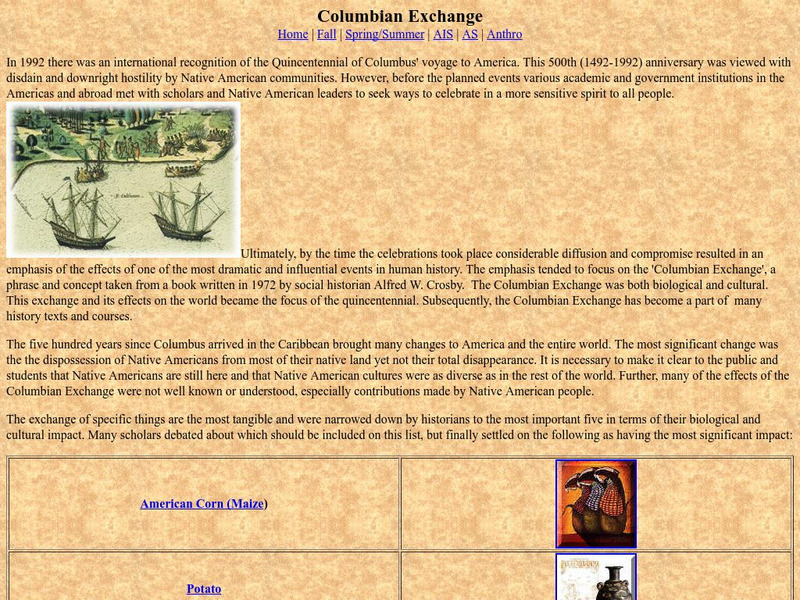
Palomar Community College District
Palomar College: Columbian Exchange
A page on the elements of the Exchange that made the most significant impact. Clicking on the item brings up a page of explanation.
Northern Arizona University
Land Use History of North America: Prehistoric Farming on the Colorado Plateau
This is an overview of the Anasazi agricultural developments -- despite unfavorable environmental conditions -- which allowed for the formation of settlements and food sharing.
Curated OER
Etc: Maps Etc: United States Economic Regions, 1900
A map from 1912 of the United States showing the principal industries of the region. The map is color-coded to show the areas of fishing grounds, industrial centers, coal mining areas, petroleum fields, and iron ore fields. This map...
Curated OER
Etc: Maps Etc: Economic Activity in North America, 1916
A map from 1916 of North America showing the economic production areas of the region. This map is color-coded to show industrial districts, productive, and non-productive regions. The map shows the principal extraction areas for coal,...
Other
Illinois State Museum: Native American Food
Experiences during the colonial years certainly were not the same for different cultural groups. This site compares and contrasts the housing, clothing, food, religion and family life of Native Americans, French settlers, and African...
Curated OER
National Park Service: Archeology Program: Late Prehistoric Period
National Park Service gives a brief description of the late Prehistoric period in Ohio, and focuses on the Fort Ancient Culture that was responsible for building the Serpent Mound.
Other popular searches
- Corn Is Maize
- Daisy Head Maize
- Dihybrid Cross in Maize
- Dr Seuss Daisy Head Maize
- Hybrid Cross in Maize
- Monohybrid Cross in Maize
- Maize Crone
- Daisy Head Maize
- Life Stricture of Maize
- Life Structure of Maize
- Mono Hybrid Cross in Maize