Hi, what do you want to do?





Independence Hall Association
U.s. History: Separate No Longer?
An explantion of how the Supreme Court decision in Brown v Board of Education of Topeka turned the concept of separate but equal on its head. See how they determined that the 14th Amendment was being violated when schools did not fund...
Then Again
Then Again: Web Chron: Plessy v. Ferguson
A short article describing the impact of Plessy v. Ferguson on the 14th Amendment. Links to other sites.

iCivics
I Civics: In Re Gault (1967)
This mini-lesson plan covers the basics of the Supreme Court's decision that said juvenile offenders have a right to due process. Students learn about 14th Amendment due process, fairness, and the specific rights afforded juveniles in...
iCivics
I Civics: Loving v. Virginia (1967)
This mini-lesson covers the basics of the Supreme Court's decision that struck down state bans on interracial marriage. Students learn about the 14th Amendment's Equal Protection Clause, and its use in court cases to challenge a range of...
iCivics
I Civics: Elk v. Wilkins (1884)
This mini-lesson examines the Supreme Court's ruling that the 14th Amendment's Citizenship Clause did not apply to American Indians born on Native reservations. Students analyze a primary document and discover how the lack of citizenship...
iCivics
I Civics: United States v. Virginia (1996)
This mini-lesson covers the basics of the Supreme Court's decision that found the Virginia Military Institute'discriminations male-only admission policy discriminated against women. Young scholars learn about the 14th Amendment's Equal...
Thomson Reuters
Find Law: u.s. Supreme Court: Escobedo v. Illinois (1964)
A detailed description of the United States Supreme Court decision on the appeal of the case Escobedo v. Illinois, which ruled on the right to have counsel under the 6th and 14th Amendments to the Constitution.
Annenberg Foundation
Annenberg Learner: Civil Rights: Demanding Equality
Teach the history of Civil Rights using this comprehensive learning module. Trace the movement from the 14th Amendment to modern times. The focus is on African American rights but also touches on women and disabled American's rights....
iCivics
I Civics: Games: Do I Have a Right?
Play this game from iCivics that requires an understanding and application of the Bill of Rights, the first ten amendments to the Constitution, and a few other amendments to argue and win cases the clients bring into the law firm. There...
National Humanities Center
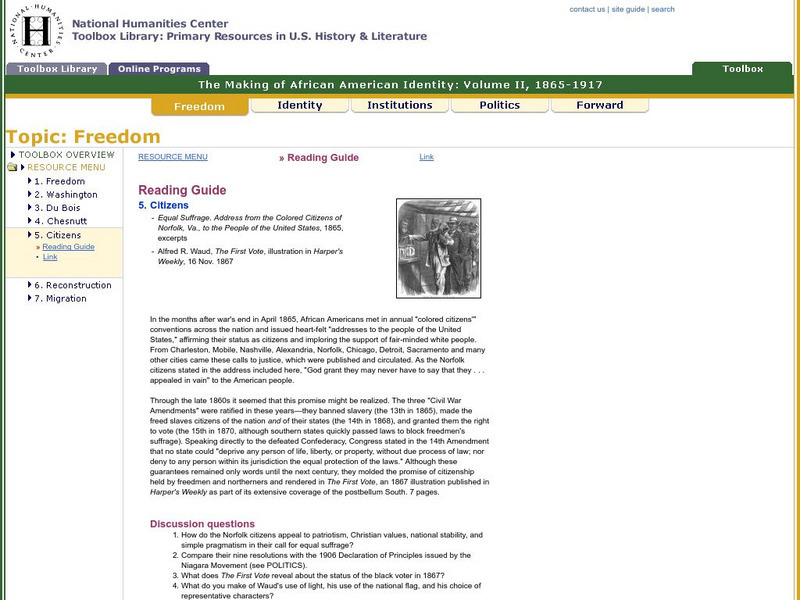
National Humanities Center: Toolbox Library: Citizens: African American Identity: 1865 1917
Discusses the efforts of African Americans to be recognized as equal citizens after the Civil War, and the 13th, 14th, and 15th Amendments. Includes links to supplemental information.

Thomson Reuters
Find Law: u.s. Supreme Court: Mapp v. Ohio (1961)
Detailed account of the Supreme Court case of Mapp v. Ohio with the ruling that states are required to exclude evidence seized by illegal search and seizure in violation of the 4th Amendment.
Texas State Library and Archives Commission
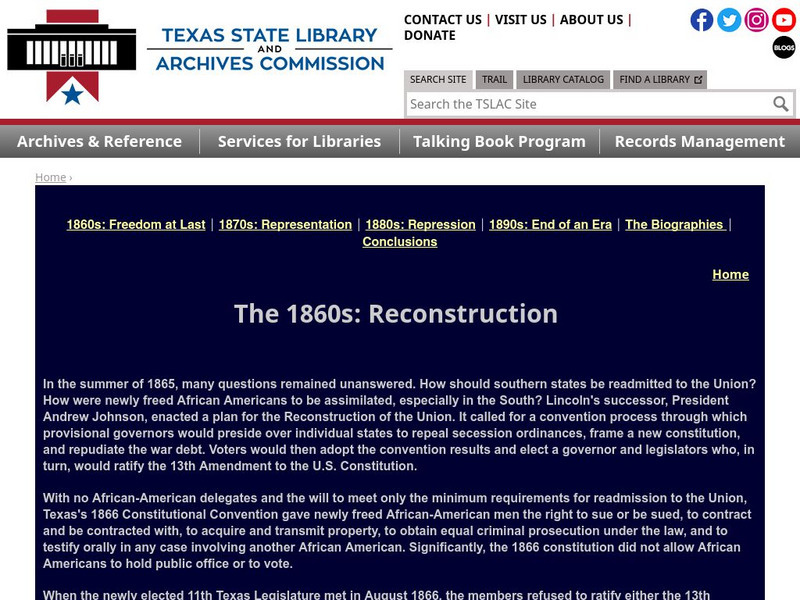
Texas State Library and Archives Commission: The 1860s: Reconstruction
Here is an article on the Reconstruction, which touches briefly on several issues that arose during this period, specifically in Texas: President Johnson's Reconstruction plan, assimilation and rights of freed slaves, the 13th and 14th...
US National Archives
Nara: Presidential Election Laws: Presidential Election Laws
Check out this site from the National Archives and Records Administration on the US Constitution and the United States Code for laws and provisions regarding presidential elections.
iCivics
I Civics: Civil War & Reconstruction
The Civil War and Reconstruction Era brought about the end of slavery and the expansion of civil rights to African Americans through the 13th, 14th, and 15th Amendments. Compare the Northern and Southern states, discover the concepts of...
iCivics
I Civics: Dred Scott v. Sandford (1857)
This mini-lesson covers the basics of the Supreme Court decision that determined that Dred Scott, having lived in a free territory, was not entitled to his freedom. Young scholars learn about the impact of the Court's decision, and how...
Immigration and Ethnic History Society
Iehs: Kevin Kenny, "Insiders & Outsiders in 19th Century American Immigration"
This article focuses on the history of who were the insiders (with rights) and the outsiders (without rights) in the early history of the US (prior to the 14th Ammendment. It was largely based on race not citizenship.
University of Missouri
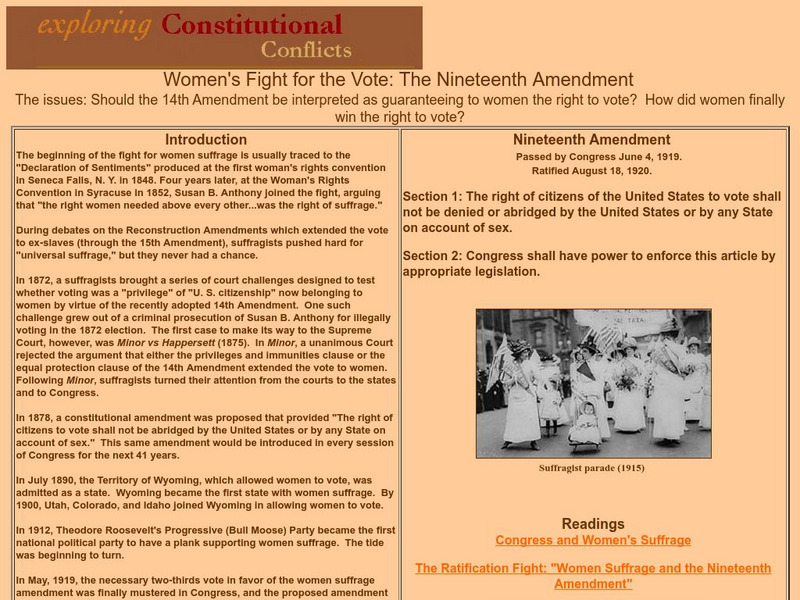
Exploring Constitutional Conflicts: Women's Fight for the Vote
Find out how women won the right to vote. Read a brief history of the women's suffrage movement and the text of the Nineteenth Amendment.
Wikimedia
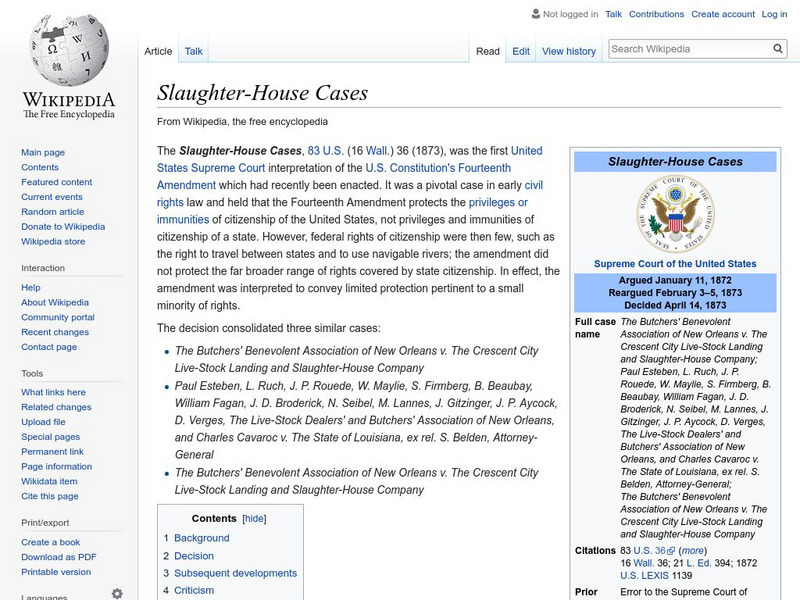
Wikipedia: The Slaughter House Cases
Learn about the historically important 1873 Slaughter-House Cases on civil rights, which became the first Supreme Court interpretation of the Fourteenth Amendment.
Other
Historical Boys' Clothing: The American Civil War: Reconstruction
Outlines the major programs of the Reconstruction period after the Civil War, and the discrimination that African Americans faced, such as from the Black Codes and the Ku Klux Klan. Also discusses the amendments made to the Constitution...
Shmoop University
Shmoop: Equal Protection
The Amendments protect our rights; but in defending one person's rights, another person may be harmed! The Fourteenth Amendment is discussed here with all the ensuing ramifications of decisions made on Affirmative Action, Women's Rights,...

US National Archives
Our Documents: A National Initiative on American History, Civics, and Service
Our Documents is home to one hundred milestone documents that influenced that course of American history and American democracy. Includes full-page scans of each document, transcriptions, background information on their significance, and...
Digital History
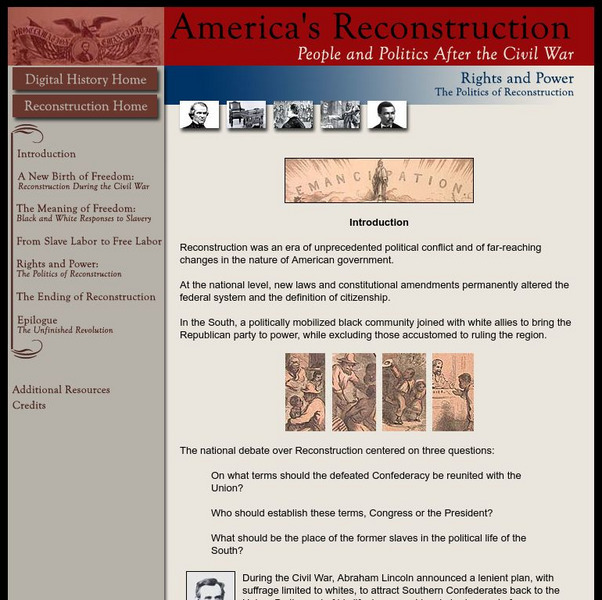
Digital History: America's Reconstruction: Rights and Power
This resource provides information about Reconstruction, the United States Government, slavery, and civil rights.
Mount Holyoke College
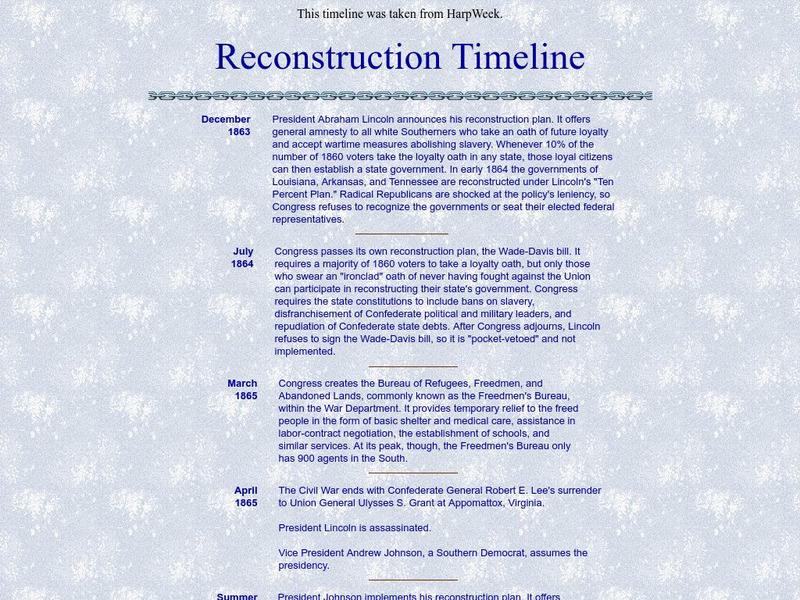
Mt. Holyoke: Reconstruction Timeline
Here's a concise timeline that highlights the important facets of reconstruction from the announcement of Abraham Lincoln's reconstruction plans to the end of reconstruction at the election of Rutherford B. Hayes.
US National Archives
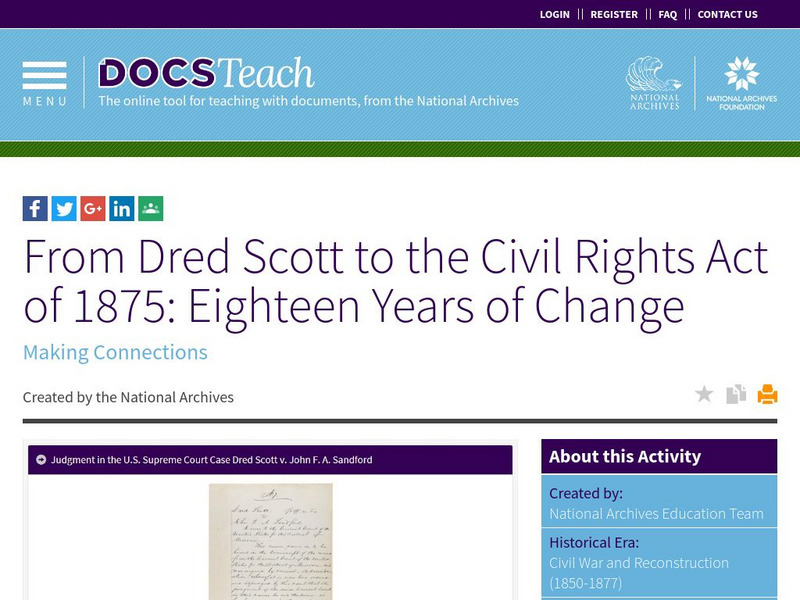
National Archives: From Dred Scott to the Civil Rights Act of 1875
The Dred Scott case decided that African Americans were not citizens of the United States. However, 18 years later they would have citizenship and many other rights. Students will examine the following documents to understand how and why...
Other popular searches
- 8th and 14th Amendments
- 13th, 14th, 15th Amendments
- Due Process 14th Amendment
- 13th 14th 15th Amendments
- 13th and 14th Amendment
- 13th, 14th 15th Amendment
- Government 14th Amendment
- 14th Amendment Court Cases
- 14th Amendment Case Study
- 13'th 14th, 15th Amendment
- 14th Amendment Images
- The 14th Amendment