Hi, what do you want to do?






Curated Video
The Appeal of Pop Music
Pop music is a popular genre that emerged in the 1950s and 60s, characterized by its catchy melodies, dance-oriented rhythms, and broad range of styles. It borrows elements from various genres, including rock, Latin, and country, and...
The Guardian
Free improvisation: still the ultimate in underground music?
Pioneered in the 1950s by musicians breaking the rules of jazz and composition, free improvisation is still as difficult – and potentially transcendent – as it ever was. A Guardian documentary takes you inside its world, talking to...


NPR
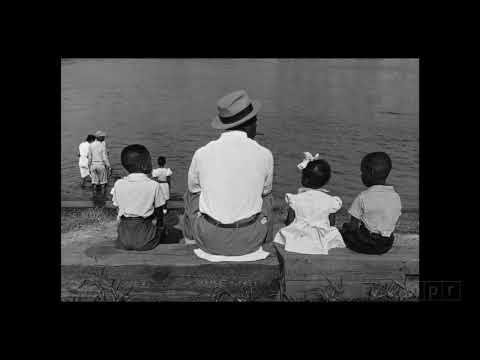
DeCarava's Photos Improvised The Music Of Life
In the 1950s, photography was hardly considered art. If you wanted to be taken seriously as a photographer, you snapped mountains and models -- not your neighbors. It also helped to be white. But Roy DeCarava, who died Oct. 27 at the age...
Odd Quartet
How Style and Instrumentation Affect Chord Progressions
Today we will look at a chord progression, but we will look at it in two different ways. First, as an 18th century piano composition. Then, as a 1950s American dance music. The trick is that we will use the same chord progression for...
Curated Video
Post-war American popular culture
Pupil outcome: I can assess the changes in American popular culture during the post-war period. Key learning points: - Televisions became widely available and popular. - A new 'teenage' identity developed in the 1940s and 1950s. - Rock...
TED-Ed
TED-Ed: What do all languages have in common? | Cameron Morin
Language is endlessly variable. Each of us can come up with an infinite number of sentences in our native language, and we're able to do so from an early age— almost as soon as we start to communicate in sentences. How is this possible?...

MinuteEarth
The Faint Young Sun Paradox!
TED-Ed
How do antidepressants work? | Neil R. Jeyasingam
In the 1950s, the discovery of two new drugs sparked what would become a multi-billion dollar market for antidepressants. Neither drug was intended to treat depression at all— many doctors and scientists believed psychotherapy was the...
TED-Ed
TED-Ed: The greatest mathematician that never lived | Pratik Aghor
When Nicolas Bourbaki applied to the American Mathematical Society in the 1950s, he was already one of the most influential mathematicians of his time. He'd published articles in international journals and his textbooks were required...
MinuteEarth
The Faint Young Sun Paradox!
This video was supported by the Heising-Simons Foundation. To learn more, visit
ef='https://www.heisingsimons.
org/' target='_blank' rel='nofollow'
>visit
Credits (and Twitter...
ef='https://www.heisingsimons.
org/' target='_blank' rel='nofollow'
>visit
Credits (and Twitter...
TED-Ed
TED-Ed: Why did the British Empire burn, sink, and hide these documents? | Audra A. Diptée
In 2009, five Kenyan people took a petition to the British Prime Minister. They claimed they endured human rights abuses in the 1950s, while Kenya was under British colonial rule, and demanded reparations. They had no documentary...
TED-Ed
TED-Ed: Whoever builds something here will be rich beyond measure | Fabio Pacucci
Since the 1950s, governments, companies, and researchers have been planting flags among the stars. But while it might seem like there's plenty of room in space, some pieces of celestial real estate are more valuable than others. As far...


Tate
Performing Sculpture – Earle Brown's Calder Piece | TateShots
Earle Brown was a major force in contemporary music and the American avant-garde since the 1950s and the creator of open form, a style of musical construction greatly indebted to the works of Alexander Calder. In 1963 Brown and Calder...
Reading Through History
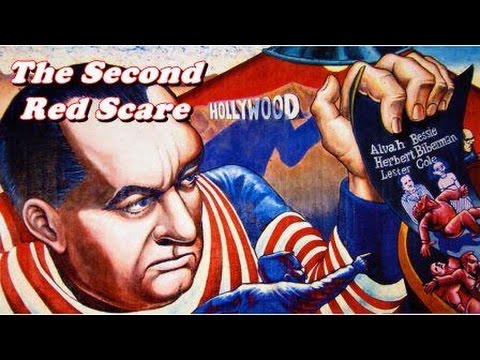
History Brief: The Second Red Scare (Part 1)


Curated Video
How Teenagers Ran the Rock 'n' Roll Era
Dancing – and dancing shows – became a teenage craze in the 1950s, spurred by figures like Cleveland DJ, Alan Freed. His hit dance show featured R&B and African American music – which he later dubbed ‘Rock and Roll.’ From the Series:...

The Royal Institution
Does This Reaction Break the Second Law of Thermodynamics?
In the 1950s, Russian chemist Boris Belousov reported a bizarre reaction. A reaction that oscillates between two states. Could it be violating the second law of thermodynamics? Andrea Sella investigates. Day 13 of our thermodynamics...

StoryCorps
The Door She Opened
#Stonewall50 #Pride2019 #StonewallOutloud “I knew I was a girl. And so that weekend, I got to be me.” DEE WESTENHAUSER AND MARTHA GONZALEZ In 2018, at the age of 63, Dee Westenhauser came out as a transgender woman. But growing up in El...

Curated Video
Indra Jaatra Festival Kathmandu, 1931
The World and Traditional Music section of the British Library holds a unique collection of South Asian material recorded by Dutch ethnomusicologist Dr Arnold Adriaan Bake (1899-1963). This collection spans not only many decades but also...
Curated Video
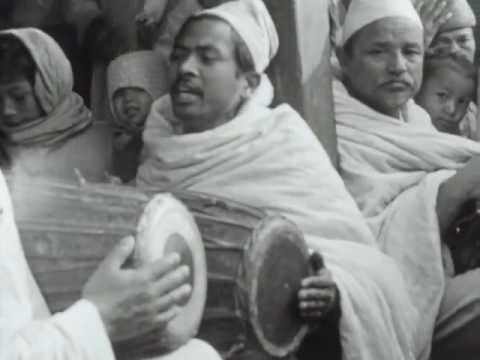
Newar musicians, Nepal 1955-56
The World and Traditional Music section of the British Library holds a unique collection of South Asian material recorded by Dutch ethnomusicologist Dr Arnold Adriaan Bake (1899-1963). This collection spans not only many decades but also...