Hi, what do you want to do?





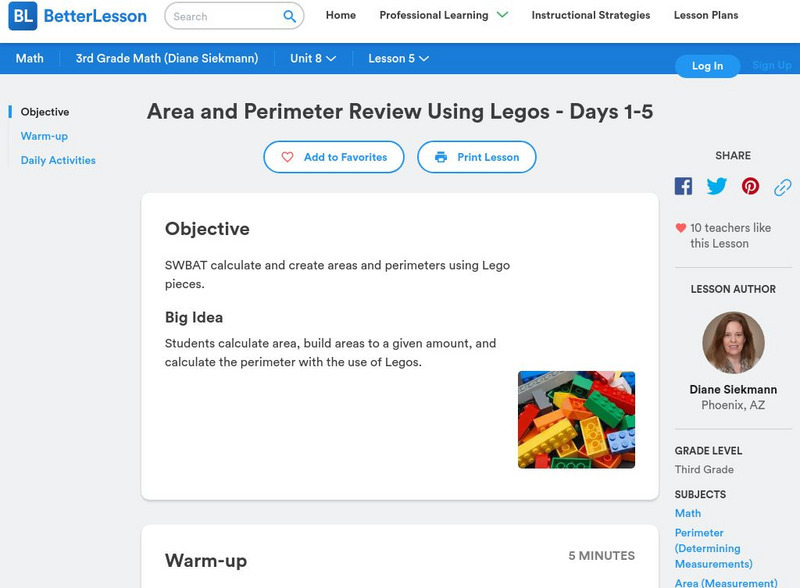
Better Lesson
Better Lesson: Area and Perimeter Review Using Legos
Lesson plan in which learners calculate area, build areas to a given amount, and calculate the perimeter with the use of Legos. Step by step instructions and videos are provided. CCSS.Math.Content.3.MD.C.7.c Use area models to represent...
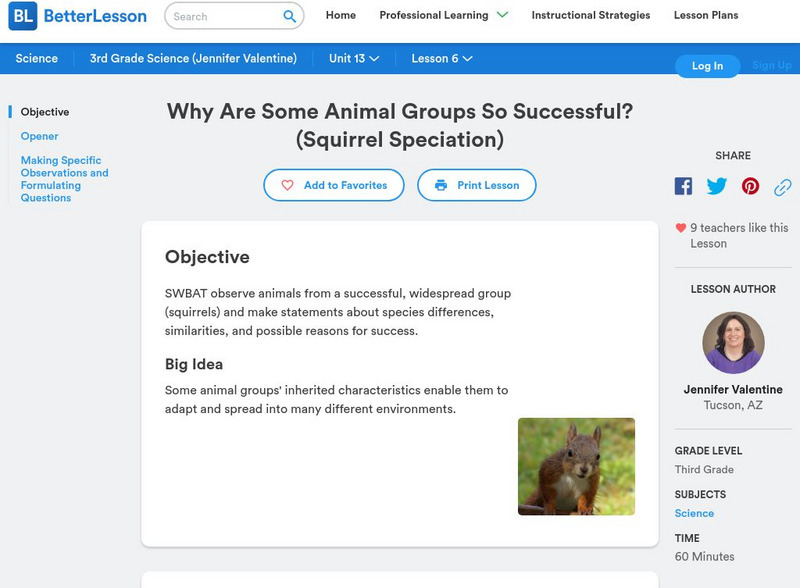
Better Lesson
Better Lesson: Why Are Some Animal Groups So Successful?
Using squirrels as an example, students will understand that some animal groups' inherited traits enable them to adapt and spread into many environments. Included in this lesson are videos showing the lesson in action, discussion...
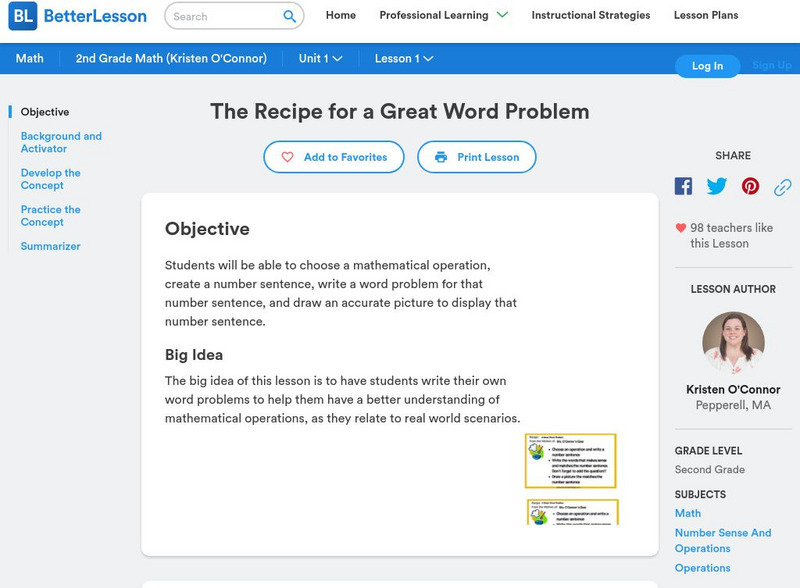
Better Lesson
Better Lesson: The Recipe for a Great Word Problem
The big idea of this instructional activity is to have students write their own word problems to help them have a better understanding of mathematical operations, as they relate to real-world scenarios. Pictures and videos of the...
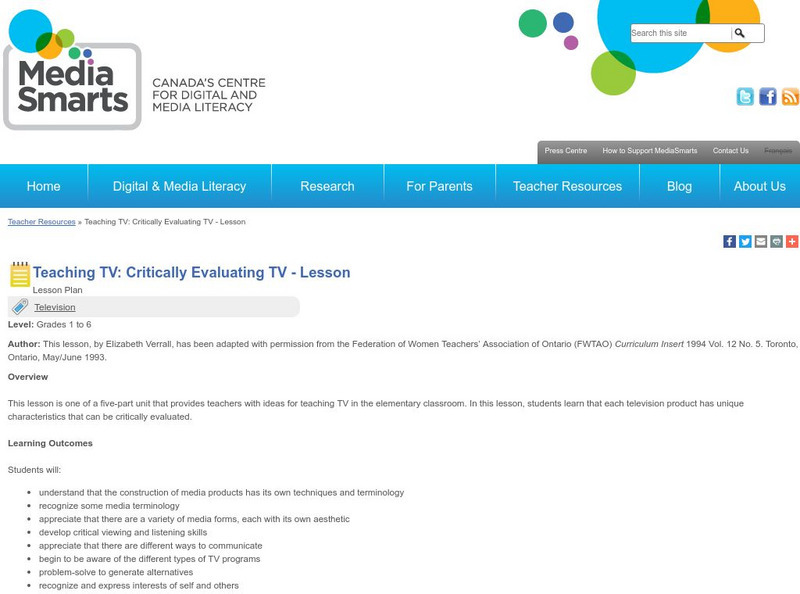
Media Smarts
Media Smarts:teaching Tv: Critically Evaluating Tv Lesson
MediaSmarts provides digital and media literacy lessons for students. In this lesson, students will learn to watch and listen to a television with a critical lense
Better Lesson
Better Lesson: Similarities and Differences Between Two Text
In this lesson, through guided practice, the learners use two texts about Martin Luther King to compare the similarities and differences between those texts. Includes videos of the lesson in action, printable charts, and a graphic...
Better Lesson
Better Lesson: Tie It Up With Transition Words to Write a Story!
Read, write, and present a digital narrative with transition words to help us put the events in order! After modeling the lesson, groups of students will write narratives to recount a short sequence of events, they will include details...
Better Lesson
Better Lesson: Who's at the Door? Use Images to Find Out!
Students will use words acquired through reading to describe images (with adjectives) that demonstrate an understanding of characters in a story. The teacher will read Miss Nelson is Back which has great descriptors and will hold a class...

Common Sense Media
Common Sense Media: Education: Lesson: Device Free Moments
[Free Registration/Login Required] In this lesson, 2nd graders learn when it's appropriate to use technology and when it's not, and practice making family rules for device-free time at home. Includes lesson plan, slideshow, student...
New York Times
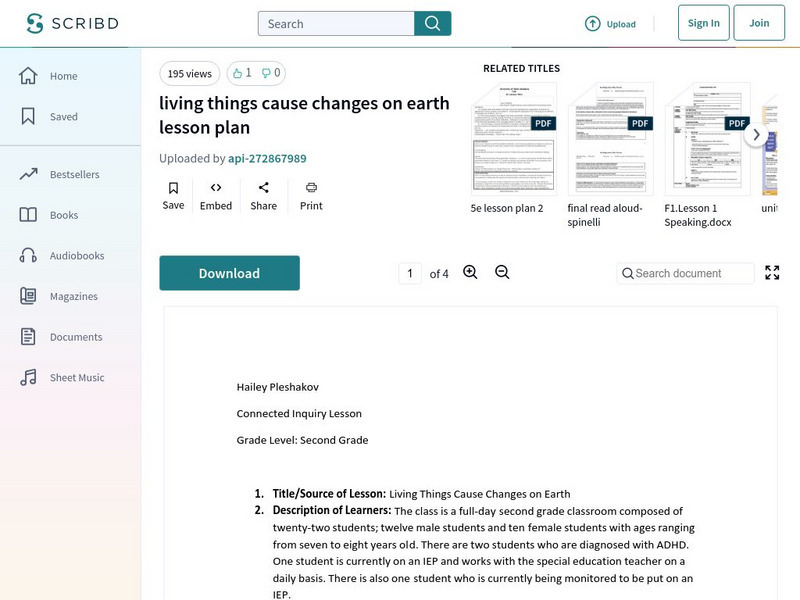
New York Times: Scribd: Living Things Cause Changes on Earth Lesson Plan
This detailed lesson plan will have the students researching why and how animals make changes to the Earth. Students will discover that animals make changes on Earth for various reasons such as shelter, protection from predators, and...
Better Lesson
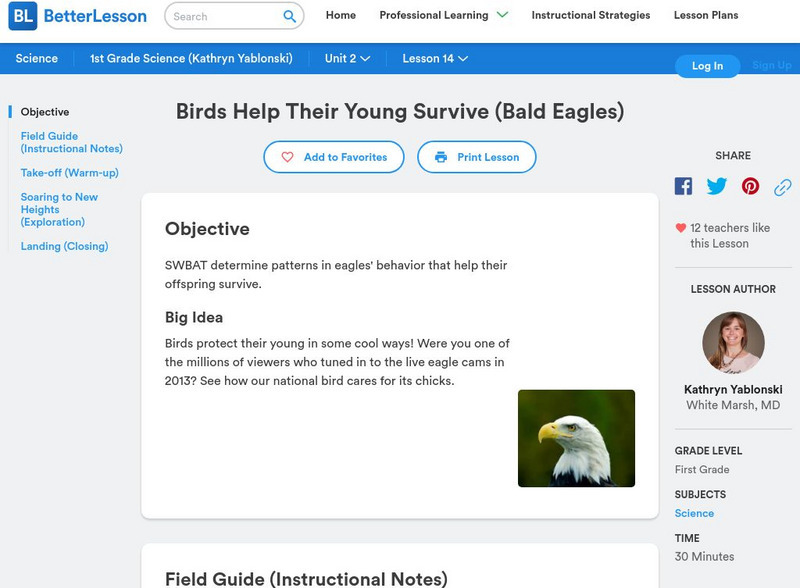
Better Lesson: Birds Help Their Young Survive (Bald Eagles)
Birds protect their young in some cool ways! See how our national bird cares for its chicks. Students will read a National Geographic article about Eagles becoming extinct, and will watch a video on Iowa Bald Eagle cameras. Students will...
Better Lesson
Better Lesson: Learning About Subheadings and Bold Words
In this lesson, young scholars will use several strategies to learn the meaning of new words they encounter in text. The students will learn specific strategies so when they encounter new words, they can figure out the meaning of those...
Better Lesson
Better Lesson: Text Feature Diagrams
At the end of this lesson, students will be able to identify and create diagrams associated with informational text. Included is a link to an eSpark video on diagrams, rules for group work, multiple examples of diagrams, and a...

Better Lesson
Better Lesson: Go Figure With Figurative Language It Helps With Predicting!
In this lesson, students will use figurative language, digital tools, and illustrations to write a story. The teacher will model how to use an app that has onomatopoeia to create a story with a good beginning, middle, and end. A video...
Committee for Children
Second Step: Grade 2: Lesson 14: Managing Anxious Feelings
This Second Step activity resource is for second grade parents. This resource accompanies Lesson 14: Managing Anxious Feelings.
Committee for Children
Second Step: Grade 2: Lesson 14: Managing Anxious Feelings
This lesson from Second Step will help students learn how to manage anxious feelings.
Love To Know Media
Your Dictionary: Adjective Lesson Plan for Kids
This article explains what adjectives do, the questions they answer, and provides examples. It also provides a list of links to websites where adjective lesson plans, worksheets, and activities can be found.
Committee for Children
Second Step: Grade 2: Lesson 12: Managing Embarrassment
This Second Step activity will help students learn how to deal with an embarrassing situation.
Committee for Children
Second Step: Grade 2: Lesson 11: Introducing Emotion Management
In this Second Step lesson, 2nd graders will begin learning about how to manage their emotions.
Better Lesson
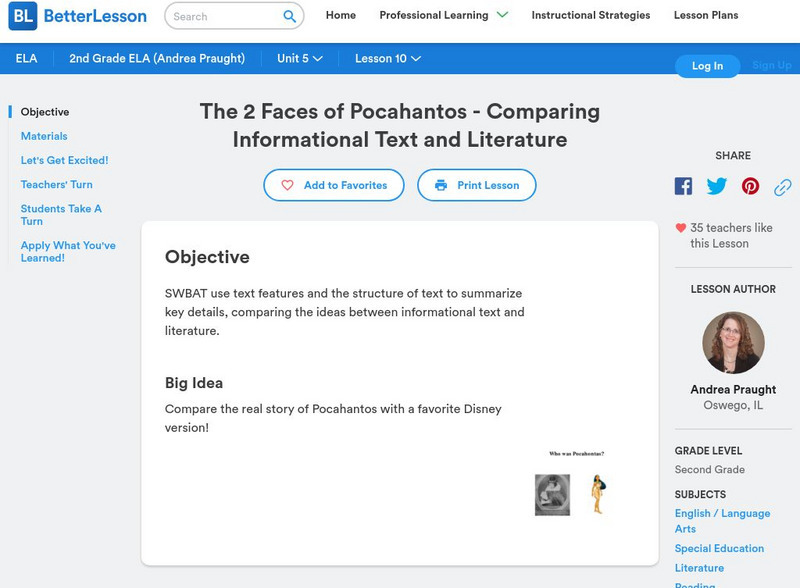
Better Lesson: The 2 Faces of Pocahontas
Teachers will engage young learners to understand how one story can be shared more than one way. This lesson demonstrates an historical interpretation of the story about Pocahontas and John Smith with the Disney movie. Several resources...
Other
Azoomee: E Safety Lesson 3: Online Bullying
This lesson teaches students how to identify online bullying and how it iffers from real-world bullying. [2:21]
Better Lesson
Better Lesson: Identifying and Writing Opinions About Clouds Using Clue Words
It is important to teach students the difference between facts and opinions. This is the groundwork for getting students to think critically when analyzing a piece of text. This lesson plan will help to lay the foundation for opinion...
Shodor Education Foundation
Shodor Interactivate: Lesson: Estimation (Elementary)
In this lesson students will practice estimation with computation, counting, length and area.

Better Lesson
Better Lesson: I Learned It Online
Preparing the new generations for college and career readiness absolutely requires us to ensure our children are competent and comfortable in the use of a variety of digital tools. Students will be learning about a topic online and...
Better Lesson
Better Lesson: Investigate Sources to Look for Answers
Students will practice locating and investigating resources to answer questions on a topic using the FINDS research process. FINDS is an acronym describing its five-step research process: Focus, Investigate, Note, Develop, and Score. A...
Other popular searches
- Esl Lessons
- Elementary Lessons
- Math Lessons
- Art Lessons
- Money Lessons
- Preschool Lessons
- 2nd Grade Lessons
- Art Lessons Primary
- Esl Lessons Grammar
- High School Lessons
- 3rd Grade Lessons
- Middle School Lessons