Hi, what do you want to do?






Better Lesson
Better Lesson: Skittle Arrays
Skittles - yum!! You will instantly have your student's attention when you teach about arrays using Skittles. This detailed activity walks you through the steps, provides worksheets for varying math levels, and includes a video of the...
Better Lesson
Better Lesson: Estimate Length in Inches
Second graders will be able to estimate the lengths of objects by mentally partitioning the lengths into inches. A video, worksheets, and a detailed lesson plan are included.

Better Lesson
Better Lesson: Where Is Water Found on Earth?
Water on Earth comes in many different forms. Students will collaborate as a team to locate forms of water on Earth. This in-depth instructional activity utilizes technology, specifically QR codes, to go on a hunt for where water is...

Better Lesson
Better Lesson: Preventing Wind Erosion
Young scholars will use the engineering process to design a windbreak to save a house from wind erosion. Included in this lesson are detailed instructions, a video of the lesson in action, a list of materials, and a printable lab sheet.
Better Lesson
Better Lesson: Comparing & Contrasting Inventors
What do inventors have that are alike? How are they different? Why do they invent? Learning about them may inspire you to invent new technology! In this instructional activity, learners will compare and contrast key details in two texts...

Better Lesson
Better Lesson: Goody Goody Gumdrop! Building Structures Are Fun!
For this lesson, the children will be building a physical model to illustrate how the shape of an object, such as triangles, helps it function. At the end, the children will test their gumdrop structures and the class will collectively...

Better Lesson
Better Lesson: Making a Landform Model
In the NGSS, one of the performance expectations is for the children to develop a model to represent the shapes and kinds of land and bodies of water in an area. In the science practices, the children also must develop and use models....
Better Lesson
Better Lesson: Quick or Slow? I've Got to Know!
Earth changes can happen quickly or slowly. The students will work in teams to stake a claim about these changes and then use texts to find evidence to prove their claims. Included in this lesson plan are video clips of the class, a list...
Better Lesson
Better Lesson: "Let Go of My Lego"
Junior scientists use their imagination to create a Lego car. This investigation allows scientists to see that they can put items together to create some new product. Videos of the lesson in action and examples of student's journal...
Better Lesson
Better Lesson: What Shapes the Land?
In this lesson plan, the teacher will read a book about different landforms. The children will learn about the features of the landforms and how they were shaped by natural forces. Then text features will be discussed. The children will...
Better Lesson
Better Lesson: And the Author Is...using Digital Tools for Writing
Empower students to recognize that they are thinkers and writers! They will collaborate on a writing piece to brainstorm, organize and publish ideas with a digital tool. This lesson plan highlights different website creations as examples...
Better Lesson
Better Lesson: Butterfly Bush Visitors
In this lesson, the children learn about how critters depend on the butterfly bush and how the butterfly bush, in turn, depends on it. Common Core writing skills are integrated as they take it to the next step, and create their own page...
Common Sense Media
Common Sense Media: Education: Lesson: Who Is in Your Online Community?
[Free Registration/Login Required] By learning the Rings of Responsibility, 2nd graders explore how the Internet connects us to people in our community and throughout the world. Help students to think critically about the different ways...
Common Sense Media
Common Sense Media: Education: Lesson: That's Private!
[Free Registration/Login Required] Staying safe online is a lot like staying safe in the real world. By helping a Digital Citizen sign up for a new app, 2nd graders learn about the kinds of information they should keep to themselves when...

CPALMS
Cpalms: The Lesson Formerly Known as "Wassssuuup"
[Free Registration/Login Required] In this activity, students are actively engaged in learning how formal and informal language are used in written and oral communications. Downloadable handouts are provided.
Other
Bscs: Forces Lesson 1: What Makes Something Start to Move?
Through hands-on activities, this lesson will show students that a force is a push or a pull and forces cause changes in motion. Included are a minute-by-minute lesson plan, activities, and teacher discussion points and questions.
Better Lesson
Better Lesson: What Is an Array?
Teach a instructional activity about repeated addition and arrays by using this very detailed lesson plan. The author walks you through the instructional activity step-by-step and even includes a video of her teaching about arrays for...
Committee for Children
Second Step: Grade 2: Lesson 11: Introducing Emotion Management
This Second Step lesson will introduce the concept of emotion management.
Love To Know Media
Your Dictionary: 2nd Grade Lesson Plans for Forming Possessives
This article focuses on teaching 2nd graders to form possessive. It provides two complete lesson plans with activities for teaching them how to form possessives.
Love To Know Media
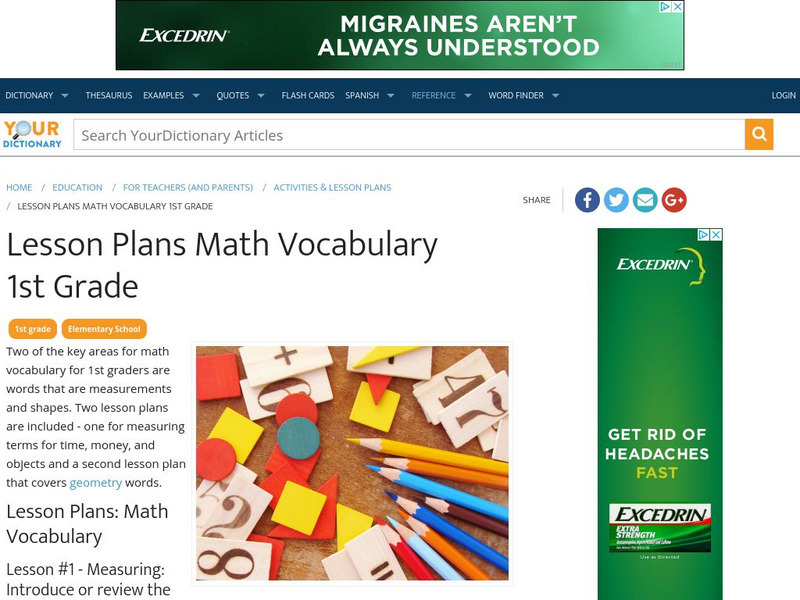
Your Dictionary: Lesson Plans Math Vocabulary 1st Grade
This site includes two first grade math vocabulary lesson plans: one for measurement terms and time and money, and another for geometry terms
Better Lesson
Better Lesson: Take It Apart, Put It Together
The purpose of this lesson plan is to reinforce the idea that things are made up of small parts that can be recombined in novel ways. It also shows that the shape of certain parts dictates their function. Students delight in taking...
Committee for Children
Second Step: Grade 2: Lesson 12: Managing Emotions
This Second Step lesson will help students to learn how to control their emotions.

Better Lesson
Better Lesson: Writing an Opinion Based on Facts From a Text
Students will plan a paragraph that states their opinion and cites evidence to justify their opinion about an informational text. This lesson uses biographies since students can easily be able to write down factual information from the...
Better Lesson
Better Lesson: Finding the Author's Purpose
What is autism? How does it affect behavior? Students will find evidence of the author's tone or purpose for writing the article, as well as hints that show evidence of opinion. Includes a video clip from the movie "Rainman", and an...
Other popular searches
- Esl Lessons
- Elementary Lessons
- Math Lessons
- Art Lessons
- Money Lessons
- Preschool Lessons
- 2nd Grade Lessons
- Art Lessons Primary
- Esl Lessons Grammar
- High School Lessons
- 3rd Grade Lessons
- Middle School Lessons