Hi, what do you want to do?





Discovery Education
Discovery Education: Science Fair Central: Choose a Project Type Inventions
Great ideas to get students started on an invention for a science fair. A list of ways students will design and engineer a solution to a problem will help students begin choosing a topic. Check out the list of general science topics,...
Ducksters
Ducksters: Kids Science Projects and Experiments: Pulse and Heartbeat
Kids learn by experimenting with science. Project about the heartbeat and pulse.
Ducksters
Ducksters: Kids Science Projects and Experiments: Skin Temperature
Kids learn by experimenting with science. Project about skin temperature.
Ducksters
Ducksters: Kids Science Projects and Experiments: Seasons Angle of the Sun
Kids learn by experimenting with science. Project showing how the angle of the sun affects our temperature.
Ducksters
Ducksters: Kids Science Projects and Experiments: Weight of Air
Kids learn by experimenting with science. Project showing how air does have weight and creates air pressure.

Science Buddies
Science Buddies: How Greasy Are Your Potato Chips?
One of America's favorite snacks is potato chips. Although potato chips are very tasty, some varieties are not very healthy for you. A typical 1-ounce (oz.) serving of a well-known national potato chip brand contains 150 calories, 90 of...
Ducksters
Ducksters: Kids Science Projects and Experiments: Sound Waves
Kids learn by experimenting with science. A project showing how sound waves move and propagate.
Discovery Education
Discovery Education: Science Fair Central: Choose a Project Type Investigation
Discover how to approach a scientific question, and learn eight steps students will perform in doing so. Offers suggestions on how to ask a testable question as well as several examples.

Science Made Simple
Science Made Simple: Why Is the Sky Blue?
This website has three different projects from which to choose on the topic of why the sky is blue. Also, you can scroll up to learn more about why the sky is blue.
Science Buddies
Science Buddies: Building Beaches
A day at the beach is a wonderful way to spend time with your family and friends. You can swim, play games, and build sand castles. But have you ever thought about how all of that sand got there and wondered why the shoreline weaves in...
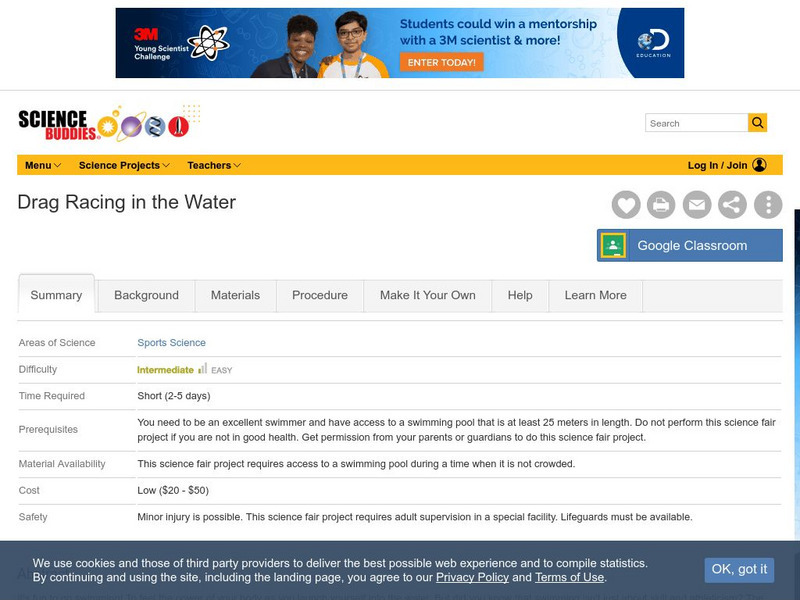
Science Buddies
Science Buddies: Drag Racing in the Water
It's fun to go swimming. To feel the power of your body as you launch yourself into the water. But did you know that swimming isn't just about skill and athleticism? The human body consists of skin, contours, and curves. How the water...

Science Buddies
Science Buddies: Put Your Water to Work: Using Hydropower to Lift a Load
Water creates a lot of energy, just look at the Grand Canyon. In this science fair project, you will demonstrate the power of water by converting the kinetic energy in moving water to mechanical energy, which will lift a small weight.
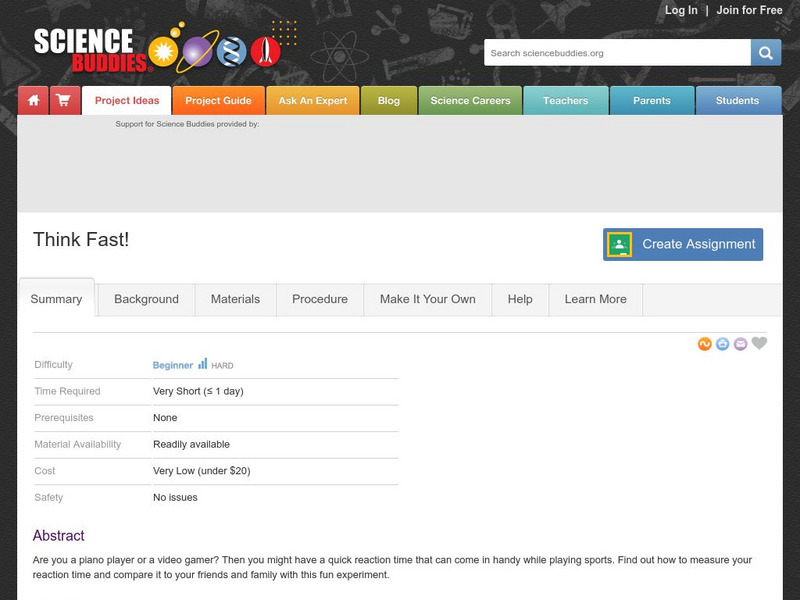
Science Buddies
Science Buddies: Think Fast!
Are you a piano player or a video gamer? Then you might have a quick reaction time that can come in handy while playing sports. Find out how to measure your reaction time and compare it to your friends and family with this fun experiment.
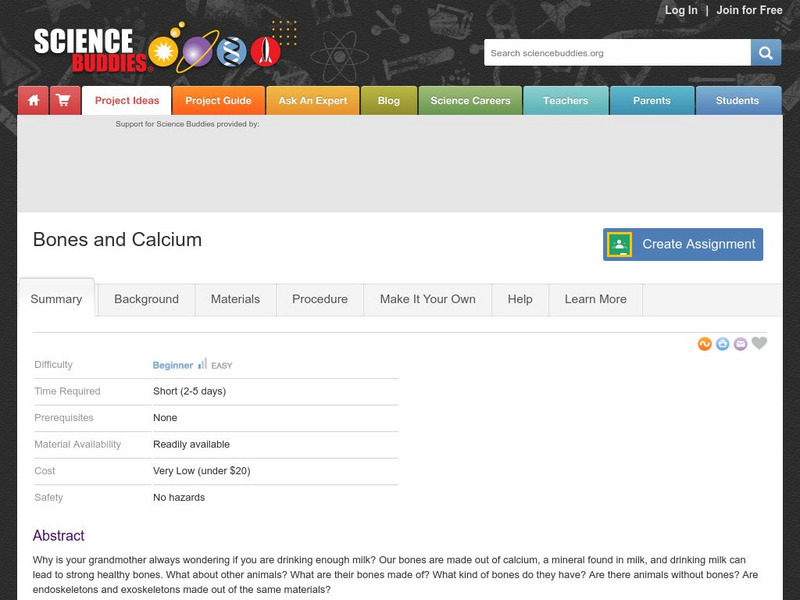
Science Buddies
Science Buddies: Bones and Calcium
Why is your grandmother always wondering if you are drinking enough milk? Our bones are made out of calcium, a mineral found in milk, and drinking milk can lead to strong healthy bones. What about other animals? What are their bones made...
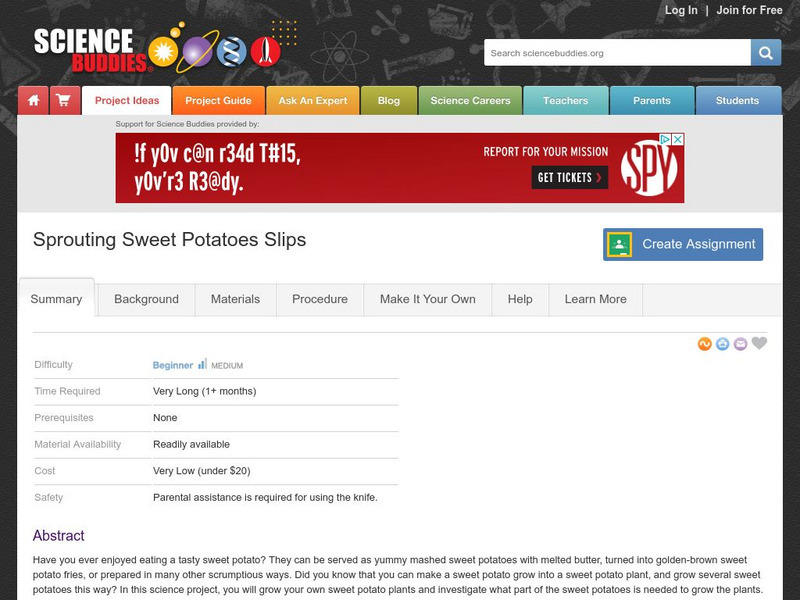
Science Buddies
Science Buddies: Do Potatoes Regulate the Formation of New Roots?
Propagate potatoes by giving it the right environment for the eyes to sprout.
Science Buddies
Science Buddies: Where Did All the Stars Go?
If you live in a big city or urban area it is hard to see many stars at night. In most urban areas only the most brilliant stars, planets and the moon can be seen. This is because of something called light pollution which is the...

Center for Innovation in Engineering and Science Education, Stevens Institute of Technology
Ciese Collaborative Projects: Bucket Buddies: Environmental Study
Bucket Buddies is an opportunity for students to participate in a world-wide environmental study. By identifying organisms in pond water, participating classes can compare their findings, and look for relationships in data. In addition...
American Museum of Natural History
American Museum of Natural History: O Logy: Stuff to Do: Buried Bones
A how-to science project with instructions to make a complete dinosaur bone dig site burying chicken bones in plaster of Paris. Click on the starred words to learn more about the topic.

PBS
Pbs Kids: Colored Water Convection
This PBS site allows users to learn more about water convection as they discover how to demonstrate the way convection currents form. A fun science project!

NASA
Nasa Space Place: Do a Science Fair Project!
Your science fair project may do one of three things: test an idea (hypothesis), answer a question, and/or show how nature works. Learn the steps involved in a project and get some great topic ideas.
Science Fun for Everyone
Science Fun: Massive Expanding Soap
Science activity shows what happens when a bar of soap is heated. Links to video of the experiment.
American Geosciences Institute
American Geosciences Institute: Earth Science Week: Places on the Planet: Latitude and Longitude
Students learn how citizen scientists involved in the Geological Society of America's EarthCaching project use GPS technology and latitude and longitude coordinates to find special places on the Earth.
Science Made Simple
Science Made Simple: How Do Animals Spend the Winter?
Use this site to learn how animals use hibernation, adaptation, and migration to overcome the difficulties of winter.

Alabama Learning Exchange
Alex: What's Your Guess? (Probability)
This lesson will allow the student to experience a series of informal comparisons, The student will explore the chances of various outcomes of an event. The student will use vocabulary associated with probability.This lesson plan was...
Other popular searches
- 4th Grade Science Project
- Physical Science Projects
- Science Project on Pulleys
- Science Project Volcano
- Science Project Gravity
- Science Project Ideas
- Forensic Science Project
- Science Fair Project Ideas
- Rock Science Project
- Science Project Food
- Science Project Terrarium
- Science Fair Project Data