Hi, what do you want to do?






National Geographic
Animal Habitats
Explore animal habitats and reinforce speaking, listening, reading comprehension, and writing skills with a unit that focuses on the Arctic, desert, ocean, prairie, and rainforest. Enthusiastic scientists read informational text to...

Core Knowledge Foundation
Animals and Habitats Tell It Again!™ Read-Aloud Anthology
A read-aloud anthology explores various habitats and the animals that inhabit them, from the Artic to the desert, the forest, and bodies of water. First graders listen to and discuss texts and complete word work. Each lesson offers...

Curated OER
Where in the Latitude Are You? A Longitude Here.
Students distinguish between latitude and longitude on the map. In this mapping lesson, students participate in mapping skills to recognize spatial relationships, and where to find natural resources on the map. Students create...

Curated OER
Yo-ho, Yo-ho a Viking's Life for Me
Students complete a unit of lessons on the Vikings. They analyze maps, read and discuss myths, summarize the main ideas from resource materials, watch videos, sing a song, draw a picture to illustrate Norse mythology, and define key...

Curated OER
We've got the whole world in our hands
Students explore spatial sense in regards to maps about the globe. In this maps lesson plan, students label oceans, locate the continents and poles, follow directions, and explain the symbols on a map.

Curated OER
Traveling Through North America
Students identify places and landmarks in North America, specifically Canada and the United States, by using and constructing maps. Six lessons on one page; includes test.

Curated OER
Getting to Know My World
Students participate in hands-on activities using maps and globes to identify geographical features. Students use map legends to identify direction. Students locate oceans, continents, countries, states and cities. Handouts and...

Curated OER
Spatial Connections
Students use maps, scales, and describe locations in order to learn about spatial sense. In this spatial sense lesson plan, students participate in many activities for this spatial sense unit that should last throughout the year.

Curated OER
Geography of the United States
Students examine the population growth of the United States. In this Geography lesson, students construct a map of the fifty states. Students create a graph of the population of the USA.

Curated OER
Regions of South America
Students explore facts about South America in the four lessons of this unit. Booklets are created from the materials produced as the class delves into the topic.

Curated OER
Landforms All Around
Students create a "Landform Dictionary". They develop an overlay map and participate in hands-on activities to identify the key characteristics of landforms. They discuss the plant and animal life of these areas. Handouts for the lessons...

Curated OER
Exploring Habitats
Students analyze the difference between the human habitat and the different habitats of animals in the six lessons of this unit. The students' imaginations and literature are used to explore important aspects of the living environments...

The Wild Classroom
The Wild Classroom: Biomes of the World: Arctic Tundra Biome
Learn all about the Arctic Tundra Biome. This site discusses where it is found, temperatures, precipitation, soil, plants and animals. It also has a few videos to view.
TED Talks
Ted: Ted Ed: Why the Arctic Is Climate Change's Canary in the Coal Mine
William Chapman explains why scientists often describe the Arctic as the "canary in the coal mine" when it comes to climate change. [3:59]
TED Talks
Ted: Ted Ed: The Arctic vs. the Antarctic
Camille Seaman describes how enterprising people and organisms have found ways to reside around both poles despite the frigid temperatures. [4:24]
University of Wisconsin
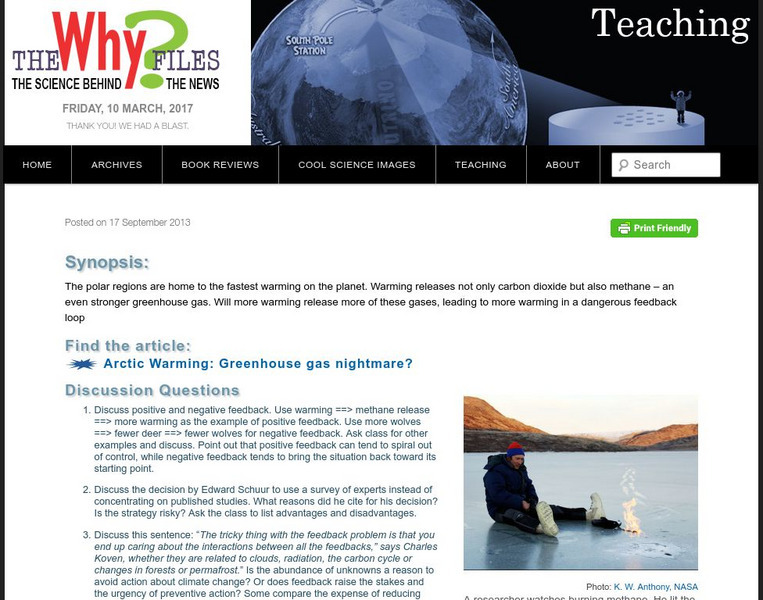
The Why Files: Arctic Warming and Greenhouse Gasses
Explore how the warming of the Earth's polar regions may lead to releasing greenhouse gasses.
E-learning for Kids
E Learning for Kids: Science: Arctic Ocean: Finland: What Is Matter?
A module to learn about matter including the exploration of mass and volume.
E-learning for Kids
E Learning for Kids: Science: Arctic Ocean: What Are Conductors and Insulators?
Visit Vlad and learn about the properties of conductors and insulators, and what materials are used for them.
E-learning for Kids
E Learning for Kids: Science: Arctic Ocean: How Can We Change Materials?
Join Jacob on the Nova Zembla Expedition, and help him use suitable materials for building his house.
Scholastic
Scholastic: Instructor: Journey to the North Pole
Journey to the North Pole in which students and teachers can use this Cyber Hunt to locate new information about this arctic region.

E-learning for Kids
E Learning for Kids: Science: Iceland: What Are Adaptations?
Join Ike when he travels in the Arctic to learn about how animals adapt to cold environments.

US Navy
The Navy Travels to the Poles
Learn about the exploration of the polar regions by the U.S. Navy. Links to various activities are found on the site.
Tramline
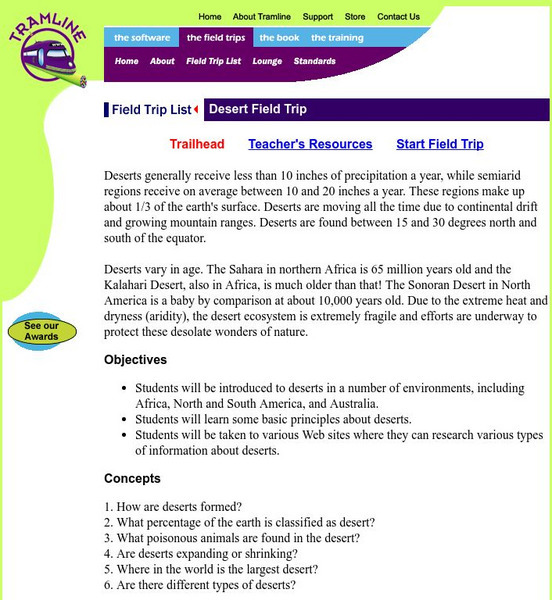
A Desert Virtual Field Trip
Travel with your students on a virtual field trip and explore the deserts of the world! This is site is interactive and informative.
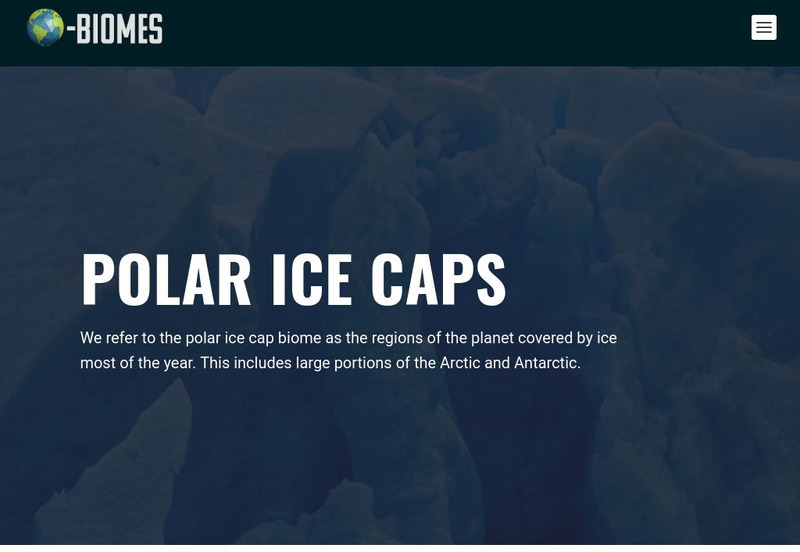
The Wild Classroom
The Wild Classroom: Biomes of the World: Polar Ice Caps Biome
Learn about the polar ice cap ecosystem. Find out about plants, animals, adaptations, and conservation efforts.
Other popular searches
- Arctic Animals
- Arctic Food Chain
- Arctic Ocean
- Arctic Ocean Diorama
- Preschool Arctic Animals
- Arctic Plants and Animals
- Arctic Region
- Arctic Circle
- Arctic Hare
- Arctic Peoples
- Arctic Predators
- Global Climate Change Arctic