Hi, what do you want to do?






Curated OER
Science Italian Style: Eruption!
Students explore ways scientists prepare for a volcanic eruption. They observe films of earthquakes, oil spills, volcanoes and hurricanes. Students perform activities to demonstrate the relationship of viscosity to lava flow. They...

Curated OER
Frozen Film
Students discover how light reflects off surfaces. In this hands-on demonstration, students examine how variations in color are produced by light interference.

Curated OER
Snowfall
Students examine the differences between snow and rain. In this precipitation instructional activity, students measure one inch of rain and snow to calculate the amount of liquid water. Students use a snowfall "conversion" chart to...

Curated OER
The Water Cycle Game
Students study the path and forms of water through Earth. In this water cycle lesson, students role-play water as it moves throughout the Earth. Students play the water cycle game and complete various stations to learn about water forms...

Curated OER
Water, Water Everywhere
Students explore water. In this water cycle lesson, students conduct a scientific investigation that requires build a terrarium models of the earth. Students record their observations of the changes regarding water in the terrarium.

Curated OER
The Water Cycle
Students explore the water cycle. In this water cycle lesson, students experiment with a variety of activities to discover what happens during the water cycle. Students create their own animated versions of the water cycle...

Curated OER
Drifting Continents, Dynamic Results
High schoolers plot earthquake and volcano data using a Compass Rose Plotting. They explain the relationship between plate movement and connection. They draw conclusions that earthquakes and volcanoes occur in predictable locations.

Curated OER
The Biological Carbon Cycle
Students learn about the biological carbon cycle. In this carbon cycle lesson, students access the web site and mouse over the diagrams to follow the carbon cycle. They read about what happens to humans and plants during this cycle.

Curated OER
Clouds as Art: Torn Paper Landscape
Students create a torn paper landscape and use it to study clouds. In this cloud study and art lesson, students make a background art image from torn paper. Students create a torn paper landscape and use cotton balls to illustrate...

Curated OER
LIFE IN SPACE Human Body: An Un-Earthly Home
Students examine an effect of zero gravity on the human body using a baby food jar, balloons and a jar with a large mouth.

Curated OER
Frozen Film
Students are introduced to the topic of light interference through this hands-on activity. They observe how light reflects off two surfaces and then meets to form an interesting variation of color on a film surface.

Curated OER
Up, Up, and Away
Students create a model to explore the water cycle. Students also perform different experiments to witness water changing from a liquid to a gas. Students are asked to if they can find ways for water to go away without pouring the...

Curated OER
It's Okay to Exhale: Photosynthesis and Cellular Respiration
Students will observe the differences between photosynthesis and cellular respiration. Then they observe the links due to climate changes and relate how climate change affects their lives.

Curated OER
Doing Science: Computer Models
In this computer models worksheet, students read information about how scientists use computer models to advance the work of science. Students also answer a critical thinking question comparing computer simulations to direct observations.

Curated OER
Wind
Students complete activities to study wind intensity. In this wind study lesson, students discuss wind speed and direction. Students then build a kite and windsock to help them study wind intensity. Students learn to use a wind meter for...
CK-12 Foundation
Ck 12: Earth Science: Effect of Atmospheric Circulation on Climate
[Free Registration/Login may be required to access all resource tools.] Looks at how atmospheric circulation cells affect the climate of regions.
CK-12 Foundation
Ck 12: Earth Science: Effect of Atmospheric Circulation on Climate
[Free Registration/Login may be required to access all resource tools.] How atmospheric circulation cells affect the climate of regions.

University Corporation for Atmospheric Research
Ucar: A Global Look at Moving Air: Atmospheric Circulation
Even with disruptions like weather fronts and storms, there is a consistent pattern to how air moves around our planet's atmosphere. This pattern, called atmospheric circulation, is caused because the Sun heats the Earth more at the...
Massachusetts Institute of Technology
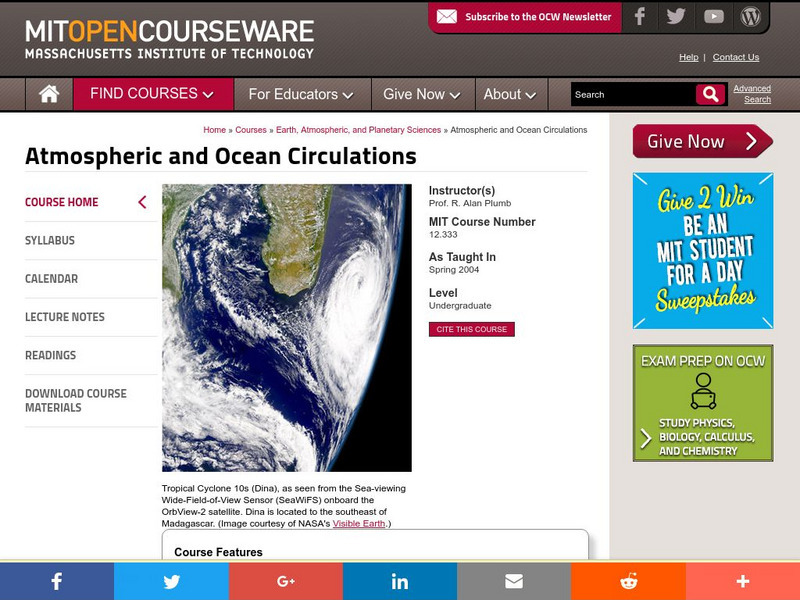
Mit: Open Course Ware: Atmospheric and Ocean Circulations
This course outline offers resources focused on the circulation of the atmosphere and ocean.
Columbia University
The Climate System: Atmospheric Forces, Balances, and Weather Systems
The large scale horizontal flow of air in the atmosphere is driven by the imbalance of net radiation over the globe. This resource introduces us to the physical laws governing the horizontal motion of air. It also describes types of...
Simon Fraser University
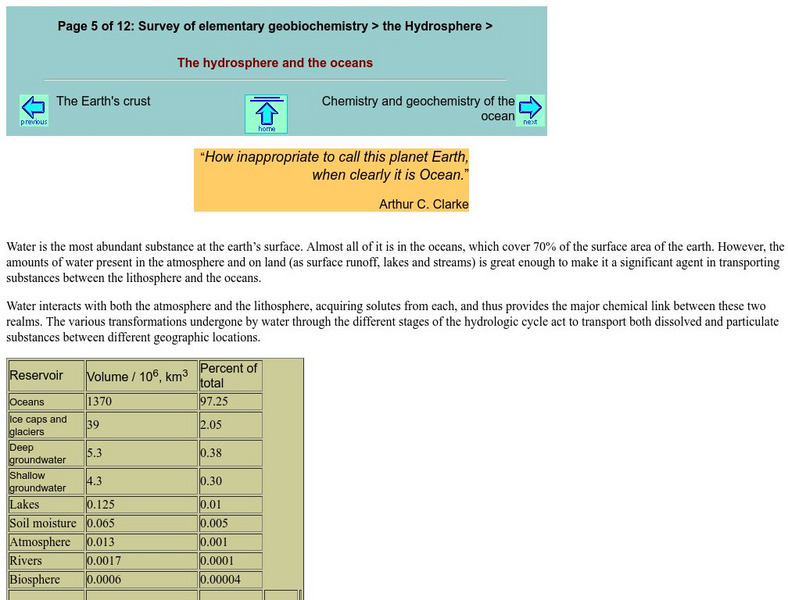
Chem1 Virtual Textbook: The Hydrosphere and the Oceans
As part of the General Chemistry Virtual Textbook, this site examines a variety of topics related to the hydrosphere and the oceans. Topics covered include where the water came from, the hydrologic cycle, Oceanic circulation, atmospheric...
PBS
Pbs Learning Media: Earth System: El Nino's Influence on Hurricane Formation
This video segment adapted from NASA's Goddard Space Flight Center explains how and where hurricanes develop. Learn how El Nino events alter the course of atmospheric circulation. Includes background reading material and discussion...
Geography 4 kids
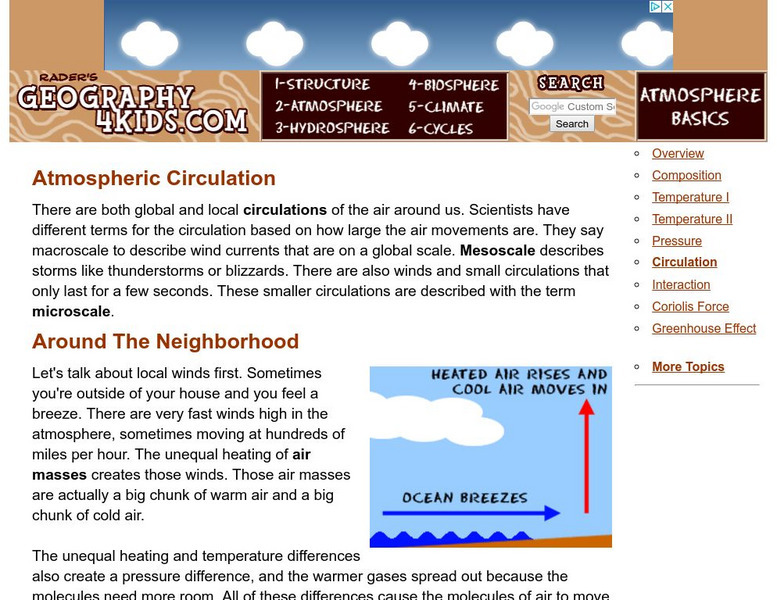
Geography4 kids.com: Atmospheric Circulation
Check out how air circulates around us. Understand the differences between mesoscale and microscale.
CK-12 Foundation
Ck 12: Earth Science: Circulation in the Atmosphere Study Guide
This comprehensive study guide covers the main terms and concepts needed for an earth science unit on circulation in the atmosphere. Review questions are included at the bottom of the study guide.