Hi, what do you want to do?





TeachEngineering
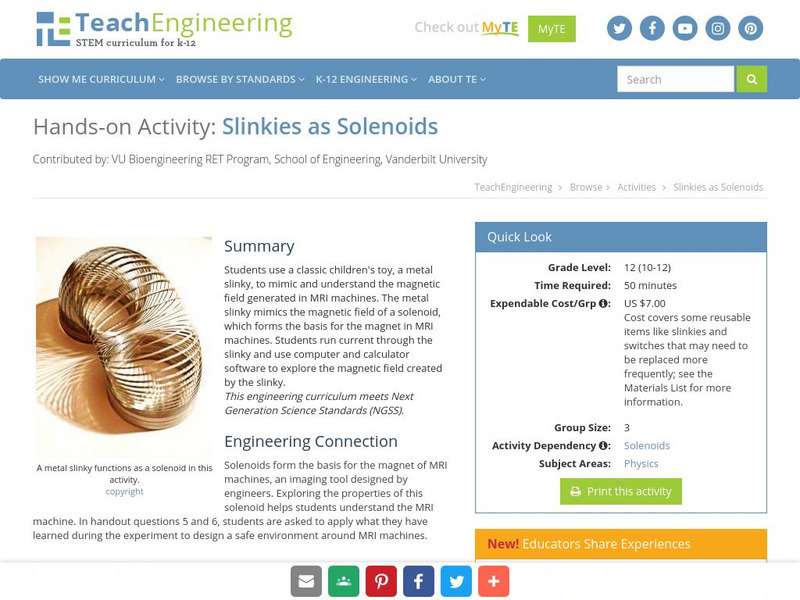
Teach Engineering: Slinkies as Solenoids
In this activity, students use an old fashion children's toy, a metal slinky, to mimic and understand the magnetic field generated in an MRI machine. The metal slinky mimics the magnetic field of a solenoid, which forms the basis for the...

Khan Academy
Khan Academy: Bonus Points
After completing the electrical engineering project called Ant Bot, improve your machine and share your ideas with others.

Khan Academy
Khan Academy: Bonus Points
Take part in some challenges after completing electrical engineering project, ant bot. SHare your ideas, and see how others have improved thier bots.
Other
Martindale's Reference Desk: Calculators on Line Center
Marindale's Reference Desk offers a comprehensive guide and listing to science and math calculators. Select from mathematics, statistics, science, chemistry, physics, astrophysics, astronomy, engineering, and computer engineering...
University of Houston
University of Houston: Engines of Our Ingenuity: No. 1319: Differential Analyzer
Read about the work of Vannevar Bush, who invented the differential analyzer, an analog computer. This is a transcript of a radio broadcast.
TeachEngineering
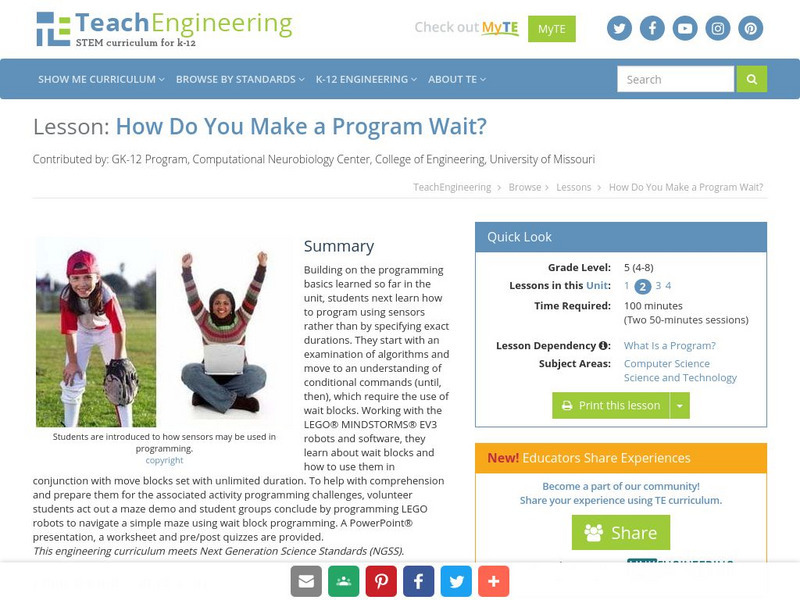
Teach Engineering: How Do You Make a Program Wait?
Building on the programming basics learned so far in a corresponding Robotics unit, students learn how to program using sensors rather than by specifying exact durations. Working with the LEGO MINDSTORMS NXT robots and software, they...
TeachEngineering
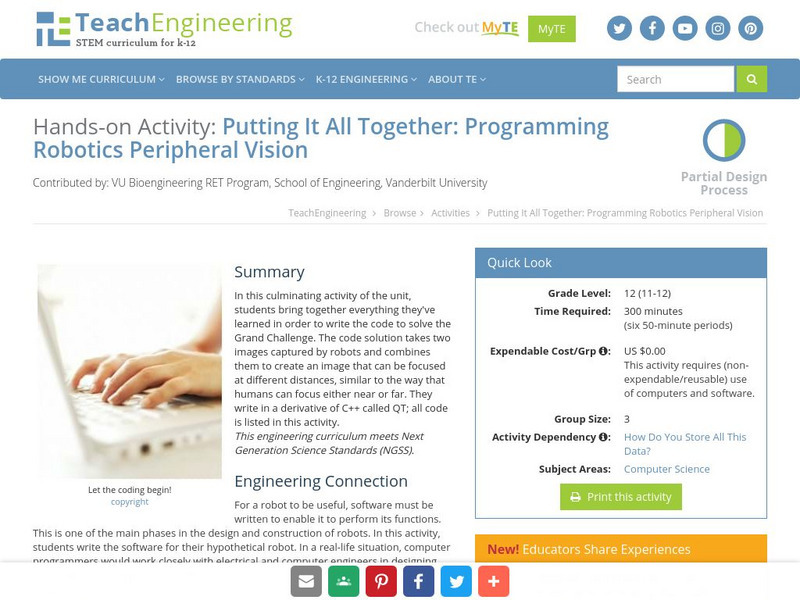
Teach Engineering: Putting It All Together: Peripheral Vision
In this culminating activity of the unit, students bring together everything they've learned in order to write the code to solve the Grand Challenge. The code solution takes two images captured by robots and combines them to create an...
TeachEngineering
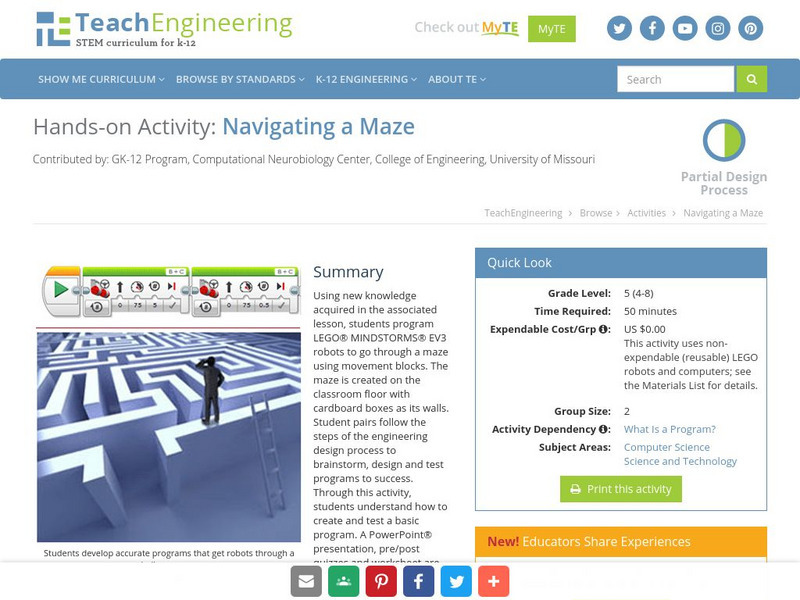
Teach Engineering: Navigating a Maze
Students program LEGO MINDSTORMS NXT robots to go through a maze using movement blocks.
TeachEngineering
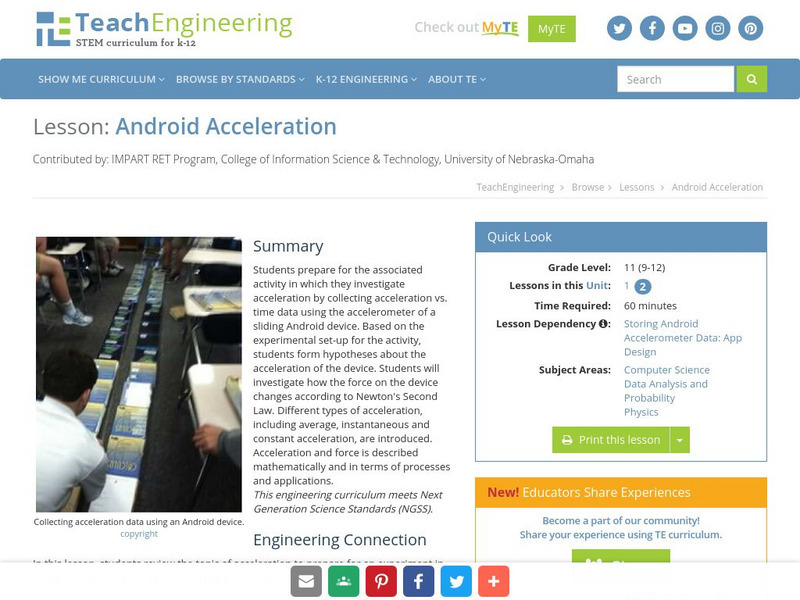
Teach Engineering: Android Acceleration
Students prepare for the associated activity in which they investigate acceleration by collecting acceleration vs. time data using the accelerometer of a sliding Android device. Based on the experimental set-up for the activity, students...
TeachEngineering
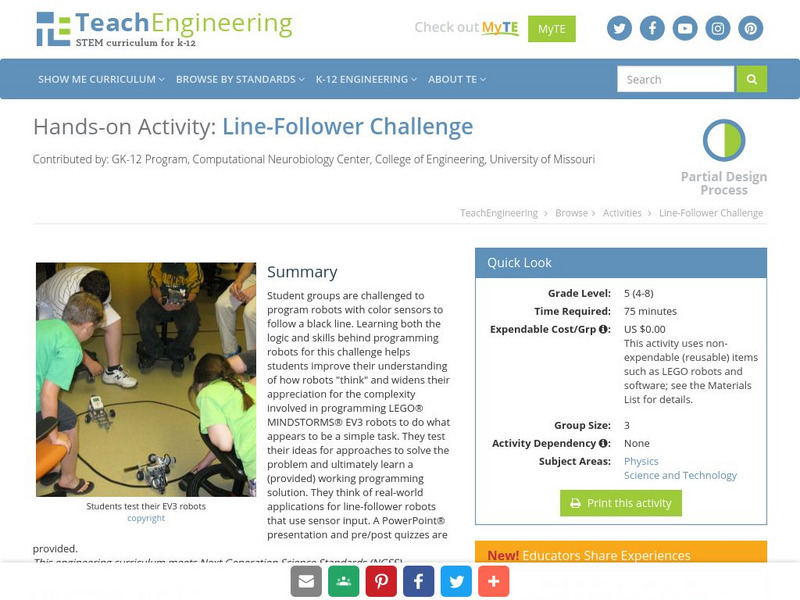
Teach Engineering: Line Follower Challenge
Student groups are challenged to program robots with light sensors to follow a black line. Learning both the logic and skills behind programming robots for this challenge helps students improve their understanding of how robots work, and...
TeachEngineering
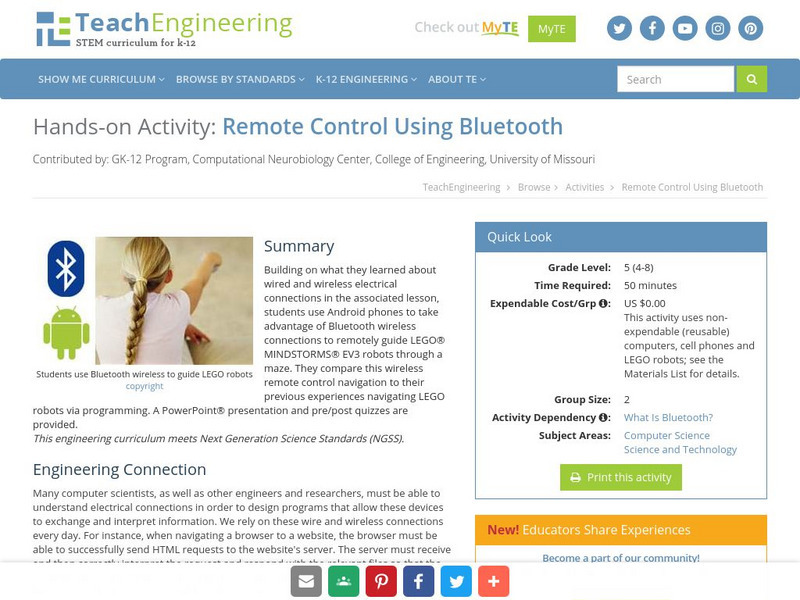
Teach Engineering: Remote Control Using Bluetooth
Building on what they learned about wired and wireless electrical connections in the associated lesson, students use Android phones to take advantage of Bluetooth wireless connections to remotely guide LEGO MINDSTORMS NXT robots through...
TeachEngineering
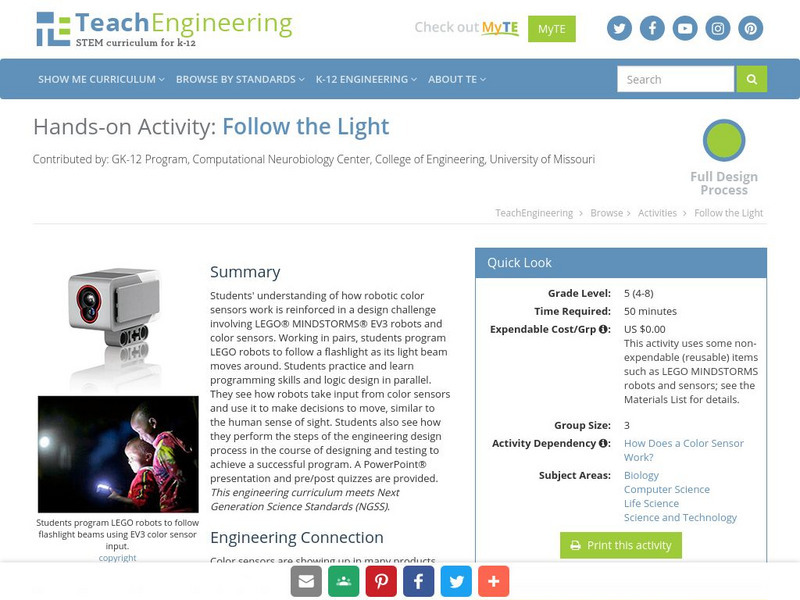
Teach Engineering: Follow the Light
A lesson involving LEGO MINDSTORMS NXT robots and light sensors, student pairs program the robots to follow a flashlight as its light beam moves around.
TeachEngineering
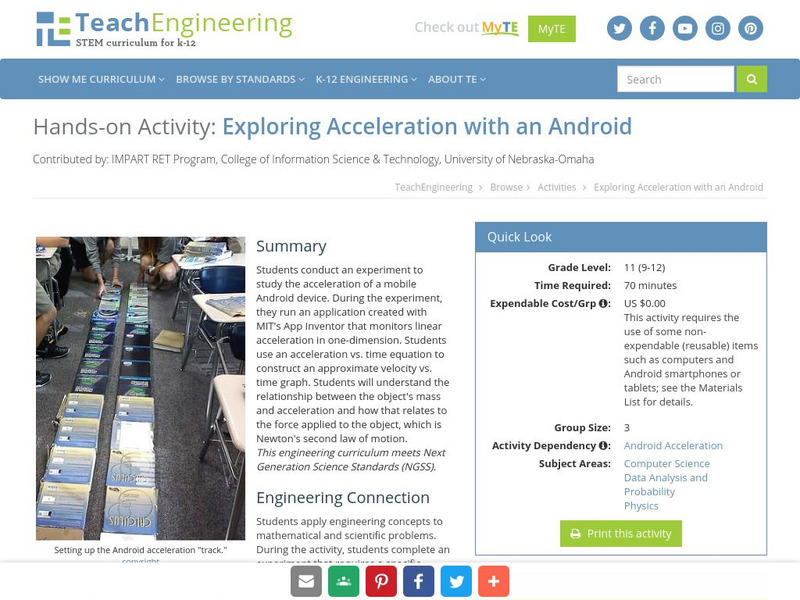
Teach Engineering: Exploring Acceleration With an Android
Students conduct an experiment to study the acceleration of a mobile Android device. During the experiment, they run an application created with MIT's App Inventor that monitors linear acceleration in one-dimension. Students use an...
TeachEngineering
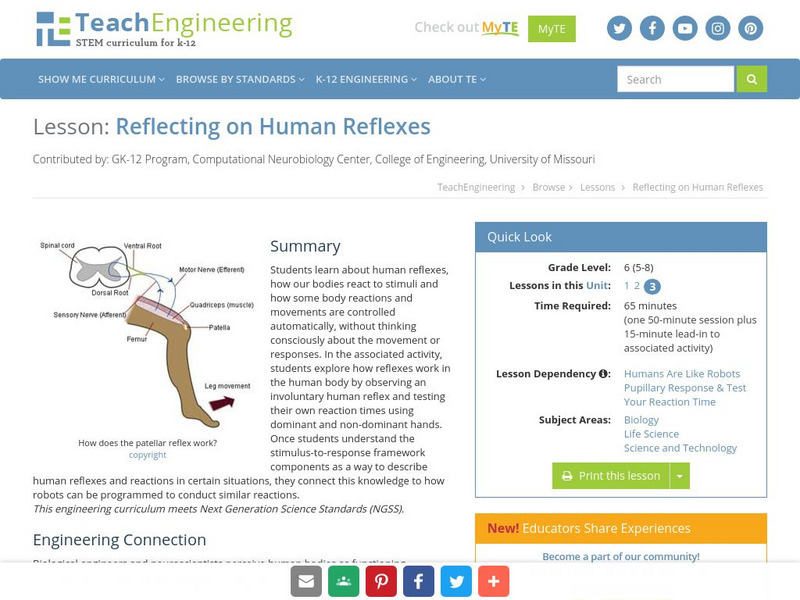
Teach Engineering: Reflecting on Human Reflexes
Students learn about human reflexes, how our bodies react to stimuli and how some body reactions and movements are controlled automatically, without thinking consciously about the movement or responses. In the associated activity,...
TeachEngineering
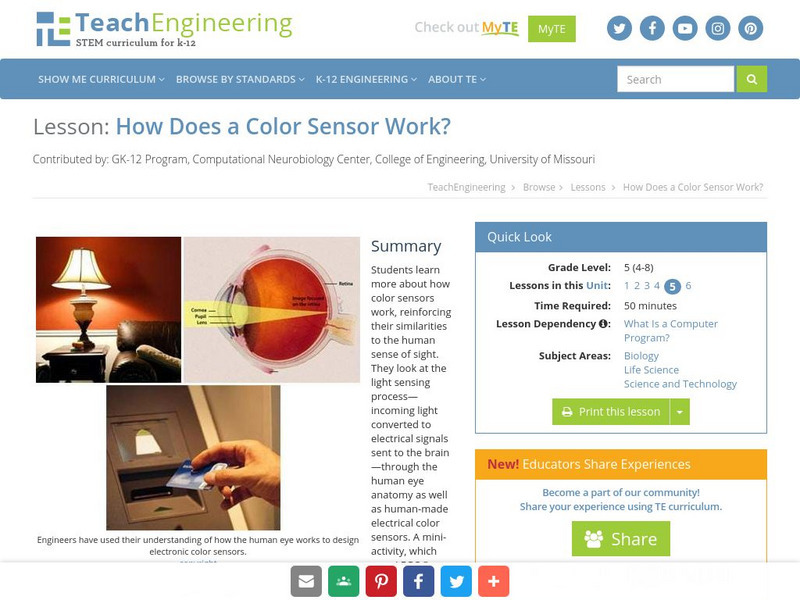
Teach Engineering: How Does a Light Sensor Work?
A mini-activity, which uses LEGO MINDSTORMS NXT intelligent bricks and light sensors gives students a chance to investigate how light sensors function in preparation for the associated activity involving the light sensors and taskbots.
TeachEngineering
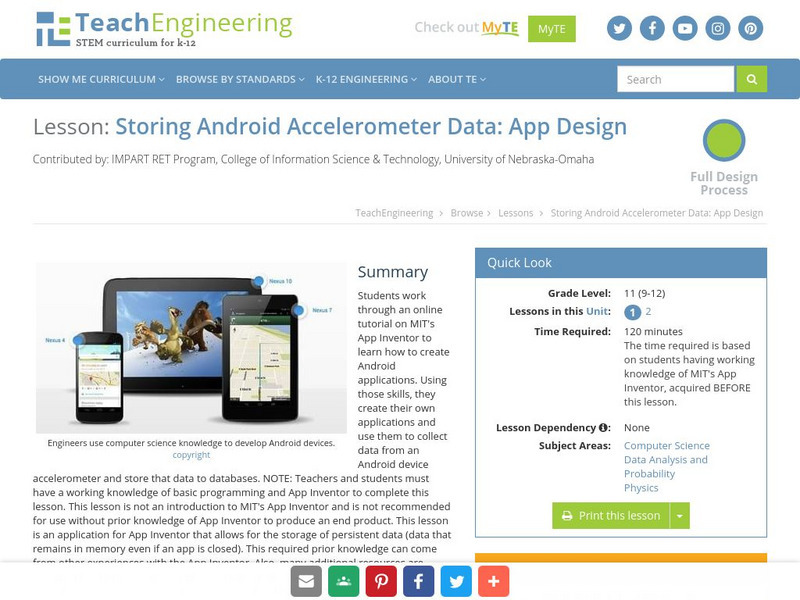
Teach Engineering: Storing Android Accelerometer Data: App Design
Students work through an online tutorial on MIT's App Inventor to learn how to create Android applications. Using those skills, they create their own applications and use them to collect data from an Android device accelerometer and...
TeachEngineering
Teach Engineering: Does It Work? Test and Test Again
Testing is critical to any design, whether it be in the creation of new software or building a bridge across a wide river. Despite risking the quality of the design, the testing stage is often hurried in order to get products to market....
TeachEngineering
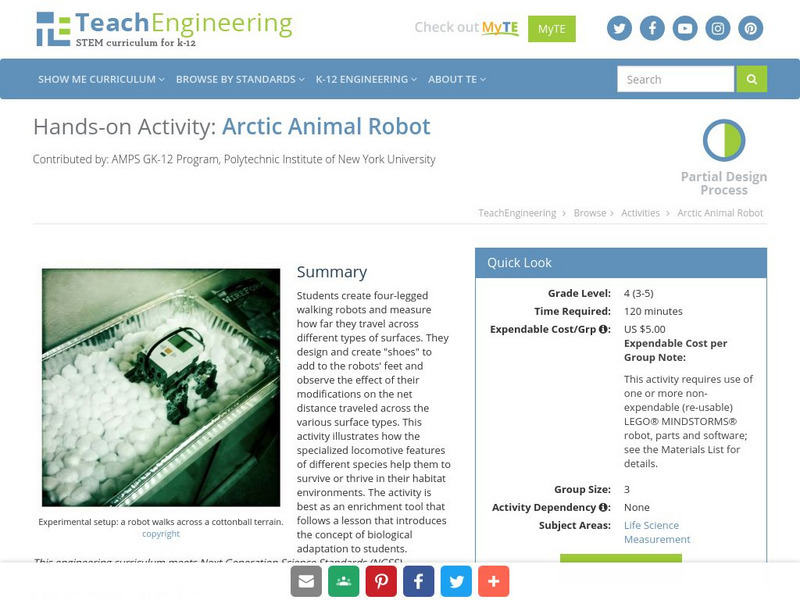
Teach Engineering: Arctic Animal Robot
Students create four-legged walking robots and measure how far they travel across different types of surfaces. They design and create "shoes" to add to the robots' feet and observe the effect of their modifications on the net distance...
TeachEngineering
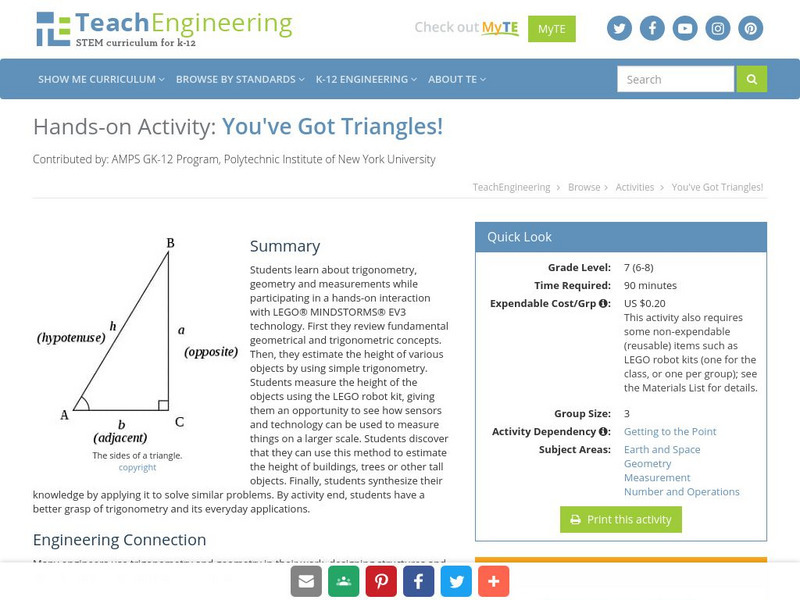
Teach Engineering: You've Got Triangles!
Students learn about trigonometry, geometry and measurements while participating in a hands-on interaction with LEGO MINDSTORMS NXT technology. First they review fundamental geometrical and trigonometric concepts. Then, they estimate the...
TeachEngineering
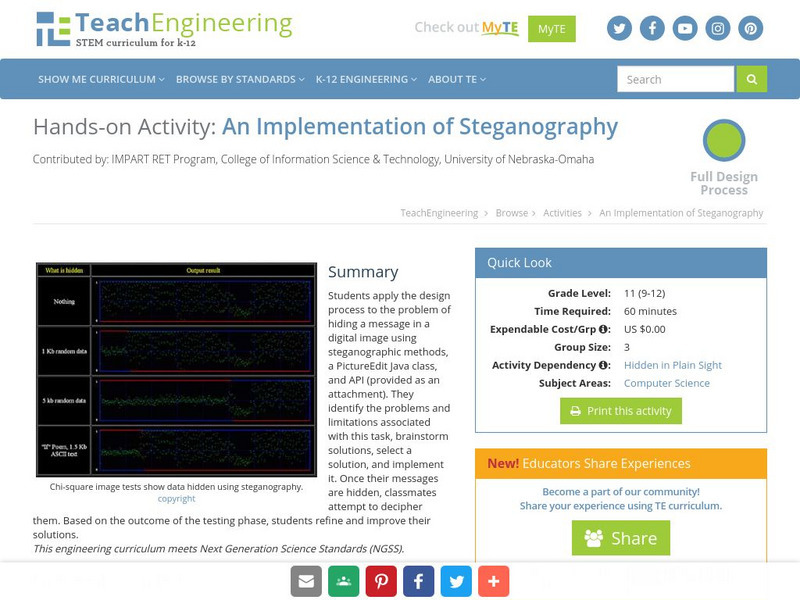
Teach Engineering: An Implementation of Steganography
Students apply the design process to the problem of hiding a message in a digital image using steganographic methods, a PictureEdit Java class, and API (provided as an attachment). They identify the problems and limitations associated...
TeachEngineering
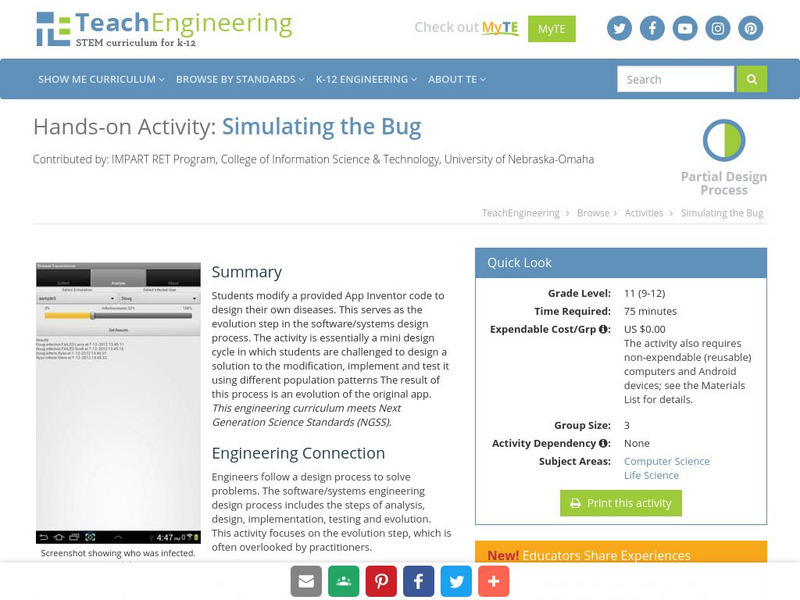
Teach Engineering: Simulating the Bug
Students modify a provided App Inventor code to design their own diseases. This serves as the evolution step in the software/systems design process. The activity is essentially a mini design cycle in which students are challenged to...
TeachEngineering
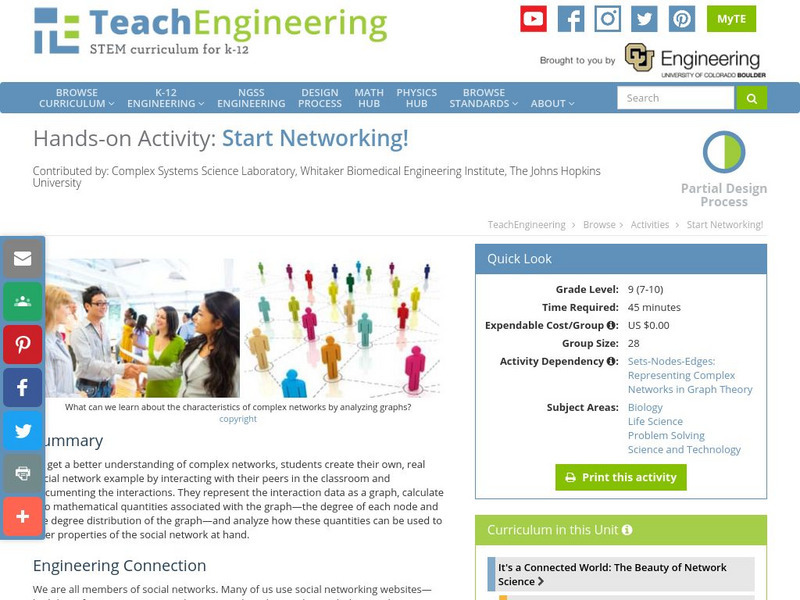
Teach Engineering: Start Networking!
To get a better understanding of complex networks, students create their own, real social network example by interacting with their peers in the classroom and documenting the interactions. They represent the interaction data as a graph,...
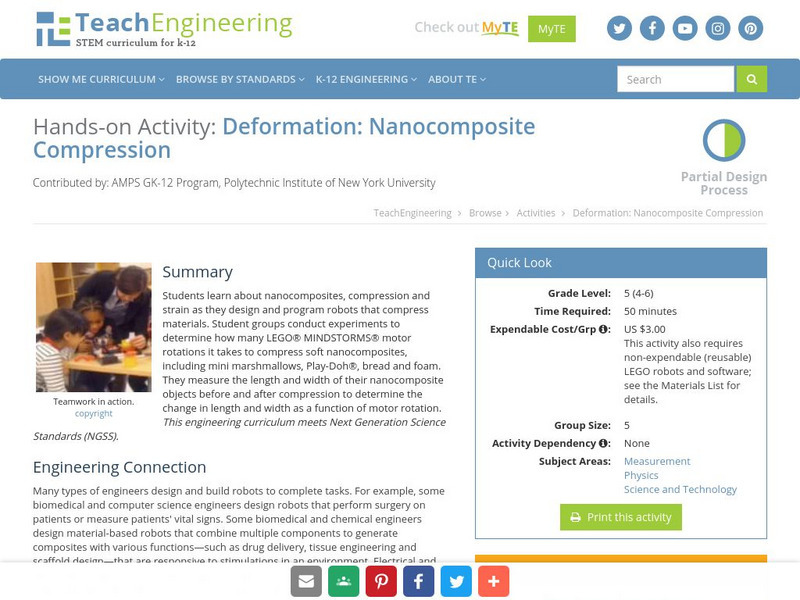
TeachEngineering
Teach Engineering: Deformation: Nanocomposite Compression
Students learn about nanocomposites, compression and strain as they design and program robots that compress materials. Student groups conduct experiments to determine how many LEGO MINDSTORMS NXT motor rotations it takes to compress soft...
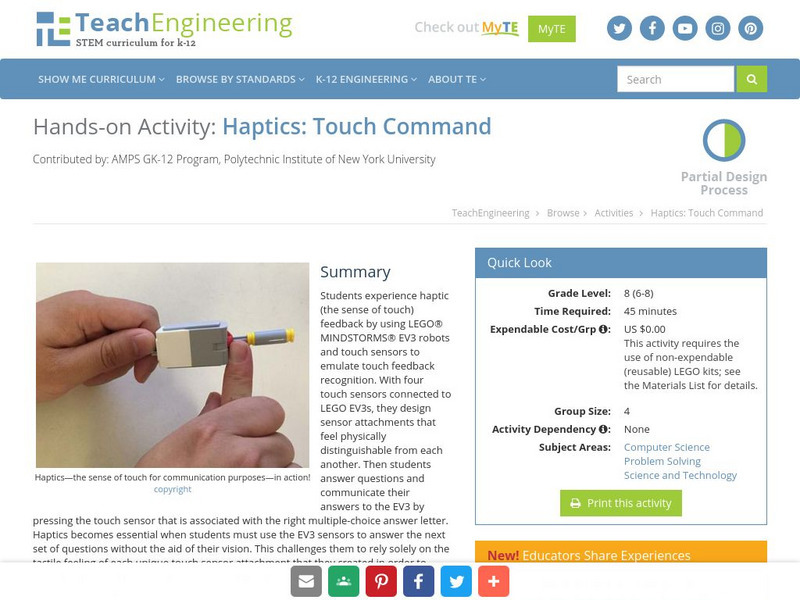
TeachEngineering
Teach Engineering: Haptics: Touch Command
Students experience haptic (the sense of touch) feedback by using LEGO MINDSTORMS NXT robots and touch sensors to emulate touch feedback recognition. With four touch sensors connected to LEGO NXTs, they design sensor attachments that...