Hi, what do you want to do?






Other
Royal Museums Greenwich: Origin of the Solar System
This site explores current theories about how the Solar System was created.
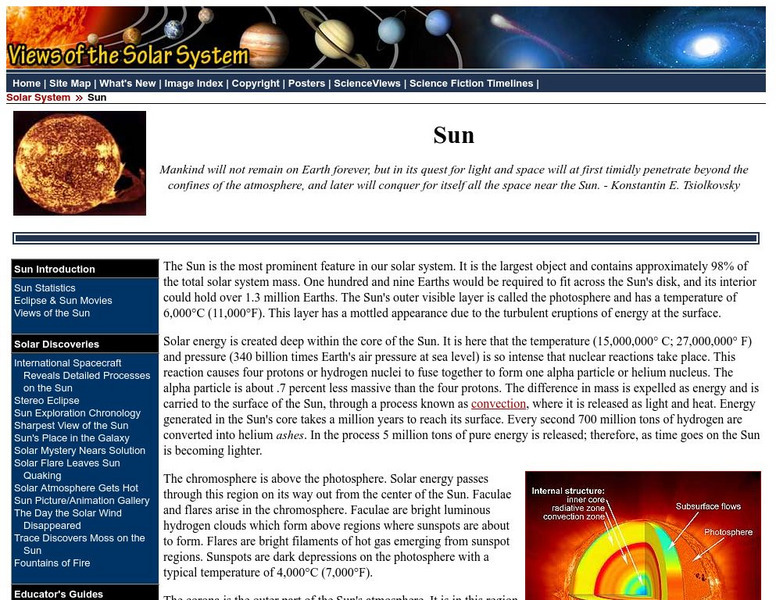
Views of the Solar System
Views of the Solar System: Sun
Explore the sun through this site that includes vivid multimedia resources. Learn sun statistics and view numerous images of the sun and eclipses.
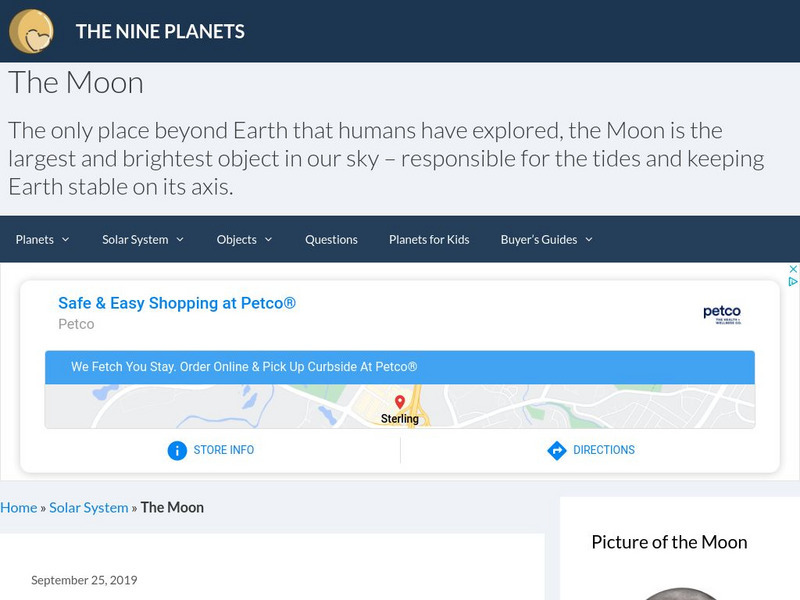
Nine Planets
The Nine Planets: The Moon
Explore the mythology, structure, observational history, gravitational force, and orbit of Earth's Moon.

Nine Planets
The Nine Planets: Small Bodies
This site explores the smaller bodies in the solar system, namely the various asteroids and comets. Links are also provided for additional information on related subjects.
Science Buddies
Science Buddies: How Big Are the Planets in Our Solar System?
This activity explores the relative size of the eight planets that circle around the Sun.
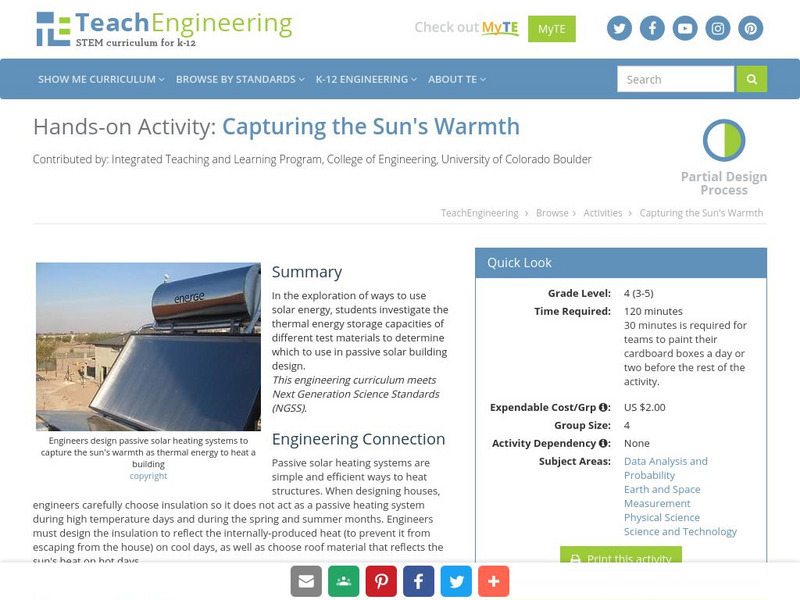
TeachEngineering
Teach Engineering: Capturing the Sun's Warmth
In the exploration of ways to use solar energy, students investigate the thermal energy storage capacities of different test materials to determine which to use in passive solar building design.

NASA
Nasa: Jet Propulsion Laboratory: Planet Quest: Exoplanet Exploration
Constellation of articles, images, diagrams, posters, videos, and more on the subject of the search for planets, particularly Earth-like planets, outside our solar system.

NASA
Nasa: The Space Place: What's in the Heart of a Comet?
NASA site explores what a comet's nucleus is composed of. Animation and photographs are provided as well.
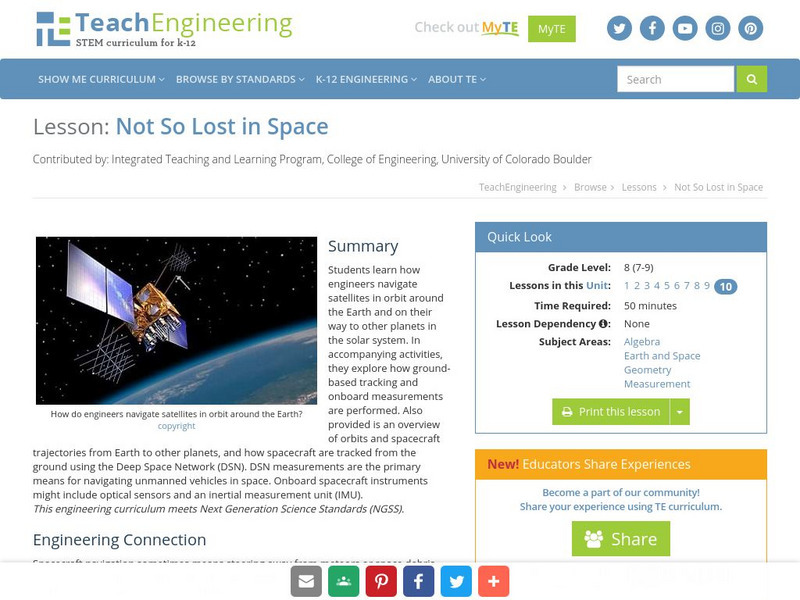
TeachEngineering
Teach Engineering: Not So Lost in Space
Students learn how engineers navigate satellites in orbit around the Earth and on their way to other planets in the solar system. In accompanying activities, they explore how ground-based tracking and onboard measurements are performed....
Other
Celestia
This site provides a free space simulation that lets you explore the universe in three dimensions. There is a forum for teachers and lesson plans that help enhance student use of the simulation. A program must be downloaded in order to...
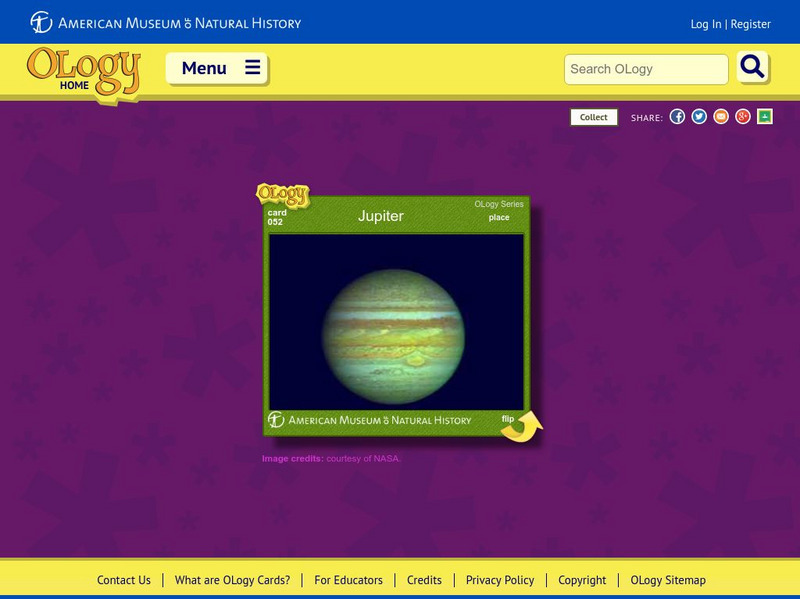
American Museum of Natural History
American Museum of Natural History: Jupiter O Logy Card
Flip this interactive card to start learning about Jupiter, the largest planet in our solar system. Answer multiple-choice and fact-or-fiction questions and review some fast facts about Jupiter.
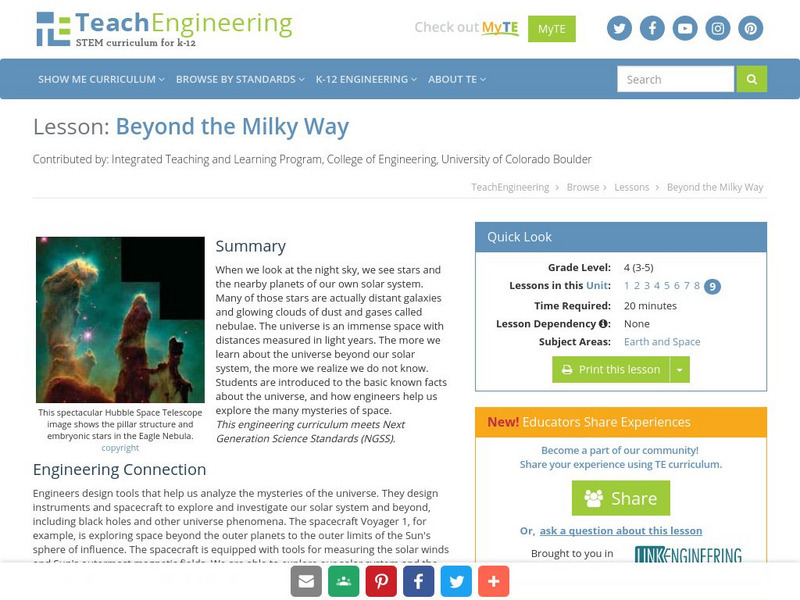
TeachEngineering
Teach Engineering: Beyond the Milky Way
When we look at the night sky, we see stars and the nearby planets of our own solar system. Many of those stars are actually distant galaxies and glowing clouds of dust and gases called nebulae. The universe is an immense space with...

TeachEngineering
Teach Engineering: The Outer Planets
Students explore the outermost planets of our solar system: Saturn, Uranus and Neptune. They also learn about characteristics of Pluto and its interactions with Neptune. Students learn a little about the history of space travel as well...
TeachEngineering
Teach Engineering: Heat Transfer
Learners explore heat transfer and energy efficiency using the context of energy efficient houses. They gain a solid understanding of the three types of heat transfer: radiation, convection and conduction, which are explained in detail...