Hi, what do you want to do?






Science Daily
Science Daily: The Oldest Homo Sapiens
The oldest fossils of modern humans (Homo Sapiens) found near Omo Kibish, Ethiopia, have been identified as being approximately 196,000 years old. This article points out the amazing significance of these findings.
Smithsonian Institution
National Museum of Natural History: The Origin of the Genus Homo
The evolution of the Genus Homo is neatly laid out in a chronological fashion beginning with the key change that signaled the origin of Homo, through the evolutionary forms, finalizing with Homo sapiens.
A-Z Animals
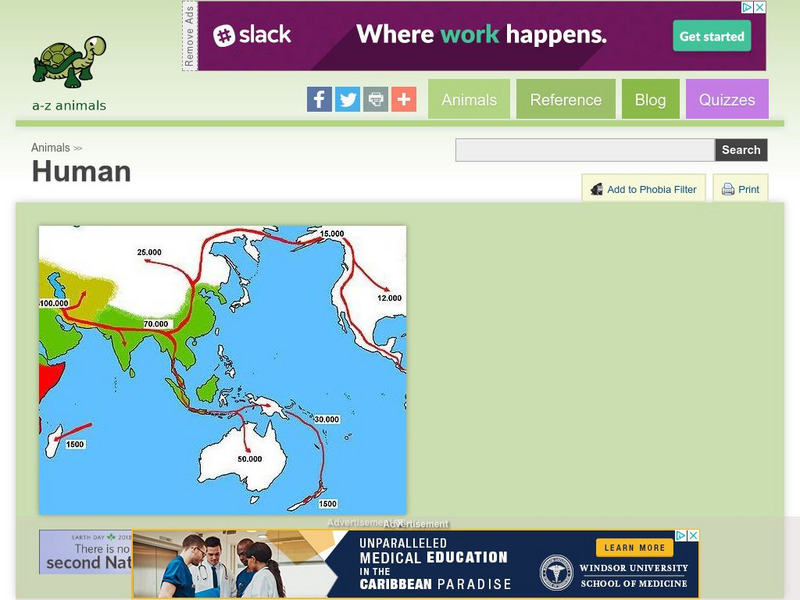
A Z Animals: Animal Facts: Human (Homo Sapiens)
This entry identifies the defining characteristics of the Homo Sapiens, more commonly known as a human being.

PBS
Pbs: Evolution: Origins of Humankind: Homo Sapiens
Read a description of Homo sapiens as a species, learn about the variety of Homo sapiens fossils that have been found, and discover evidence of the culture of these early people.
Curated OER
Cbc: The Great Human Odyssey: Homo Sapiens: Child of the Ice Age
A fascinating look at where humans came from. The interactive journey begins in Ethiopia over four million years ago with our ancestor, Ardipithecus ramidus. It continues at intervals along a timeline up to the present. The journey is...
Palomar Community College District
Palomar College: Flashcards: Early Modern Homo Sapiens
A set of eleven flashcards featuring facts about the early humans.
Other
Fossil Record
This effective site traces the history of modern man from his early ancestors (Australopithecus Afarensis) to Homo Sapiens sapiens.
A-Z Animals
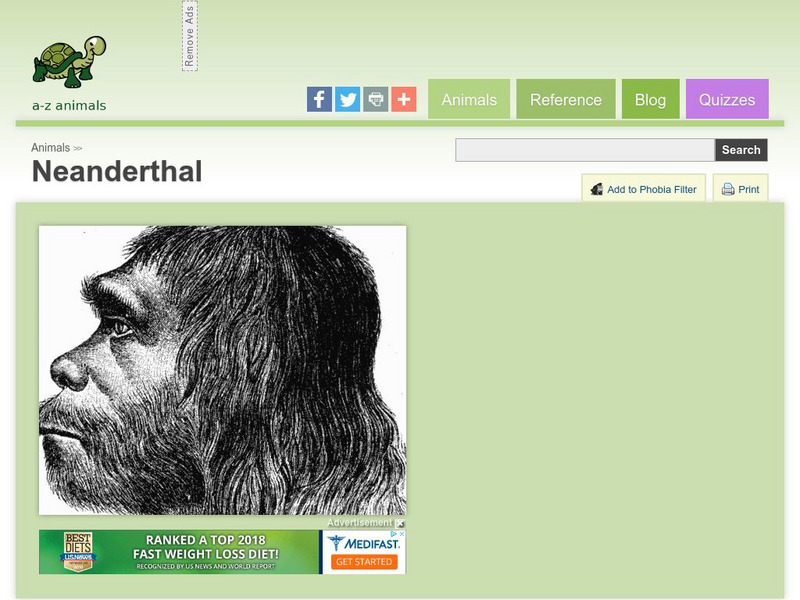
A Z Animals: Animal Facts: Neanderthal (Homo Sapiens Neanderthalensis)
Illustrated entry describes the Neanderthal with details about its physical characteristics and statistics.
University of Texas at Austin
E Fossils: Life Size Printout: Modern Adult Homo Sapiens [Pdf]
A PDF file of a modern human adult male skeleton that can be printed and assembled into a life size one dimensional model.
University of Texas at Austin
E Fossils: Juvenile Modern Homo Sapiens [Pdf]
This life-sized printout will help students learn about the human skeleton and identify some of the important bones of the human body.
Palomar Community College District
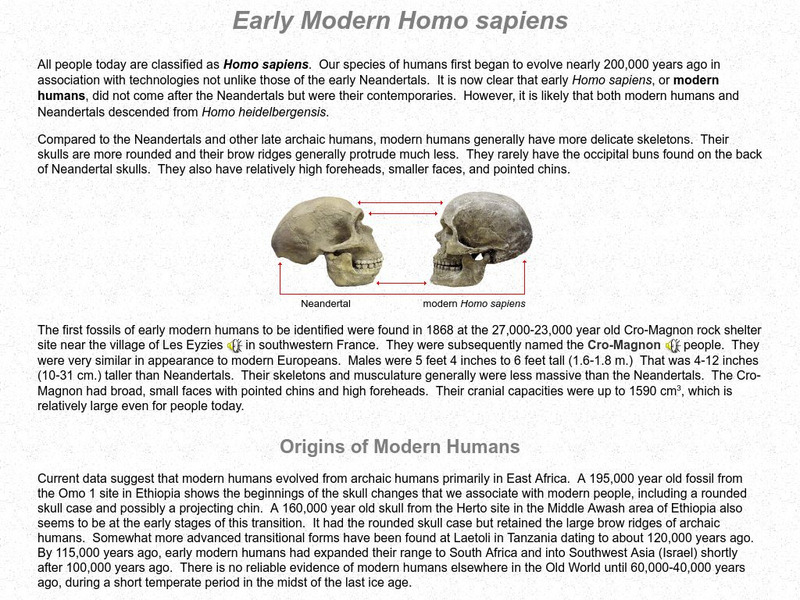
Palomar College: Early Modern Homo Sapiens
An easy-to-understand article traces the origins of modern humans through the use of a simple graph. Various models of migration are also discussed.
A&E Television
History.com: How Early Humans Survived the Ice Age
The most recent ice age peaked between 24,000 and 21,000 years ago, when vast ice sheets covered North America and northern Europe, and mountain ranges like Africa's Mt. Kilimanjaro and South America's Andes were encased in glaciers. At...
Talk Origins Archive
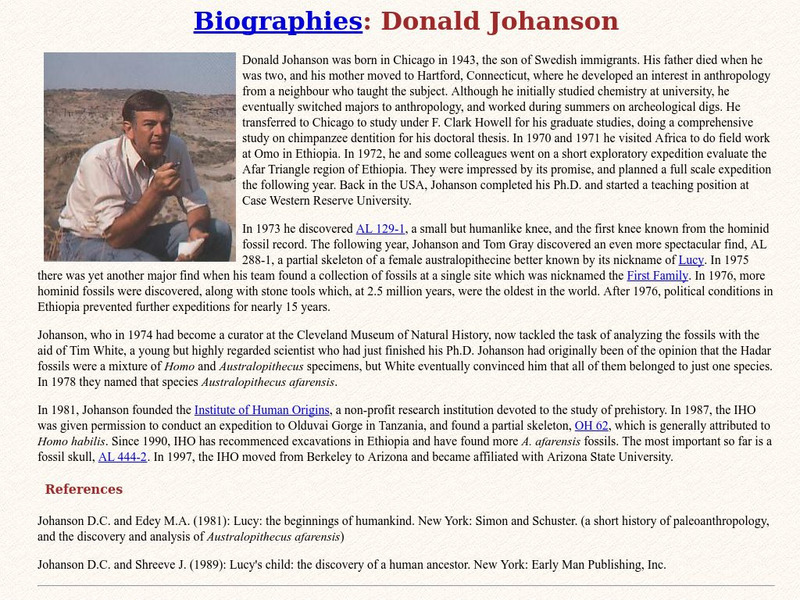
Talkorigins: Biography: Donald Johanson
A biography of Donald Johanson, an anthropologist who has discovered many homo erectus skeletons.
BiologyWise
Biology Wise: Theories Behind the Extinction of Neanderthals
Discusses the discovery of Homo neanderthalensis and describes the different theories that have been put forward to explain why Neanderthals became extinct.
Other
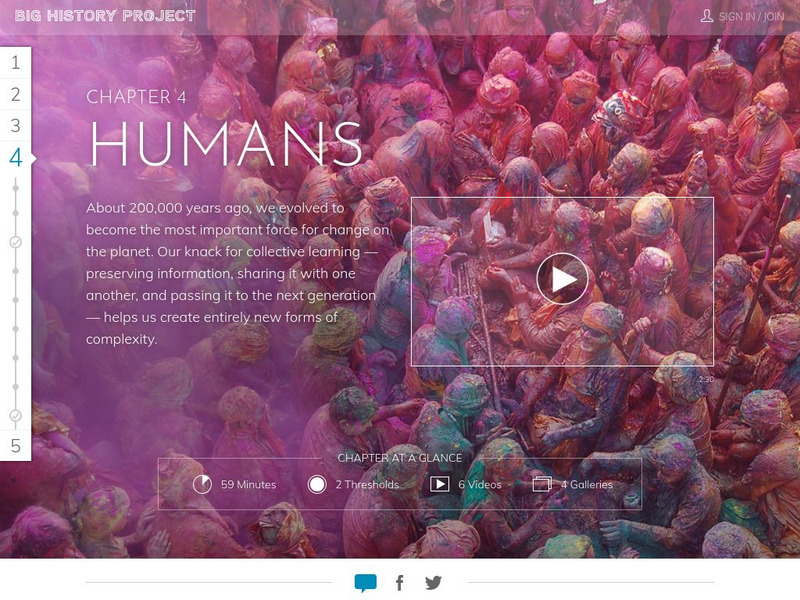
Big History Project: Chapter 4: Humans
Big History Project takes a comprhensive look at humans. From evolution to migration, agriculture to complex civilizations, students and teachers will be intrigued by this interactive learning module.
Curated OER
Homo Floresiensis and a Modern Human Skull
NPR article about the fascinating find in a cave in Indonesia -- fully formed bones of an adult who stood barely 3 feet tall and was alive during the time of Homo Sapiens.
Other
Washington State University: Hominid Species Timeline
This complete resource contains a chronological chart that shows the main hominid species and their approximate relationships in time. A description of each hominid is included as well.
Lin and Don Donn
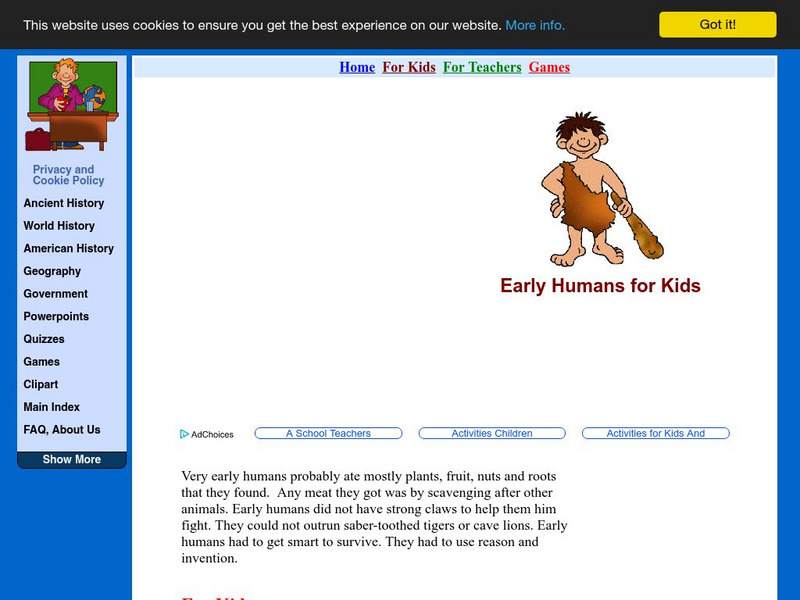
Lin and Don Donn: Who's Who of Early Man
The little cave man guy with a club welcomes you to the site. Did early man look like him? Mr. Donn has put together a Cheat Sheet of Who's Who of Early Man beginning with the famous Lucy and ending with men that looked a lot like us!
PBS
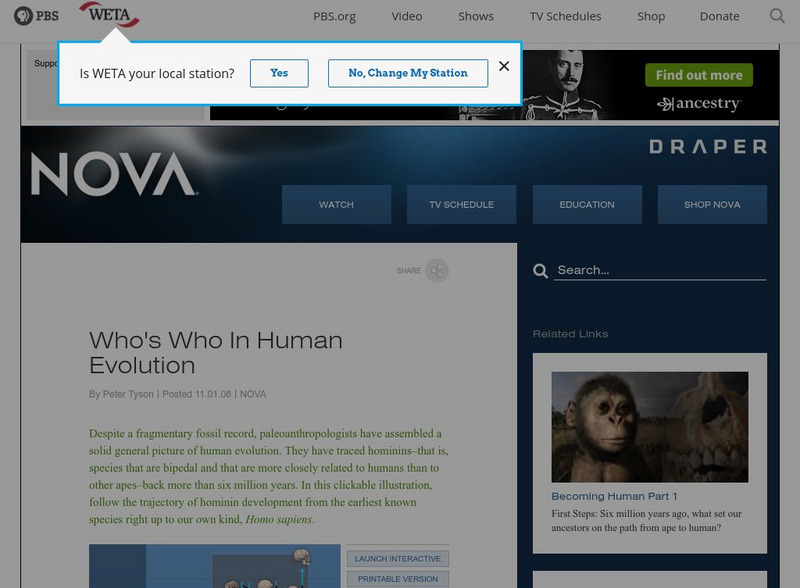
Pbs Nova: Who's Who in Human Evolution
Easy-to-understand chart of human evolution that traces hominins back more than six million years. Follow along using this clickable illustration right up to us, Homo sapiens. Clicking on each name will provide a brief descriptive...

TED Talks
Ted: Ted Ed: If Superpowers Were Real: Immortality
In this series, educator Joy Lin tackles the superpower, immortality, and reveals just how scientifically realistic it is to be immortal. [4:30]
Frontiers Media
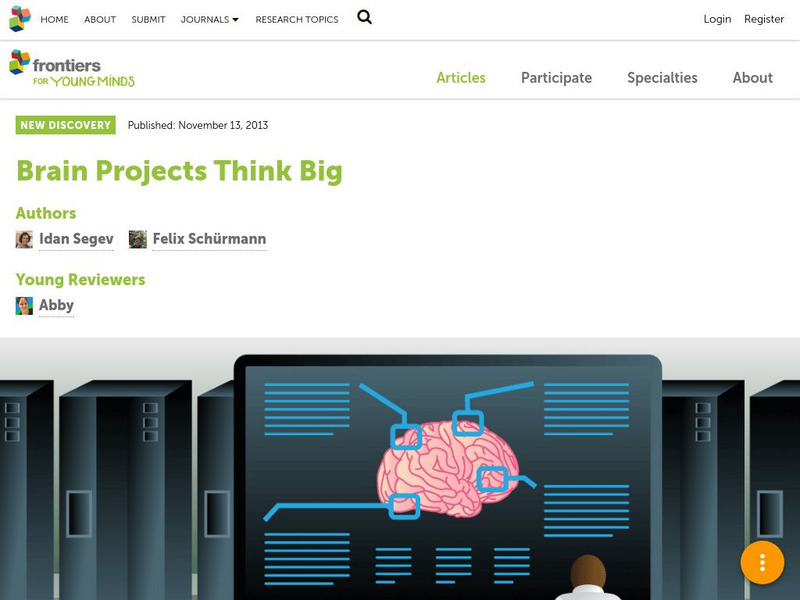
Frontiers: Brain Projects Think Big
When you read these words, hundreds of millions of nerve cells are electrically and chemically active in your brain. This activity enables you to recognize words, sense the world, learn, enjoy and create new things, and be curious about...

TED Talks
Ted: Ted Ed: Why Are We the Only Humans Left?
Just 50,000-100,000 years ago, Earth was home to three or four separate human species, including our most famous cousins: the Neanderthals. New research has shown that Neanderthals were not the brutish, unintelligent cavemen that...

Khan Academy
Khan Academy: Recordkeeping and History
Although many species note the passing of time, only our own species, Homo sapiens, is capable of sharing accounts, or memories, of past events and turning these into stories or "histories." This article traces the development of written...
PBS
Pbs: A Modern Mass Extinction
Are we in the midst of a mass extinction? Is Homo sapiens triggering this mass extinction? Four expert panelists have written responses to the aforementioned questions for this highly informative site.