Hi, what do you want to do?





CK-12 Foundation
Ck 12: Polarity and Intermolecular Forces
[Free Registration/Login may be required to access all resource tools.] The following online tutorial describes how the electronegativity difference between two atoms in a covalent bond results in the formation of a nonpolar covalent,...
Other
Western Oregon University: Intermolecular Forces
A presentation on intermolecular forces. Click the desired topic to view a PowerPoint slideshow.

Michael Blaber, PhD
Florida State University: Intermolecular Forces
This article from the Florida State Univeristy provides good information on the various intermolecular forces, including nice diagrams.

Concord Consortium
Concord Consortium: Stem Resources: Intermolecular Attractions
Learn that boiling point, solubility, and DNA are affect by intermolecular forces in this module. Module includes lessons with questions and animations to explain London dispersion and dipole-dipole attractions. To conclude the lessons,...
Texas Instruments
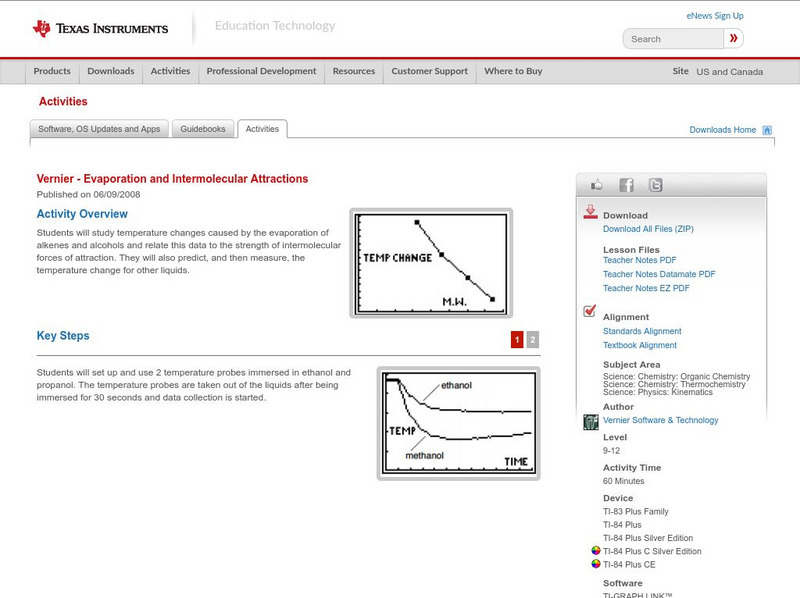
Texas Instruments: Evaporation and Intermolecular Attractions
Students will study temperature changes caused by the evaporation of alkenes and alcohols and relate this data to the strength of intermolecular forces of attraction. They will also predict, and then measure, the temperature change for...
Sophia Learning
Sophia: Intermolecular and Intramolecular Forces: Lesson 1
This lesson will define intramolecular forces and intermolecular forces and explain the difference between them. It is 1 of 2 in the series titled "Intermolecular and Intramolecular Forces."

Concord Consortium
Concord Consortium: Stem Resources: Seeing Intermolecular Attractions
This simple interactive tool lets students explore the forces of attraction between polar and non-polar molecules.

CK-12 Foundation
Ck 12: Chemistry Simulation: Dripping Droplets
[Free Registration/Login Required] Explore intermolecular forces by seeing how many drops of a liquid a penny can hold.
Concord Consortium
Concord Consortium: Comparing Attractive Forces Between Molecules
Simulations that explore different attractive forces between polar and non polar molecules.

Florida State University
Florida State University: Intermolecular Forces: Changes of State
Discusses the changes of state that can occur for the three different types of matter (solids, liquids, and gases) and different types of heat energy that have been defined by scientists.
CK-12 Foundation
Ck 12: Liquids
[Free Registration/Login may be required to access all resource tools.] In the following online tutorial students will describe a liquid according to the kinetic-molecular theory. They will also learn how a liquid exhibits surface...
Georgia Department of Education
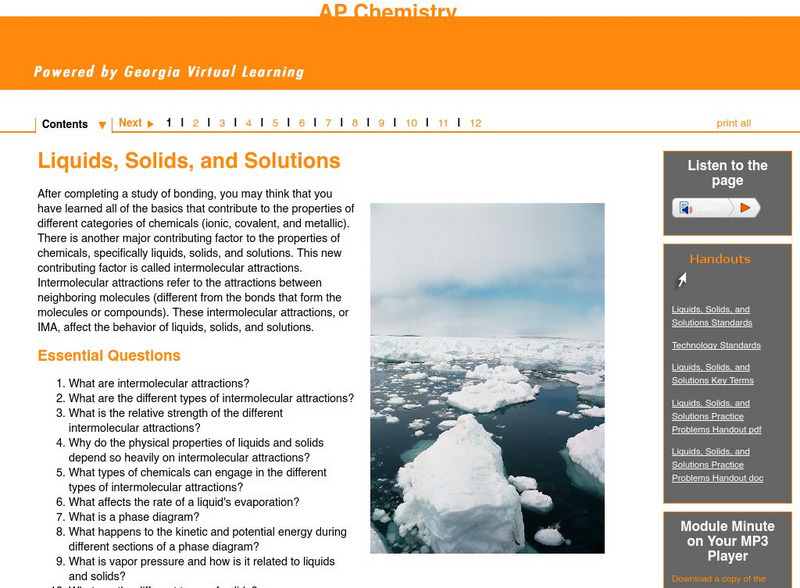
Ga Virtual Learning: Ap Chemistry: Liquids, Solids, and Solutions
Students discover intermolecular attractions between neighboring molecules. These intermolecular attractions, or IMA, affect the behavior of liquids, solids, and solutions.

University of Florida
Chem. 2041 Lecture Notes: The Forces Between Molecules
A discussion of the variety of forces which hold molecules together. The relative strengths of these forces for the various states of matter is discussed. The effect of such forces on the boiling points and other phase change...
Concord Consortium
Concord Consortium: Molecular Workbench: Van Der Waal Bonds and Duct Tape
Adjust the peeling force in this simulation to see how the van der Waals bonds break while peeling a piece of duct tape off of a surface.

Concord Consortium
Concord Consortium: Molecular Workbench: Experiment on Material Strength
Adjust the strength of interatomic interactions in this virtual bullet experiment. Observe how the adjustments in strength affect the material in the experiment.

Carnegie Mellon University
Chem Collective: Brownian Motion
Particulate level simulations that show only solute particles are convenient, since they focus student attention on the molecules of most interest. However, such solute molecules move in a Brownian manner. This simulation helps students...

Vision Learning
Vision Learning: Three States of Matter
Concept animation compares molecular movement of solids, liquids, and gases.
Concord Consortium
Concord Consortium: Molecular Workbench: Hypothetical Nanoscale Machine
Observe the intermolecular interactions of a hypothetical multi-gear nanoscale machine.
Sophia Learning
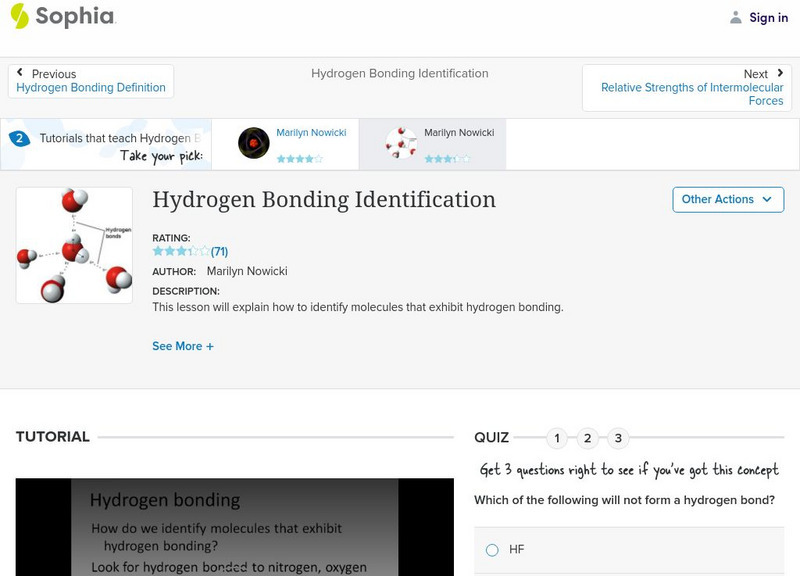
Sophia: Hydrogen Bonding Identification: Lesson 1
This lesson will explain how to identify molecules that exhibit hydrogen bonding. It is 1 of 2 in the series titled "Hydrogen Bonding Identification."
Concord Consortium
Concord Consortium: Molecular Workbench: Sorting Molecules With a Nano Conveyor
Observe how molecules can be sorted in a hypothetical nano conveyor-belt mechanism.
Concord Consortium
Concord Consortium: Forming an Molecular Bond (Conceptual Version)
Create a molecular bond and observe energy over time.
Concord Consortium
Concord Consortium: Stem Resources: Solubility
Learners can use this web-based activity to study solutions, as far as the intermolecular attractive forces that allow or do not allow a solvent to dissolve in a solute. Also discussed includes the solubility rule "like dissolves like"...
Curated OER
4 Different Modes of Representation of Covalent Bonds
A tutorial on covalent bonds and intermolecular forces. A good summary weak forces, including Van der Waals forces and an excellent illustration showing the relative strengths of different forces and bonds.

Science Education Resource Center at Carleton College
Serc: Floating Metal Pins Discrepant Event/guided Inquiry on Surface Tension
Through a combination of an interactive demonstration and guided inquiry, students learn the basic nature of surface tension in liquids.