Hi, what do you want to do?





Sophia Learning
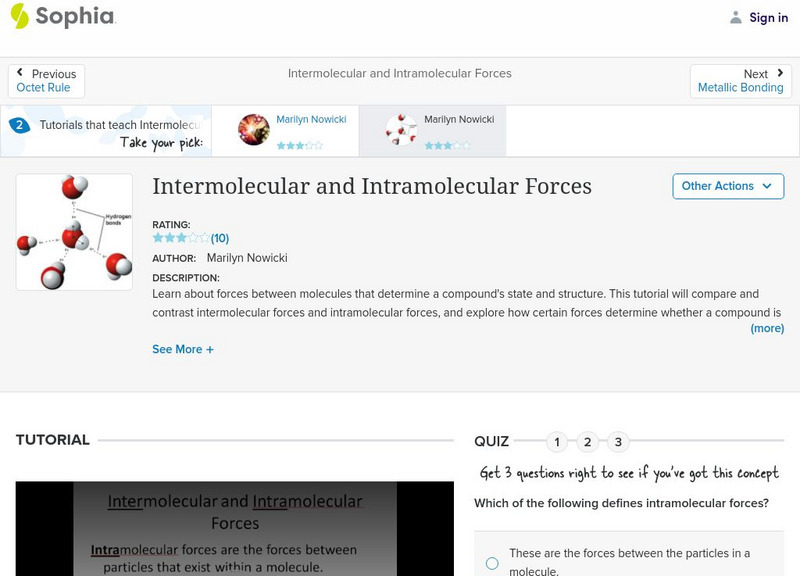
Sophia: Intermolecular and Intramolecular Forces: Lesson 1
This lesson will define intramolecular forces and intermolecular forces and explain the difference between them. It is 1 of 2 in the series titled "Intermolecular and Intramolecular Forces."

Concord Consortium
Concord Consortium: Stem Resources: Seeing Intermolecular Attractions
This simple interactive tool lets students explore the forces of attraction between polar and non-polar molecules.

Sophia Learning
Sophia: Dipole Dipole Forces
A brief tutorial which defines a dipole-dipole force, and explains how to identify which molecules exhibit dipole-dipole forces.

CK-12 Foundation
Ck 12: Chemistry Simulation: Dripping Droplets
[Free Registration/Login Required] Explore intermolecular forces by seeing how many drops of a liquid a penny can hold.
Concord Consortium
Concord Consortium: Comparing Attractive Forces Between Molecules
Simulations that explore different attractive forces between polar and non polar molecules.

Florida State University
Florida State University: Intermolecular Forces: Changes of State
Discusses the changes of state that can occur for the three different types of matter (solids, liquids, and gases) and different types of heat energy that have been defined by scientists.
University of Arizona
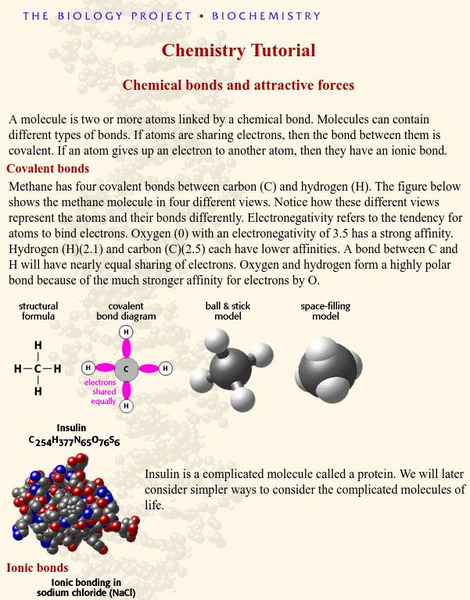
University of Arizona: Bonds Tutorial
A tutorial on covalent bonds and intermolecular forces. A good summary weak forces, including Van der Waals forces and an excellent illustration showing the relative strengths of different forces and bonds.
CK-12 Foundation
Ck 12: Liquids
[Free Registration/Login may be required to access all resource tools.] In the following online tutorial students will describe a liquid according to the kinetic-molecular theory. They will also learn how a liquid exhibits surface...
Concord Consortium
Concord Consortium: Intermolecular Attractions and Solubility
Have you ever wondered why oil and water don't mix? Discover why some substances dissolve in water while others don't.
Georgia Department of Education
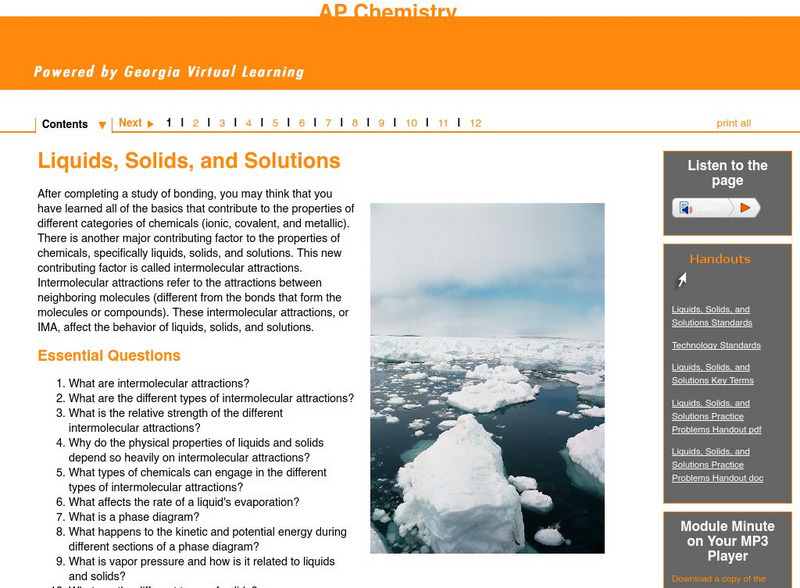
Ga Virtual Learning: Ap Chemistry: Liquids, Solids, and Solutions
Students discover intermolecular attractions between neighboring molecules. These intermolecular attractions, or IMA, affect the behavior of liquids, solids, and solutions.
Concord Consortium
Concord Consortium: Intermolecular Attractions and Boiling Point
The temperature at which substances boil is determined by intermolecular attractions. Explore how these forces affect a substance's boiling point.

Scientific American
Scientific American: The Intricacies of a Gecko's Grip
This article, published by Scientific American (June 19, 2000), explores how geckos hang on vertical surfaces. They don't use glue, or suction, or even nature's version of Velcro. Instead, they utilize intermolecular forces "to get a...

University of Florida
Chem. 2041 Lecture Notes: The Forces Between Molecules
A discussion of the variety of forces which hold molecules together. The relative strengths of these forces for the various states of matter is discussed. The effect of such forces on the boiling points and other phase change...
Concord Consortium
Concord Consortium: Molecular Workbench: Van Der Waal Bonds and Duct Tape
Adjust the peeling force in this simulation to see how the van der Waals bonds break while peeling a piece of duct tape off of a surface.

Concord Consortium
Concord Consortium: Molecular Workbench: Experiment on Material Strength
Adjust the strength of interatomic interactions in this virtual bullet experiment. Observe how the adjustments in strength affect the material in the experiment.

Carnegie Mellon University
Chem Collective: Brownian Motion
Particulate level simulations that show only solute particles are convenient, since they focus student attention on the molecules of most interest. However, such solute molecules move in a Brownian manner. This simulation helps students...

Vision Learning
Vision Learning: Three States of Matter
Concept animation compares molecular movement of solids, liquids, and gases.
Concord Consortium
Concord Consortium: Molecular Workbench: Hypothetical Nanoscale Machine
Observe the intermolecular interactions of a hypothetical multi-gear nanoscale machine.
Vision Learning
Visionlearning: Physical States and Properties: Properties of Liquids
Read about the many properties of liquids. Take an assessment when finished.
Sophia Learning
Sophia: Hydrogen Bonding Identification: Lesson 1
This lesson will explain how to identify molecules that exhibit hydrogen bonding. It is 1 of 2 in the series titled "Hydrogen Bonding Identification."
University of Iowa
Univ. Of Iowa: Introduction to Organic Molecules and Functional Groups [Pdf]
This PDF shows many examples of organic molecules and functional groups.
Concord Consortium
Concord Consortium: Molecular Workbench: Sorting Molecules With a Nano Conveyor
Observe how molecules can be sorted in a hypothetical nano conveyor-belt mechanism.
Concord Consortium
Concord Consortium: Forming an Molecular Bond (Conceptual Version)
Create a molecular bond and observe energy over time.
Chem Tutor
Chem Tutor: Chemistry: Compounds
This lesson focuses on chemical compounds including Ionic and Covalent Bonds, Valences, Lewis Structures, Binary Covalent Compounds, Radicals or Polyatomic Ions, and much more. It also includes a compound worksheet in which the pupils...