Hi, what do you want to do?






Curated OER
Who's the Father?
Students analyze gels to determine parentage in this lesson plan about scientific evidence, investigation, and DNA concepts. The lesson plan includes a pre-activity worksheet, a final individual assessment, and student handouts for...

Curated OER
Zoology
In this zoology word search, students find 30 words. This is a very difficult puzzle with complicated science vocabulary, but there is a word bank.

Curated OER
Pheed the World: Edible Phyla
Students discuss the contributions of different organisms to our world. In this biology activity, students research countries with limited food supply. They create an improvement plan for a fictitious country assigned to them.


National Health Museum
Access Excellence: Molecular Biology/primate Phylogeny
This lesson plan involves comparison of amino acids to create a phylogenetic tree of primates. Students will also use other species information to draw conclusions about evolutionary relationships.

Tree of Life Project
The Tree of Life Web Project
The Tree of Life is a multi-authored, Internet distributed project containing information about phylogeny and biodiversity. The Tree of Life can be used to locate information about a particular group of organisms through their taxonomy.
University of California
Ucmp: Online Exhibits
Visit the virtual exhibits at this site to learn more about paleontology, the history of the earth, and life on earth. Use the information on this site to understand geology, geologic time, evolution, and phylogeny.
American Institute of Biological Sciences
Action Bioscience: Malaria, Algae, Amoeba and You: Eukaryotic Relationships
Researchers are considering more recent findings of eukaryotes and their phylogeny. Investigate the insights to understand that there may be more progress found in determining the relationships to other eukaryotes.

Alabama Learning Exchange
Alex: The Tree of Life
This is a lesson to help young scholars understand the phylogeny of organisms and how all organisms are linked in a certain way. By navigating an Internet site, students will learn how organisms are classified.
Famous Scientists
Famous Scientists: Ernst Haeckel
Find out about Ernst Haeckel, a scientist known for his work with ecology, zoology, and the study of phylogeny.
George Washington University
George Washington University: Basics of Cladistic Analysis [Pdf]
This is an advanced level review of cladistic theory and methodology. Some sections are very dense but there are useful sections for teachers and students seeking a better understanding of the topic.
Tree of Life Project
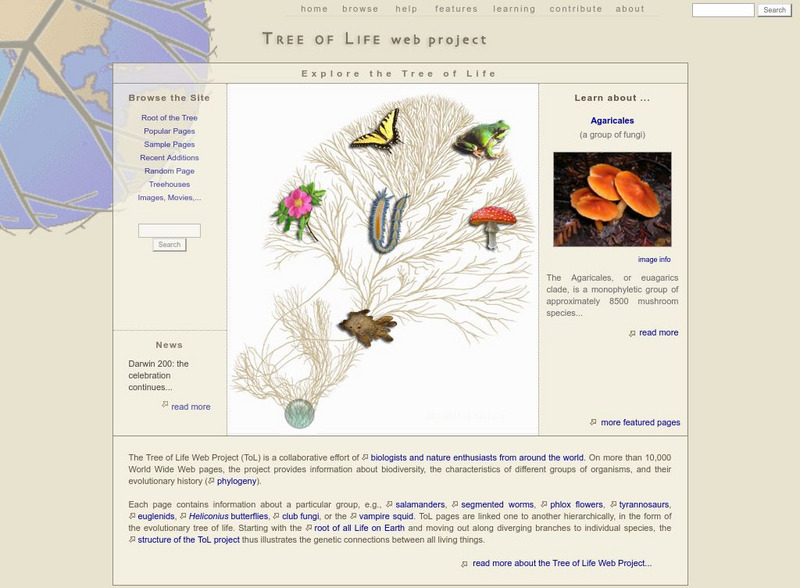
The Tree of Life Web Project
The Tree of Life Web Project contains information on living organisms including their history and characteristics. Over 3,000 web pages are linked together uniting all living things.
Science Education Resource Center at Carleton College
Serc: Phylogenetics Problems
A lesson plan where students solve problems by using cladistics to determine phylogenies. Problems require that students determine which characteristics are ancestral or derived by looking at both dinosaurs' remains and primate skulls....

University of California
Ucmp: The Museum of Paleontology
This site contains on-line exhibits including animals, plants, time periods, phylogeny, geology, and evolution. Also, a search is provided at the bottom of the site for more specific information.
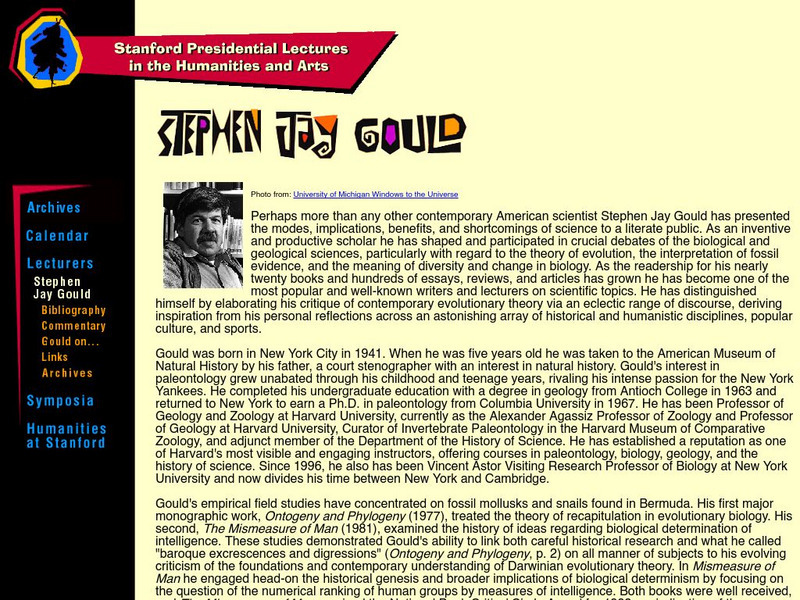
Stanford University
Stanford Presidential Lectures: Stephen Jay Gould
Standford University provides interesting biographical and professional information on Stephen Jay Gould and his many contributions to scientific thought, including his efforts to help people see science "As something that is important...
Yale University
Yale New Haven Teachers Institute: Evolution of Plants
An extensive coverage of the evolutionary history of plants. Click on a topic in the outline and you'll go to a good discussion on this material.
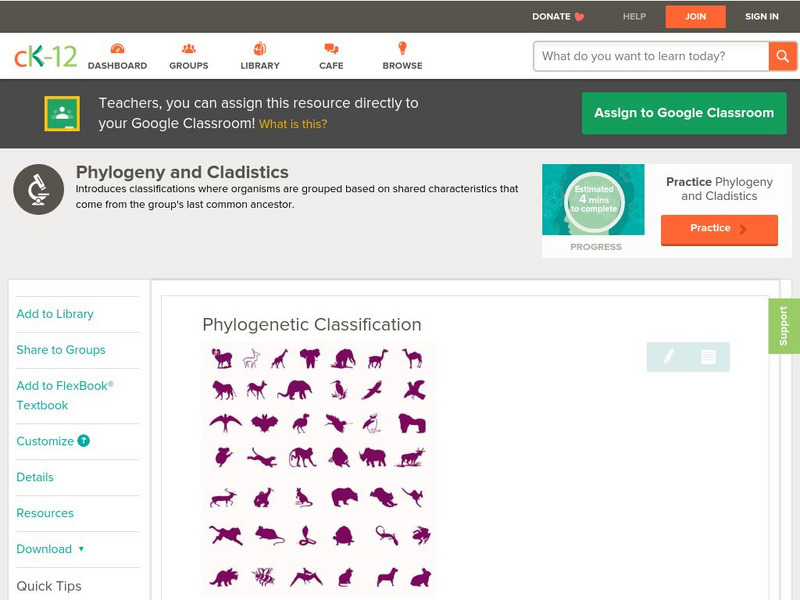
CK-12 Foundation
Ck 12: Biology: Phylogenetic Classification
[Free Registration/Login may be required to access all resource tools.] Introduces phylogenetic classification and compares it with the Linnaean classification.
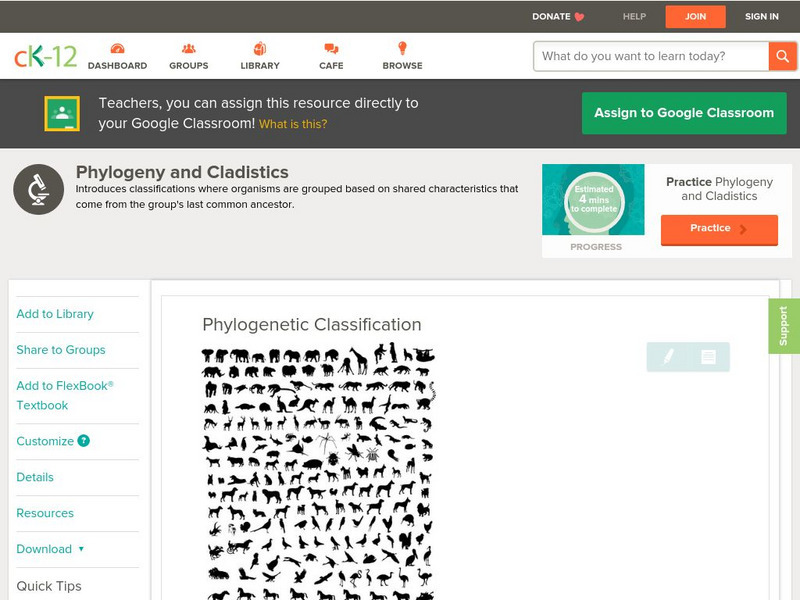
CK-12 Foundation
Ck 12: Biology: Phylogenetic Classification
[Free Registration/Login may be required to access all resource tools.] Introduces phylogenetic classification and compares it with the Linnaean classification.

Tree of Life Project
University of Arizona: Hyperoartia Lampreys
A corner of the University of Arizona's Tree of Life project. This site gives the phylogeny and background of the lamprey in good detail. Very strong research site. Abundant references.

Untamed Science
Untamed Science: Phylum Chordata
Learn about the characteristics, classification, and phylogeny that make the Phylum Chordata, a distinct animal classification group. See examples and photos of different species of chordates.
City University of New York
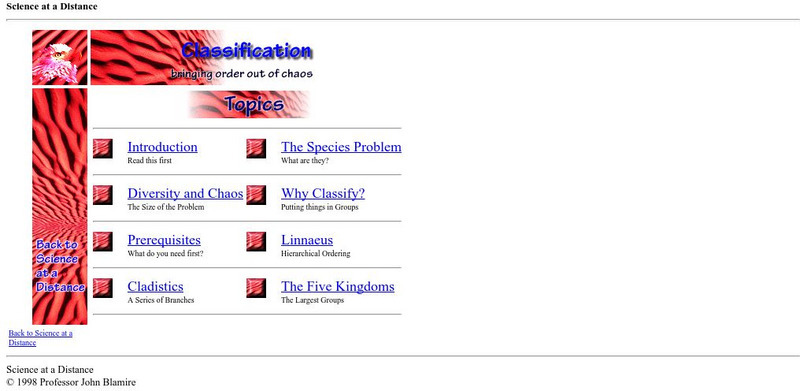
Classification: Bringing Order Out of Chaos
A self-directed module on all aspects of biological classifications that covers the species problem, diversity and chaos, cladistics, putting things in groups, and so on.

Vision Learning
Visionlearning: Biology: Galapagos Finches
Interactive animation illustrates how Charles Darwin used his study of finch beaks to explain evolution. A phylogenetic tree diagram shows how the birds' color and beak shape changed over generations.
Estrella Mountain Community College
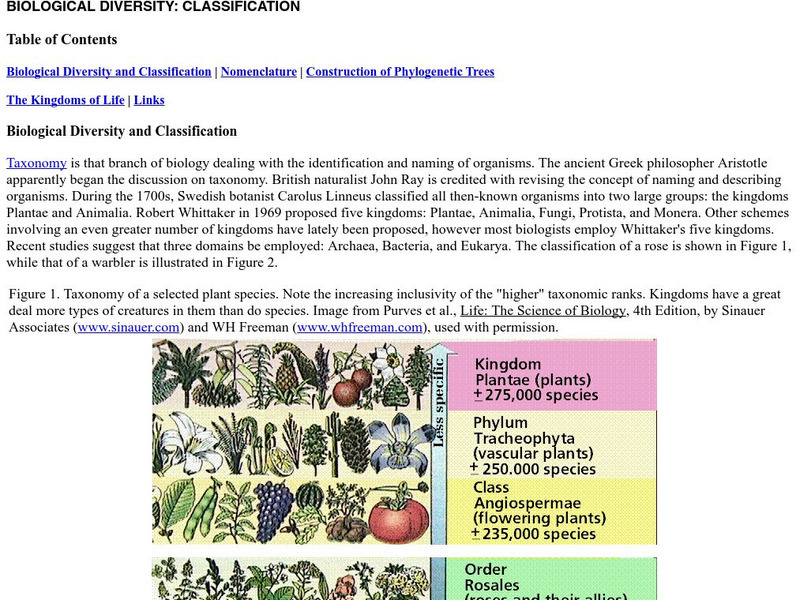
Estrella Mountain College: Classification
Discusses many aspects of information pertainingto organism classification. Provides links to other areas in biology as well.
Tree of Life Project
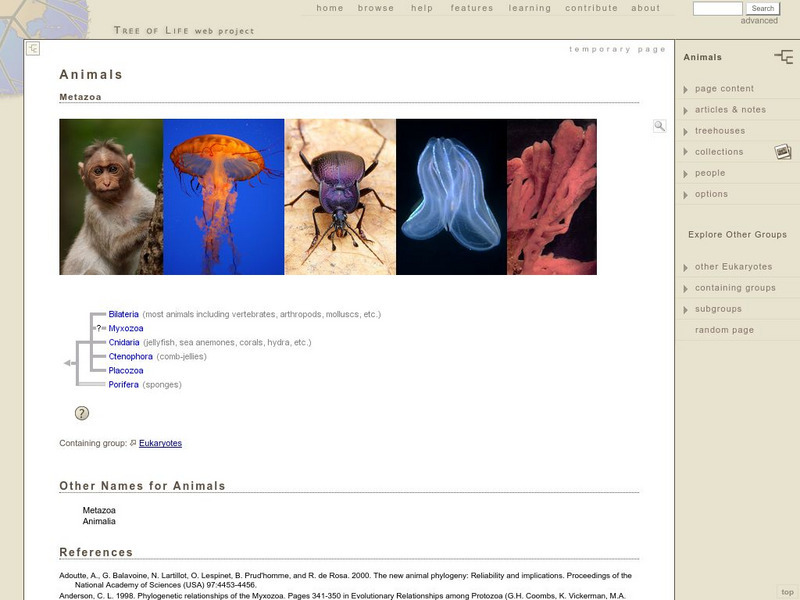
The Tree of Life Web Project: Animals
Extensive site that contains much information about the various animal phyla. Each phyla gives photos, common examples, scientific names and references. Collection of 1630 websites about bio-diversity.
Other popular searches
- Phylogeny Tree
- Evolution Phylogeny
- Phylogeny and Evolution
- Phylogeny and Systematics
- Human Phylogeny
- Plant Phylogeny
- Animal Phylogeny
- Invertebrate Phylogeny
- Evolution + Phylogeny
- Mammal Phylogeny
- Invertebrate Phylogeny Tree
- Invertebrates Phylogeny