Hi, what do you want to do?





Other
Daniel J. Kurland: Critical Reading: Inference: Reading Ideas as Well as Words
This college instructor offers his insights into critical reading and how to develop skills to interpret as well as comprehend the written word. RL.9-10.1, RL.11-12.1, RI.9-10.1 textual evidence and inference.
TES Global
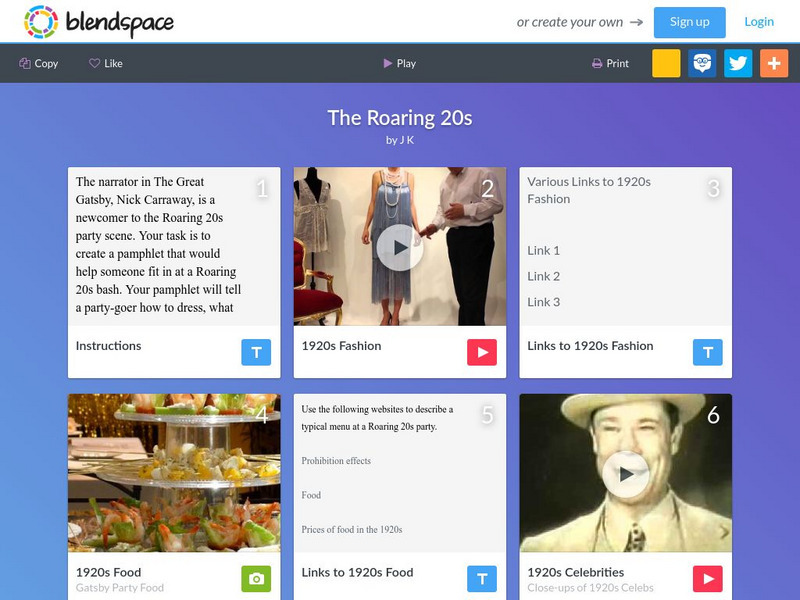
Blendspace: The Roaring 20's
A learning module with thirteen links to texts, images, and videos, with information about life during the 1920's. RI.9-10.7 different mediums
Other
Nielsen Norman Group: Guidelines for Multimedia on the Web
Guidelines on how to design presentations for web media. This is an old article and some of the information is outdated, but much is still relevant. SL.9-10.5 Audio Visuals, RI.11-12.7 Eval Different Media/format....

Tom Richey
Slide Share: Distinguishing Main Ideas and Supporting Details
This downloadable slideshow focuses on main ideas and supporting details including definitions, identification, and practicing with paragraphs. RI.9-10.2 central idea/summary

Mind Tools
Mind Tools: Reading Strategies
This site from Mind Tools reviews six different strategies to help you read more effectively. RI.11-12.10a Text Complexity
Other
Laflemm.com: Reading Resources: Inference
This page has reading tips and exercises that explain inferences. There is an answer key for students to check their work. RL.9-10.1, RL.11-12.1, RI.9-10.1 & RL.11-12.1 textual evidence and inferences
Other
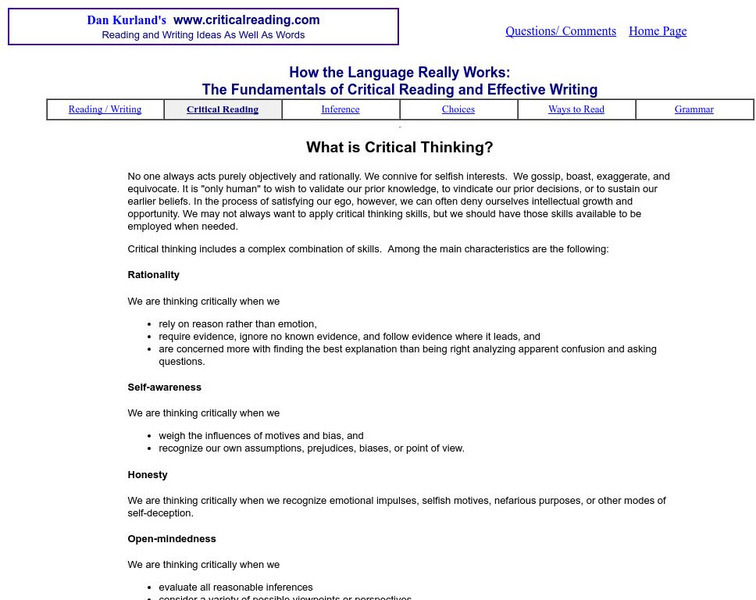
Critical Reading: How the Language Really Works: What's Critical Thinking?
Reading and writing are essentially thinking. This site examines the aspects of critical thinking, including rationality, self-awareness, honesty, open-mindedness, discipline, and judgment. RI.11-12.10a Text Complexity
Other
Prezi: What Is Complex Literature?
This Prezi was created by Marko Zlomislic. The presentation explains what constitutes complex literature. It defines complex texts, discusses the varied benefits of learning to read them, and provides links to lesson plans and examples....
Other
Rudolph Academy: Figurative Language Quizzes and Practice Exercises
This site offers a multitude of figurative language quizzes (some by grade level), a PowerPoint presentation and links to much more. It features a 30 question quiz asking students to either read or listen to statements and then select...
Bartleby
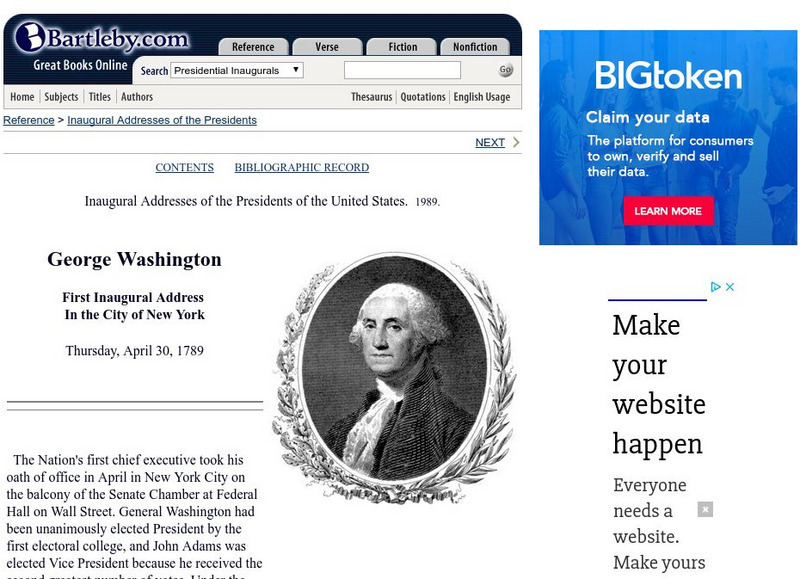
Bartleby.com: bartleby.com: Presidential Inaugural Address: Geo. Washington: 1st
Review the text George Washington's first inaugural address given on April 30, 1789. RI.11-12.8 seminal U.S. texts
Texas Education Agency
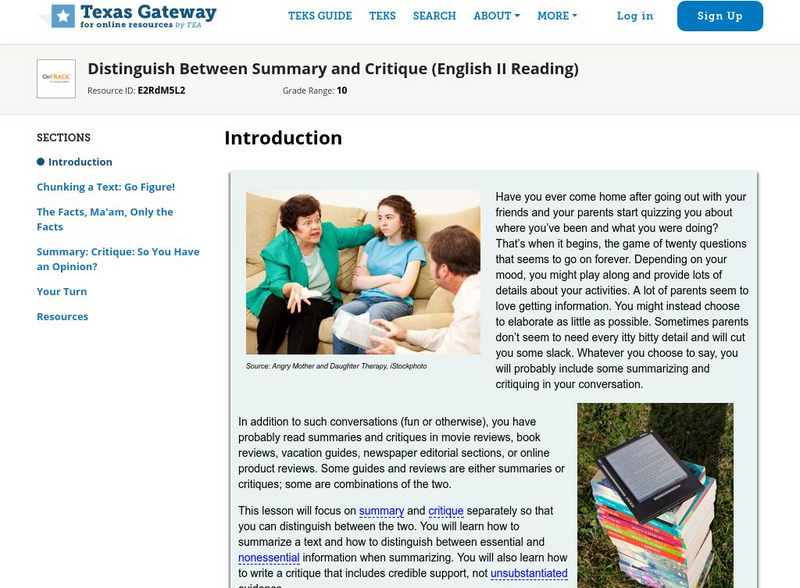
Texas Gateway: Distinguish Between Summary and Critique (English Ii Reading)
This lesson will focus on summary and critique separately so that you can distinguish between the two. You will learn how to summarize a text and how to distinguish between essential and nonessential information when summarizing. You...
CommonLit
Common Lit: Women in Ancient Rome
CommonLit.org is a wonderful resource to use in a Language Arts classroom. Each story or article is accompanied by guided reading questions, assessment questions, and discussion questions. In addition, students can click on words to see...
CommonLit
Common Lit: Duck & Cover: School Drills During the Cold War
CommonLit.org is a wonderful resource to use in a Language Arts classroom. Each story or article is accompanied by guided reading questions, assessment questions, and discussion questions. In addition, students can click on words to see...
Better Lesson
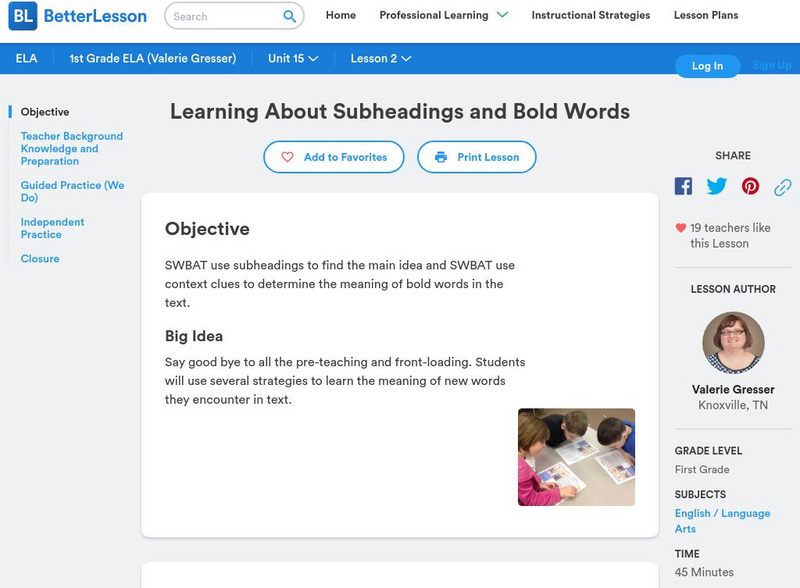
Better Lesson: Learning About Subheadings and Bold Words
In this lesson, students will use several strategies to learn the meaning of new words they encounter in text. The students will learn specific strategies so when they encounter new words, they can figure out the meaning of those words...
Curated OER
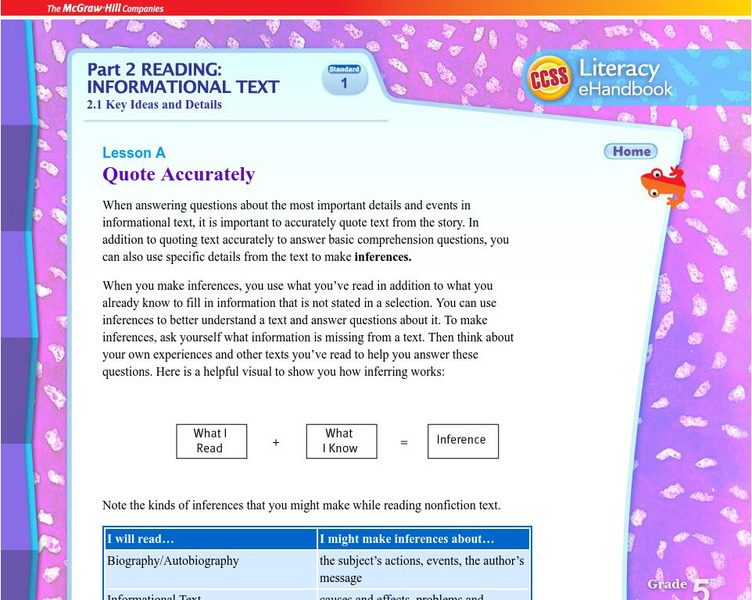
Mc Graw Hill: Part 2 Reading: Informational Text: Quote Accurately
Learn about quoting accurately and making inferences on this site. A link provides a model with text and supported inferences.
ReadWriteThink
Read Write Think: Scaffolding Summarization With Fishbone Mapping
Lesson that teaches students how to find important and significant information while reading text. After locating information through strategies, students learn how to summarize content-area text. A downloadable fishbone template is linked.
University of South Florida
Fcat Express: Main Idea With Supporting Details
Strategies to help students recognize main ideas and supporting details provided by a standardized test preparation site intended for fourth grade. Includes strategies such as Main Idea Pyramids, Number Notes, QAR (Question/Answer...
TeachEngineering
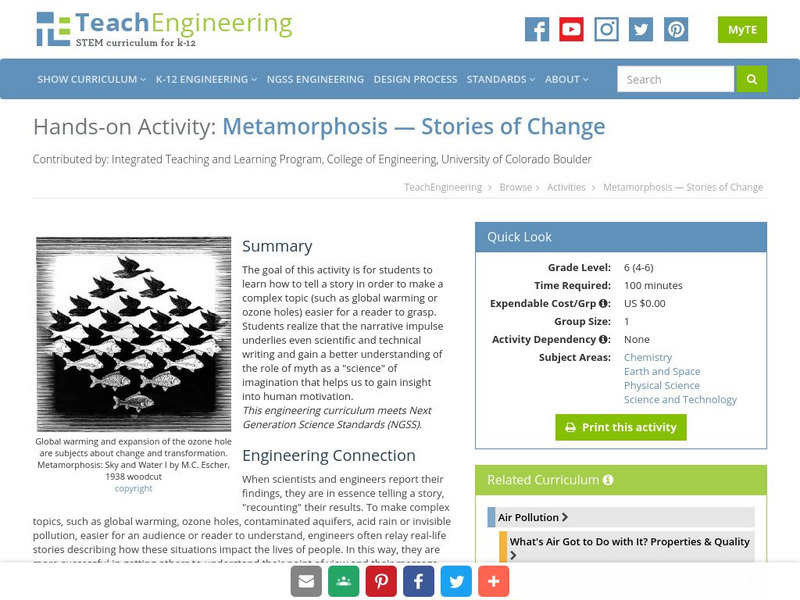
Teach Engineering: Metamorphosis Stories of Change
The goal of this activity is for students to learn how to tell a story in order to make a complex topic (such as global warming or ozone holes) easier for a reader to grasp. Students realize that the narrative impulse underlies even...
Cengage Learning
National Geographic: Informational Text and Young Children [Pdf]
Research-based informative article on when, why and how to introduce and teach reading skills with informational texts to early-elementary students beginning as early as kindergarten.
CommonLit
Common Lit: Dr. Martin Luther King, Jr., Changing America
CommonLit.org is a wonderful resource to use in a Language Arts classroom. Each story or article is accompanied by guided reading questions, assessment questions, and discussion questions. In addition, students can click on words to see...
CPALMS
Florida State University Cpalms: Florida Students: Why Did the Author Write That?
This tutorial explains point of view in informational texts. Students will learn how to analyze multiple accounts of the same topic or event and identify similarities and differences in different points of view.
Other
Laura Candler: Green Court Claims: Are Green Companies Really Green? [Pdf]
For this lesson, students investigate claims that companies make about their products and business practices they use to imply that they are environmentally friendly. Students work in groups to research the claim they chose and then...

CPALMS
Florida State University Cpalms: Florida Students: Integrating Information: A Titanic Challenge
Read about the sinking of the Titanic and learn to identify key ideas in multiple texts, review similarities and differences between those key ideas, and identify the difference between important and interesting key ideas. This...
Better Lesson
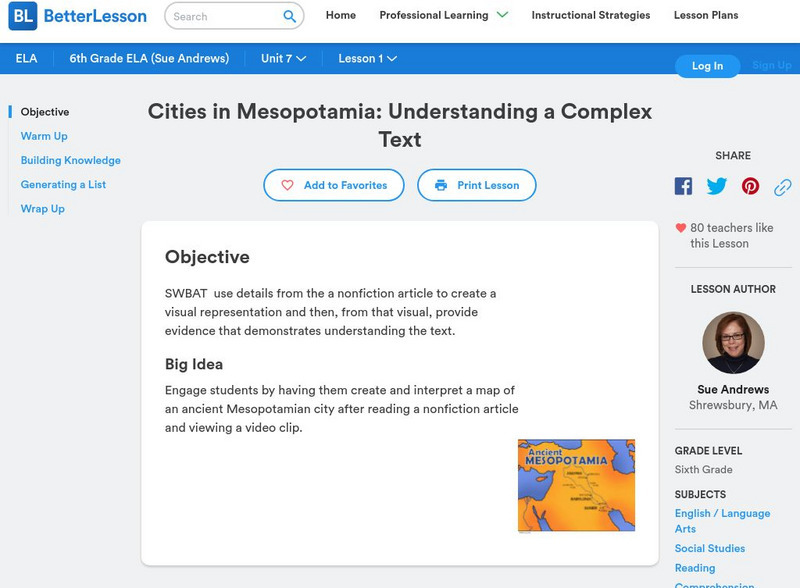
Better Lesson: Cities in Mesopotamia: Understanding a Complex Text
In this instructional activity, 6th graders use details from a nonfiction article to create a visual representation and then, from that visual, provide evidence that demonstrates their understanding of the text. Includes samples of...