Hi, what do you want to do?





![Digital History: The Problem of Reconstruction [Pdf] Website](https://static.lp.lexp.cloud/images/attachment_defaults/resource/large/FPO-knovation.png "Digital History: The Problem of Reconstruction [Pdf] Website")
Digital History
Digital History: The Problem of Reconstruction [Pdf]
How does a country put itself back together after a civil war? Read about the problems with the destruction of the Southern economy and land, the recognition of former slaves as freedmen, and the ways to bring the Southern states back...
Stanford University
Sheg: Document Based History: Reading Like a Historian: Reconstruction Sac
[Free Registration/Login Required] Students use primary source documents to investigate central historical questions. In this structured academic controversy, students examine constitutional amendments, a Black Code, a personal account...
PBS
Africans in America: Virginia Recognizes Slavery
Here is a general description of the gradual change from using indentured servants to recognizing Africans as slaves and the laws reflecting this change.
Other
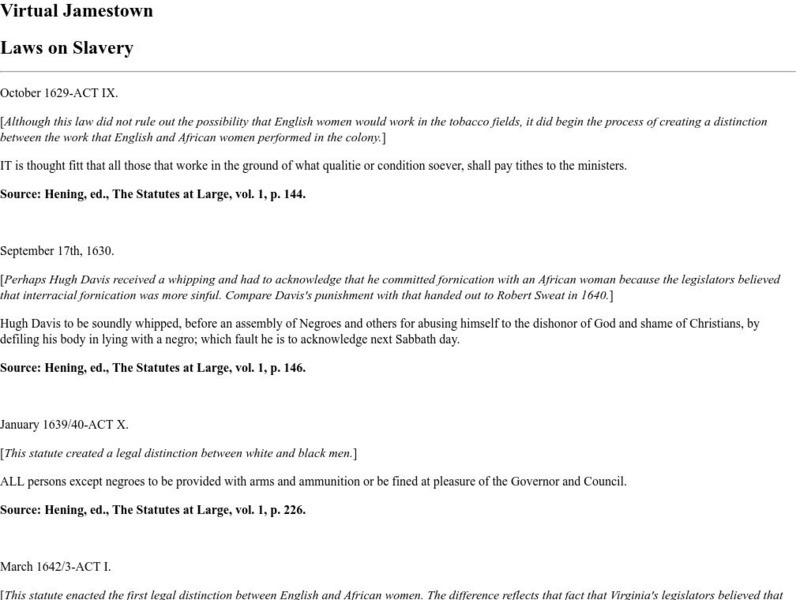
Virtual Jamestown: Laws on Slavery
This site provides the original text of Virginia colonial laws concerning different aspects of slavery for Africans, Native Americans, and indentured servants.
Other
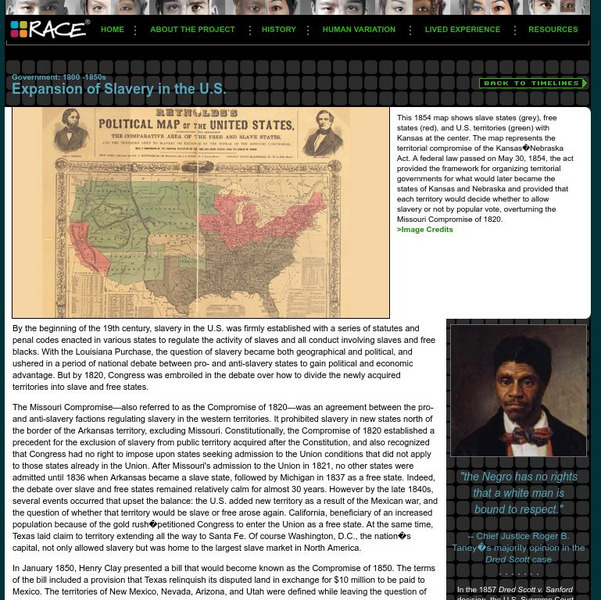
American Anthropological Association: 1800 1850s: Expansion of Slavery in the Us
Outlines the political events prior to the Civil War as the United States expanded its territories to include new states and conflicts arose over the issue of slavery.

PBS
Pbs: Bleeding Kansas 1853 1861
This site details events surrounding the era known as "Bleeding Kansas" due to the conflict surrounding slavery in what is now Kansas.
National Humanities Center
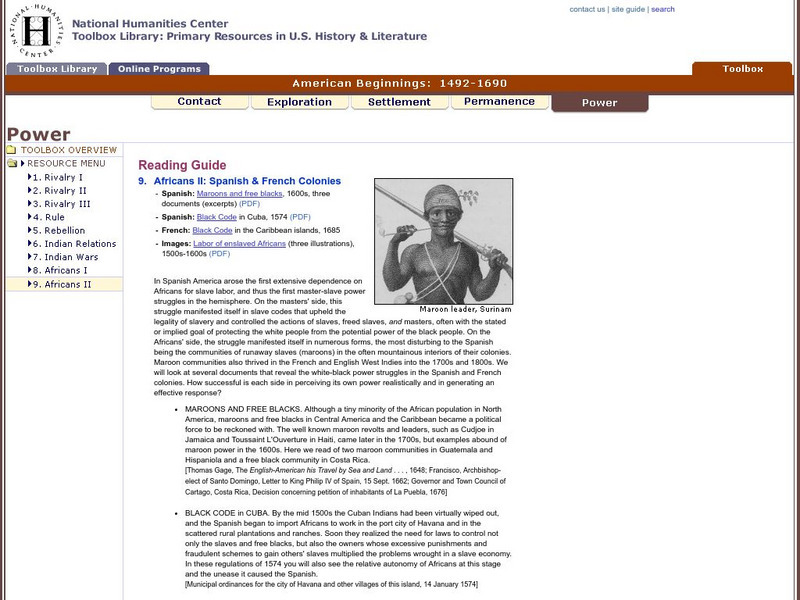
National Humanities Center: Toolbox Library: Africans Ii, American Beginnings: 1492 1690
Three illustrations and five documents about slave codes, master-slave power dynamics, and free blacks within French and Spanish settlements of the Caribbean.

Kentucky Educational Television
Ket: Kentucky's Underground Railroad: Passage to Freedom
Kentucky Educational Television presents this PBS Award Winning special about the Underground Railroad in Kentucky. Video clips, songs, and excellent research make this site comprehensible and very useful to ELL students and any student...
Independence Hall Association
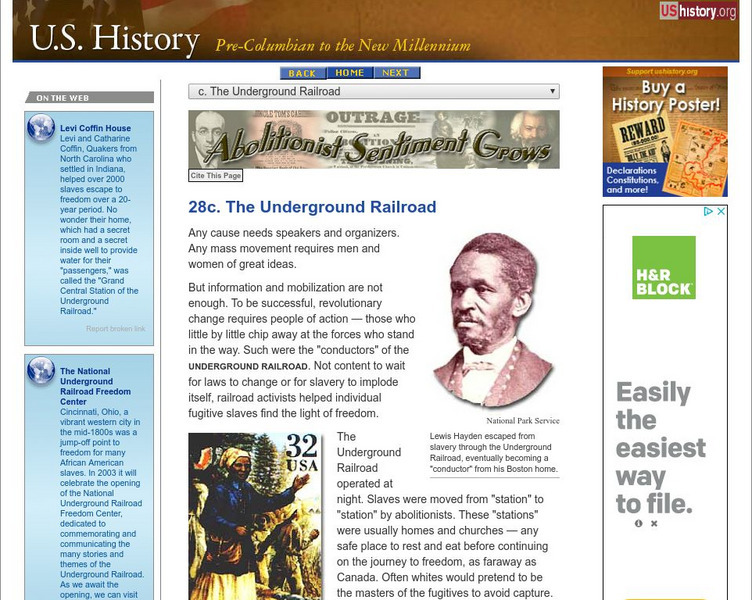
U.s. History: The Underground Railroad
A brief look at the Underground Railroad and how it operated. Find some of the code words used to help runaway slaves find their way, and read about some of the "conductors" who led slaves along the routes to the North.
PBS
Pbs: Cet: Africans in America: The Stono Rebellion
The Stono Rebellion and its impact is described in this informative essay. Hyperlinks to more discussion of this event. Teacher's Guide offers teacher resources.
Independence Hall Association
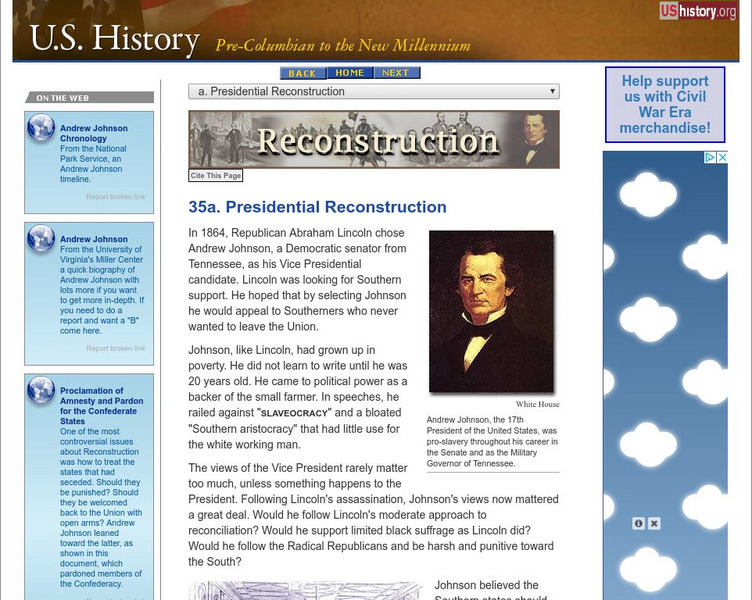
U.s. History: Presidential Reconstruction
After the death of Abraham Lincoln, Andrew Johnson was responsible for implementing Reconstruction in the South after the Civil War. Read about his views on African-Americans, and the leniency he offered Confederate leaders and soldiers....
Other
The Abolitionist: History and Geography of the Underground Railroad
Read a comprehensive account of the Underground Railroad, how it was organized, and the routes that were used. Be sure to read all three parts.
ReadWriteThink
Read Write Think: Escaping Slavery: Sweet Clara and the Freedom Quilt
Contains plans for three lessons that use the internet and the book Sweet Clara and the Freedom Quilt by Deborah Hopkinson to learn about the Underground Railroad. In addition to objectives and standards, this instructional plan contains...

ClassFlow
Class Flow: Road to Freedom
[Free Registration/Login Required] This flipchart takes students on a virtual trip on the Underground Railroad and introduces them to some important people who acted as conductors. It discusses how quilts were created with secret codes...
Curated OER
Slideshow
Three illustrations and five documents about slave codes, master-slave power dynamics, and free blacks within French and Spanish settlements of the Caribbean.

Yale University
Yale New Haven Teachers Institute: Connecticut Blacks in 18th and 19th Centuries
A curriculum unit that examines the history of slavery in Connecticut, the laws permitting it, segregation, and the struggles faced by freed blacks to achieve equality.
Scholastic
Scholastic Instructor: The Path to Freedom
Here is a great list of ideas for teachers to utilize in the classroom for lessons about the Underground Railroad. This site provides historical information, facts, reproductibles and more.

Siteseen
Siteseen: American Historama: Civil Rights Act of 1866
The purpose of the Civil Rights Act of 1866 was to protect ex-slaves (Freedmen) from legislation in the Southern States such as the Black Codes and the Vagrancy Laws and help African Americans obtain equal status under the law.
Curated OER
Educational Technology Clearinghouse: Maps Etc: United States, 1821
A map of the United States and territories in 1821 after the Missouri Compromise, showing the Free States and territories, the Slave States and territories, and the transitional territories at the time. The map is color-coded to show the...
Curated OER
Educational Technology Clearinghouse: Maps Etc: The United States , 1860
A map of the United States in 1860 showing the states and territory boundaries at the time, and is color-coded to show the slave States and distribution of slaves, the free states, and the territories, all open to slavery under the...
Curated OER
Educational Technology Clearinghouse: Maps Etc: United States, 1800
A map of the United States in 1800, color-coded to show the States, Territories, British possessions, and Spanish possessions. The map shows State and Territory boundaries at the time, the disputed territory in northern Massachusetts...
Curated OER
Etc: Progress of Emancipation, 1777 1804
A map of the eastern United States showing the progress of emancipation from 1777 to 1804. The map is coded to show states and territories with dates of emancipation, including States granting emancipation by State Constitution, State...
Curated OER
Educational Technology Clearinghouse: Maps Etc: The United States, 1821
A map of the United States in 1821 showing the states and territories which either accepted or abolished slavery after the Missouri Compromise of 1820. The map is color-coded to show absolutely free states, states undergoing gradual...
Curated OER
Etc: Maps Etc: The United States, September, 1850
A map of the United States at the time of the passing of the Compromise of 1850 (September, 1850). This compromise was a series of bills attempting to resolve territorial and slavery issues raised by the Missouri Compromise (1820) and...