Hi, what do you want to do?






Weber State University
The Sun and the Seasons
Why is there more daylight in June than in December if you live above the equator? How does the angle of sunlight shift throughout the year? Answer these questions and more with an interactive article about the sun, its path through the...

American Museum of Natural History
One-on-One With The Sun
Follow along as Stella Stardust interviews the sun. A fun and informative interview provides scholars with information about the sun.

American Museum of Natural History
What is the Greenhouse Effect?
Without the greenhouse effect, Earth would not be inhabitable. A thorough online resource describes the greenhouse effect and how it occurs. The source highlights the different types of gases that work together to absorb the sun's...

American Museum of Natural History
Journey to the Stars
Fifteen detailed pictures and informative captions delve deep into the exploration of stars—their life cycle and importance in the universe.

American Museum of Natural History
Planetary Mysteries
A website all about planetary mysteries—it's a one-stop-shop for all things, stars, planets, and space travel. Scholars read an astronomy overview to discover the page's big ideas, then choose from the plethora of resources, including...

American Museum of Natural History
The Milky Way Galaxy
Just how big is the galaxy? Learners read information about the size of the Milky Way galaxy to better comprehend its size. Pupils develop an understanding of the number of stars in the galaxy by finding just how big a billion is and...

American Museum of Natural History
What is Astronomy?
Go study the universe. Pupils learn seven aspects about astronomy and astronomers. They begin to learn about constellations; distance and motion between objects; gravity; the electromagnetic spectrum; dark matter and energy; and teams of...

American Museum of Natural History
Fascinating Fish
A fish is not just a fish. So many fish in remote places have unique characteristics. Take a trip with an ichthyologist to the Congo River to discover the species of one of the most diverse fish populations in the world. The online...

American Museum of Natural History
What is Marine Biology?
A marine environment covers the majority of the earth but is arguably the least understood. Teach young scientists about the characteristics of oceans and ocean species using an interactive online lesson. The in-person or remote learning...

American Museum of Natural History
A Closer Look at Mars
A website looks at how we know so much about Mars—telescopes, robots, and spacecraft—and the search for martian life. Following the informational text are three questions that quiz pupils about possible life on Mars.

NASA
Nasa: The Sun
An introduction to the Sun including its size and distance from the Earth, sunspots, flares and coronal mass ejections.
California Institute of Technology
Cool Cosmos: Sun Ask an Astronomer
Cool Cosmos provides the answer to many questions about the sun! Just find your question and click on it.
PBS
Pbs Learning Media: Galileo: Sun Centered System
In the early 1600s, most people believed that the Sun revolved around a stationary Earth. This video segment adapted from NOVA tells how Galileo proved that the Sun, not Earth, is at the center of our universe.
Ohio State University
Osu: Beyond Weather and the Water Cycle: The Sun: Earth's Primary Energy Source
Extensive article that discusses the first principle of climate science, i.e., that the Sun is the primary energy source for the climate system of the Earth. Presents five concepts for this principle and explains each, providing...
British Library
British Library: 20th Century Works: Empire of the Sun
"Empire of the Sun" is a semi-autobiographical novel by the British writer J.G. Ballard. Read an overview and view additional resources such as articles and collection items.
Nine Planets
The Eight Planets: The Sun Solar Wind
This Eight Planets site briefly describes solar wind, a low density stream of charged particles emitted by the Sun. It also provides the basics on the sun's composition and additional sun links.
NOAA
Noaa: National Weather Service: The Sun and Its Effect on the Earth [Pdf]
The Space Environment Center (SEC) put together a slide show for use by teachers on Space weather. Begin with discussing solar emission and the sun itself. Then end with a summary of climatic effects of space weather, and a note on space...
NASA
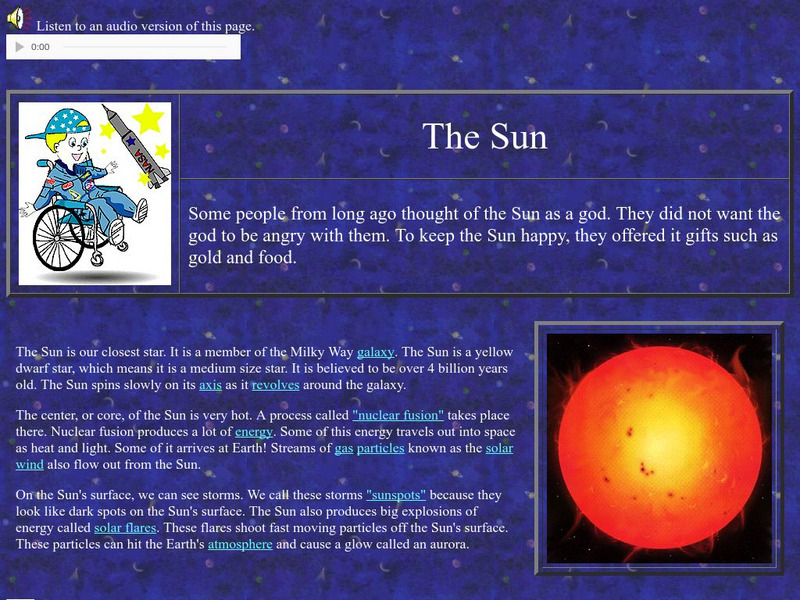
Nasa Star Child: The Sun
Get to know our nearest star with this introduction to the sun. Listen to the information in an audio file. Vocabulary words are linked to a glossary of terms. Features include links to other interesting facts and a printable version of...

Nine Planets
The Nine Planets: The Sun Facts
Statistical data, general features, key terms, characteristics, and influences of the sun.
Other
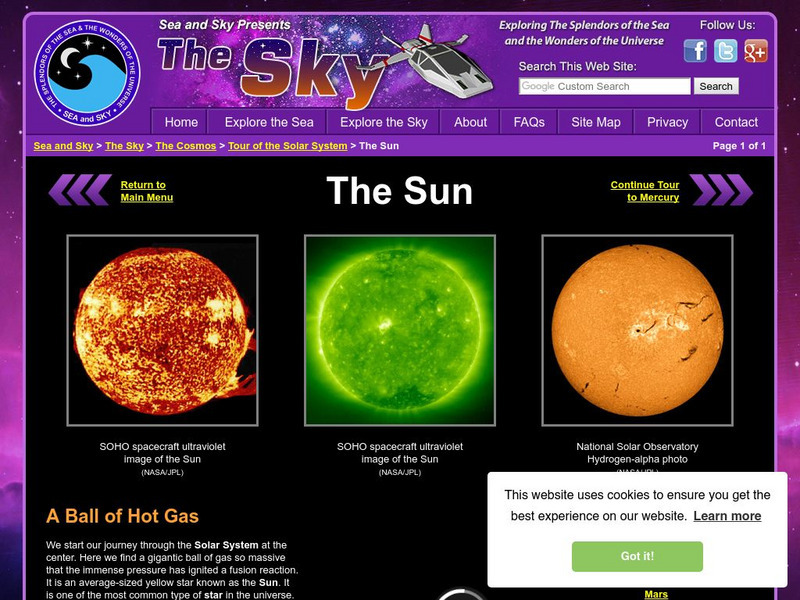
Sea and Sky: The Sky the Sun
This section of The Sky web site focuses on the Sun! Included are basic facts and statistical information as well as dramatic photos from NASA.
National Museums Liverpool
Liverpool Museums: The Sun Tracker
This simulation allows the user to see the sun's arc in the sky anywhere in the world at any time. By changing the season settings the user can see how seasons affect the height of the sun's arc.
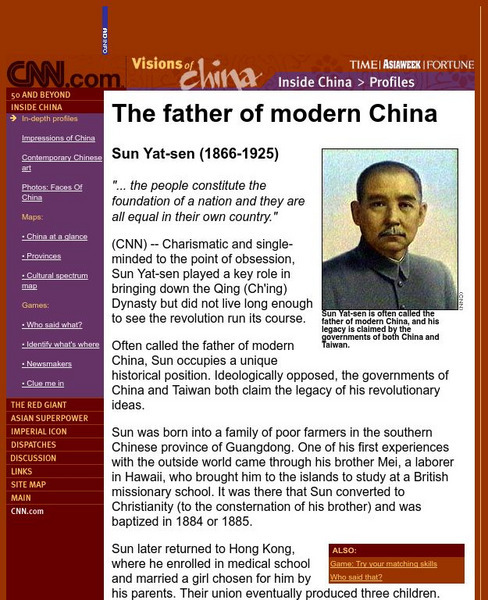
CNN
Cnn: The Father of Modern China: Sun Yat Sen (1866 1925)
This is a CNN profile on Sun Yat-sen. It contains biographical information, quotes, and photographs.
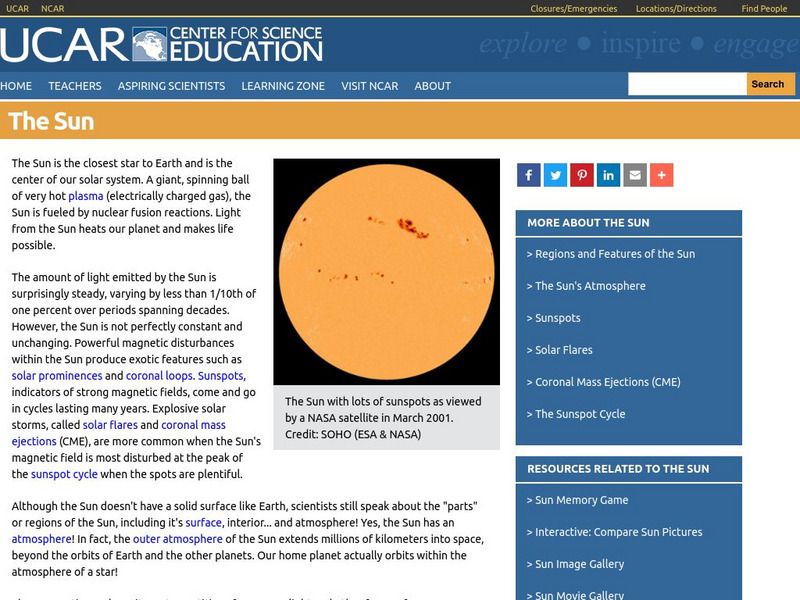
University Corporation for Atmospheric Research
Ucar: The Sun
Learn about the sun, the center of our solar system and the closest star to Earth.
Centers for Disease Control and Prevention
Centers for Disease Control: Bam! Your Safety: Sun Proof
Tips for protecting yourself from the sun.
Other popular searches
- A Raisin in the Sun
- The Sun
- Sun and Moon
- Earth Moon Sun System
- Sun and Planets
- Sun Safety
- Sun and Stars
- Myths of the Sun
- Acrostic Poem About Sun
- Raisin in the Sun
- Characteristics of the Sun
- Sun and Earth