Hi, what do you want to do?





Texas Instruments
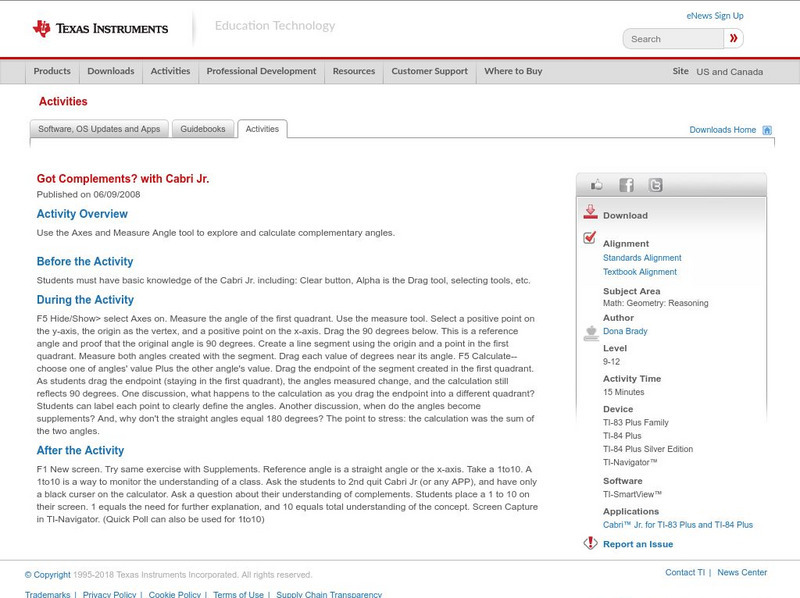
Texas Instruments: Got Complements? With Cabri Jr.
Use the Axes and Measure Angle tool to explore and calculate complementary angles.
Texas Instruments
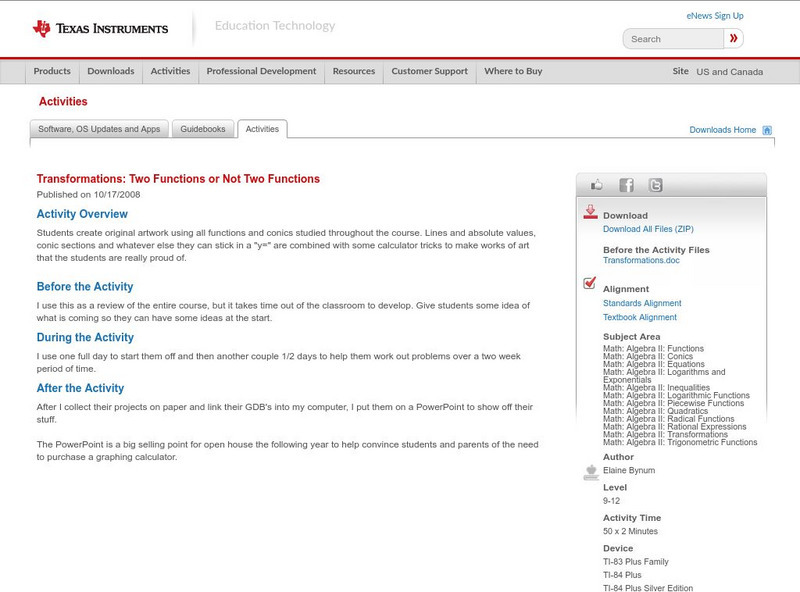
Texas Instruments: Two Functions or Not Two Functions:
Students create original artwork using all functions and conics studied throughout the course. Lines and absolute values, conic sections and whatever else they can stick in a y= are combined with some calculator tricks to make works of...

Texas Instruments
Texas Instruments: Ratios in Regular Polygons
In this activity, students use linear measurement and calculators to investigate the ratios between corresponding parts of regular polygons.
Texas Instruments
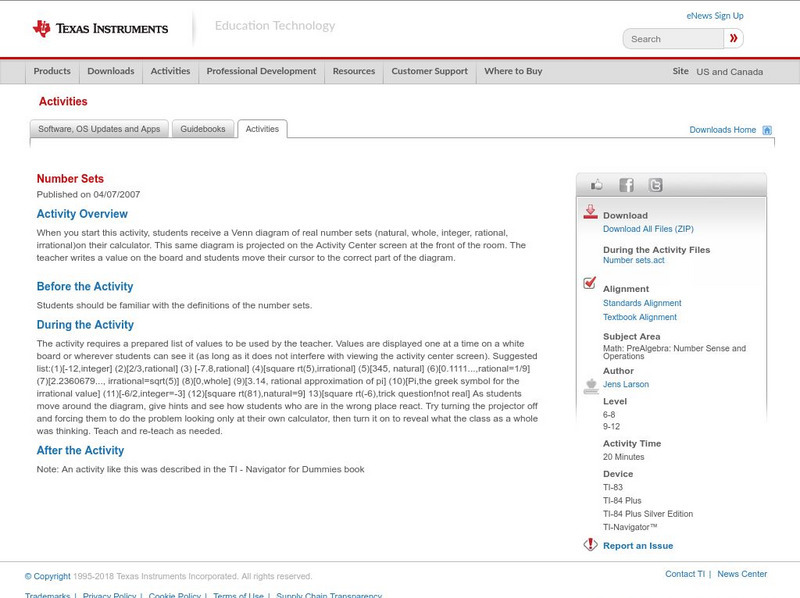
Texas Instruments: Number Sets
When you start this activity, students receive a Venn diagram of real number sets (natural, whole, integer, rational, irrational)on their calculator. This same diagram is projected on the Activity Center screen at the front of the room....
Texas Instruments
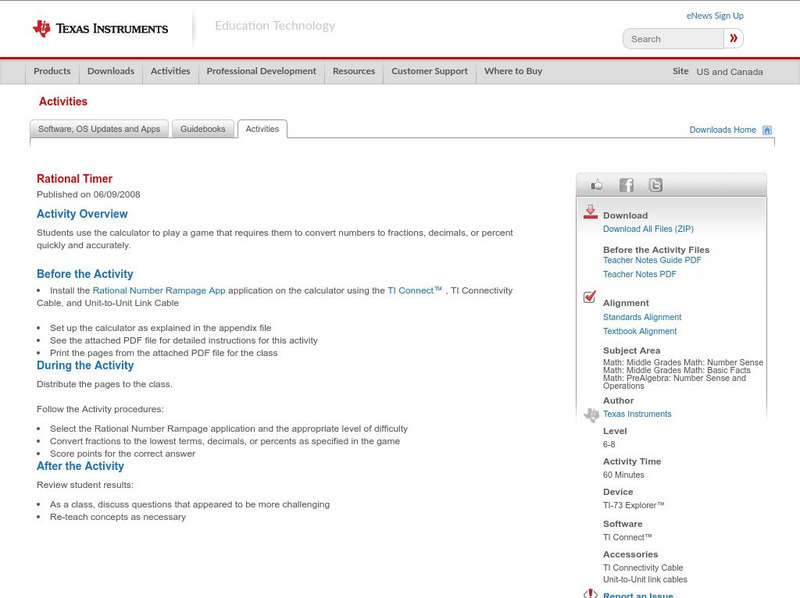
Texas Instruments: Rational Timer
Students use the calculator to play a game that requires them to convert numbers to fractions, decimals, or percent quickly and accurately.
Texas Instruments
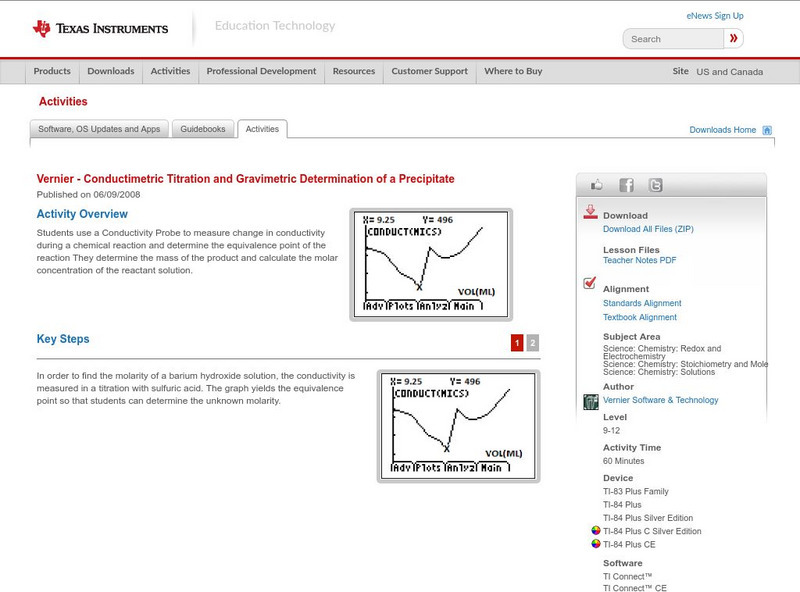
Texas Instruments: Conductimetric Titration & Gravimetric Determination
Students use a Conductivity Probe to measure change in conductivity during a chemical reaction and determine the equivalence point of the reaction They determine the mass of the product and calculate the molar concentration of the...
Texas Instruments
Texas Instruments: Holt Modern Chemistry: Energy Content of Foods
This probeware Lab Energy Content of Foods from the chapter Causes of Change uses a temperature probe to calculate the temperature change of the water to determine how much energy was released when food samples burn.
Texas Instruments
Texas Instruments: Math Today World Population in 2050
The data in the USA TODAY Snapshot "World Population in 2050" is in a relative frequency form. students can use the percents to calculate the population for each of the continents shown and then display this data as a bar graph.
Texas Instruments
Texas Instruments: Integration Crossing
This worksheet allows the students the opportunity to learn how to use the graphing calculator to compute anti-derivatives.
Texas Instruments
Texas Instruments: Using Derive
In this activity, students use the Derive software to solve trigonometric equations, expressions with exponentials, and log equations. They also determine the equation of tangent and normal of a function; evaluate integrals, find area...
Texas Instruments
Texas Instruments: Math by Hand
Students use the calculator to improve number sense and place value skills. They use the Math by Hand application to go step-by-step through multiplication problems. They also insert numbers into the missing places to complete problems.
Texas Instruments
Texas Instruments: Double Your Design
Students learn to use pattern blocks to investigate symmetry by building a design, making its mirror image, and using the calculator to determine the value of both the design made and its reflection.

Texas Instruments
Texas Instruments: Greatest Common Factor
Students use a graphing calculator to find the Greatest Common Factor of two or more numbers.
Texas Instruments
Texas Instruments: Measuring Angles in a Quadrilateral
In this activity, use an interactive, and investigative approach to determining the sum of the interior angles of a quadrilateral. They use Cabri Jr. to draw, measure, and calculate the characteristics of the angles of quadrilaterals.
Texas Instruments
Texas Instruments: Parabolic Applications
Students will analyze a parabola graphed from word problems. Students can use the calculator to find the roots and vertex of the graph to answer questions based on the word problems.
Texas Instruments
Texas Instruments: Analyzing Number Cube Sums
In this activity, students extend their understanding of theoretical probability and patterns. They use number cubes, to build awareness that a fraction and its decimal and percent representation on the calculator are "close," but not...