Hi, what do you want to do?






Curated OER
Good E-mail Manners
Students discuss online e-mail safety and etiquette rules and how they should apply the same rules in cyberspace as they use when encountering strangers in the face-to-face world. They participate in mock situations and tell what the...

Curated OER
Hack Attack
Students explore the recent hacker attacks on e-commerce sites by comparing and contrasting security issues in traditional commerce and e-commerce companies, determining solutions for security issues that face both types of companies.

Curated OER
Counting By 5s
Second graders count by 5's to 100. In this math lesson plan conducted on the 100th day of school, 2nd graders use picture stamps in the KidPix program to count by 5's and get to 100.

Curated OER
The Civil War
Eleventh graders study selected prints and/or photos and consider how Americans of the 19th century chose to present themselves to other Americans and the world by means of visual images. They share their observations and opinions.

Curated OER
Autobiography
Sixth graders read and write autobiographical sketches, determine the author's purpose in writing, and type paragraphs using WP utilities.

Curated OER
Understanding the Layers of the Earth
Fourth graders explore the three layers of the Earth describing the composition, thickness, and temperature of each layer. Layers are compared and contrasted and data unearthed placed into graphic organizers.

Curated OER
Lesson Three: Poem Pieces
Students read and analyze stanzas of Civil War poem, The Flags of Michigan, to get perspective on what life was like and how Americans viewed Civil War, rewrite stanzas in modern language, and share new versions of poem with classmates.

Curated OER
Nursery Rhymes
Young scholars listen to the narrative of several nursery rhymes. They then create drawings about the rhymes. This can be done with manual or computerized media tools. The use of computers is better for the integration of technology...

Curated OER
Science-Unit on Matter-Gases
First graders understand that gases take up space even though you can't see or smell it. This is done through many experiments like trapping air in different sized bags, using balloons and plastic bottles, and blowing bubbles. They...

Curated OER
Dangers of Payday Loans
Young scholars examine the interest and penalties associated with payday loans. In this finance lesson, students identify payday loans and the dangers of short term credit. Young scholars create their own informational PowerPoint about...

Curated OER
Dialing into Government Knowledge
Young scholars read about the services provided by the different levels of the government.

Curated OER
Wild Or Domestic?
Students discuss differences between wild and domestic animals. They list animals on chart paper, and then cut out pictures from magazines to create large collage showing wild and domestic animals.
Quia
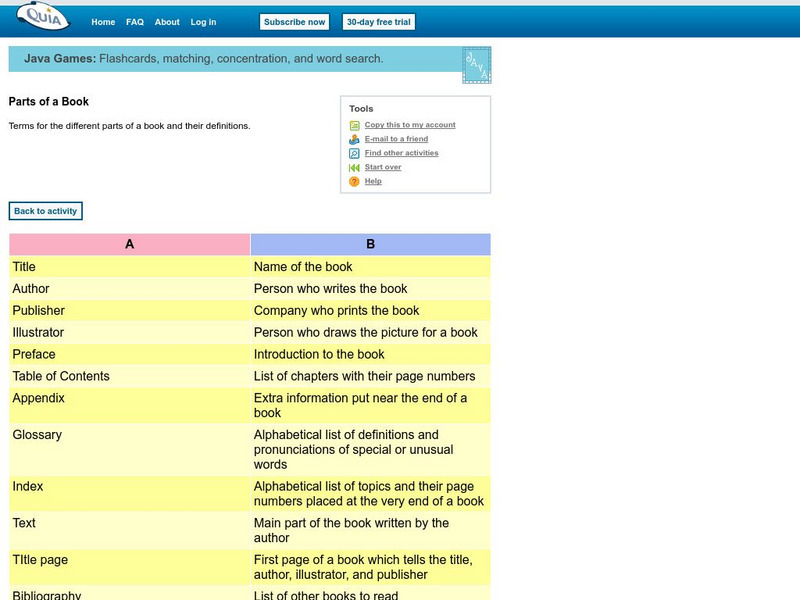
Quia: Parts of a Book
This website provides chart lists and defines the parts books all readers should know, such as the title, author, table of contents, and glossary. Click on "Back to activity," to be taken to four games, which will help students learn and...
Quia
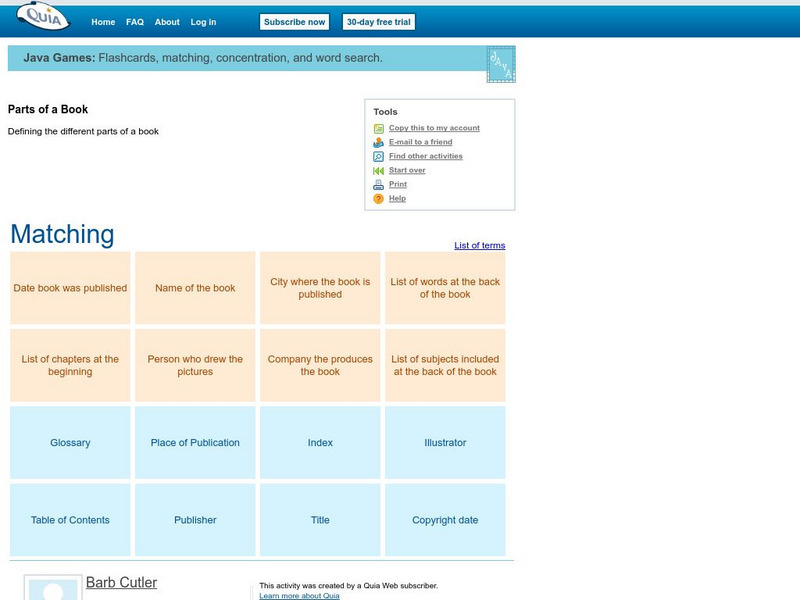
Quia: Parts of a Book
This is a matching game in which parts of a book are matched with their definitions. Java is required.

ClassFlow
Class Flow: Parts of a Book
[Free Registration/Login Required] This flipchart introduces K-2 students to parts of a book including author, illustrator, publisher, cover, title page, index, etc.

ClassFlow
Class Flow: Title Page Reveal: Finding Bibliographic Information
[Free Registration/Login Required] Practice locating the title, author and publication information of a book using real title and CIP pages, and a reveal tool.

Alabama Learning Exchange
Alex: Spine Labels
This is a first or second grade library skills unit, conducted by the librarian with help from the art, computer, and homeroom teachers. Students will create: their own book cover and title page containing title, author & slideshow...

Grammarly
Grammarly Blog: Capitalization:titles of Books, Articles, Songs
This page explains the rules for capitalizing titles: In informal writing all words may be capitalized, but in formal writing, articles, conjunctions, and prepositions are NOT capitalized unless they begin a sentence. Examples are provided.
University of Florida
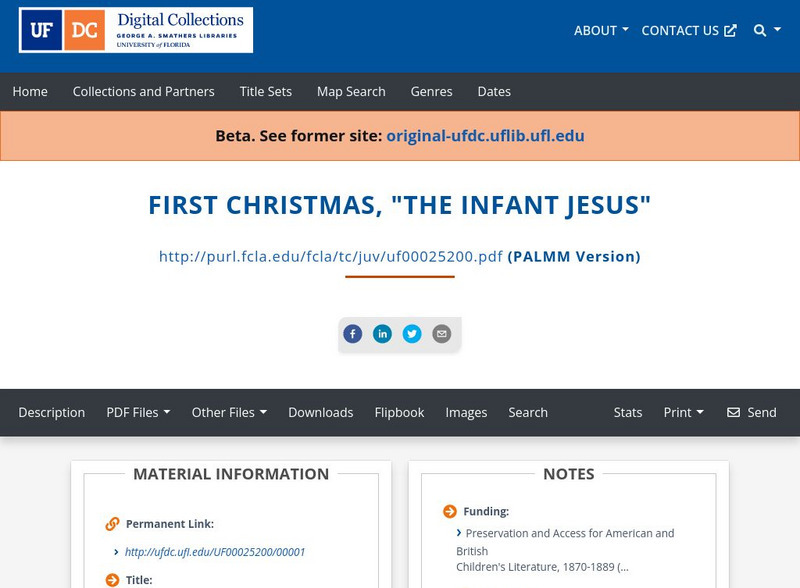
Baldwin Library: The First Christmas, "The Infant Jesus" by Frederick W. Faber
This is an online photocopy of the original of the children's book The First Christmas, "The Infant Jesus" by Frederick William Faber, a title page from the original book; the rest is missing.
Harold D. Underdown
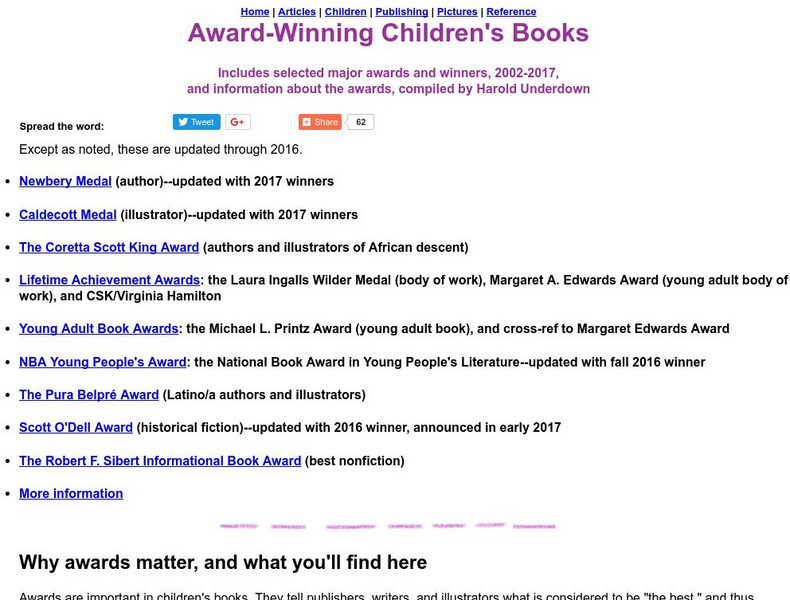
The Margaret A. Edwards Award
Includes a brief description and winners since 2002 of this award for a "lifetime contribution" in writing young adult literature. Clicking on each award-winning title brings you to the book's page on "Amazon.com."

ClassFlow
Class Flow: Table of Contents
[Free Registration/Login Required] This flipchart explores the basic parts of a table of contents including chapter number, chapter title and page number. It explores the basic parts of a table of contents.

EL Education
El Education: 1853: 24 Hours in the Fight for Freedom
This is a book created by a 4th grade class after studying slavery and women's rights in 1853. Students wrote 1st person stories of experiences they read about and illustrated them; each story detailed a snapshot in the life of their...

Other
Embracing the Child: The Caldecott Medal
This page provides a listing of all Caldecott-winning books, with links to reviews of each winning title and biographical information about the authors and illustrators.

Curated OER
Title Page of Book, the Hon. Thos. D'arcy Mcgee: A Sketch of His Life and Death
Thomas D'Arcy McGee was an eloquent speaker and writer with strong views on Confederation as well as on Ireland's independence. As a politician, he vigorously promoted Canadian unity. His support for Irish independence changed to...