Hi, what do you want to do?





Annenberg Foundation
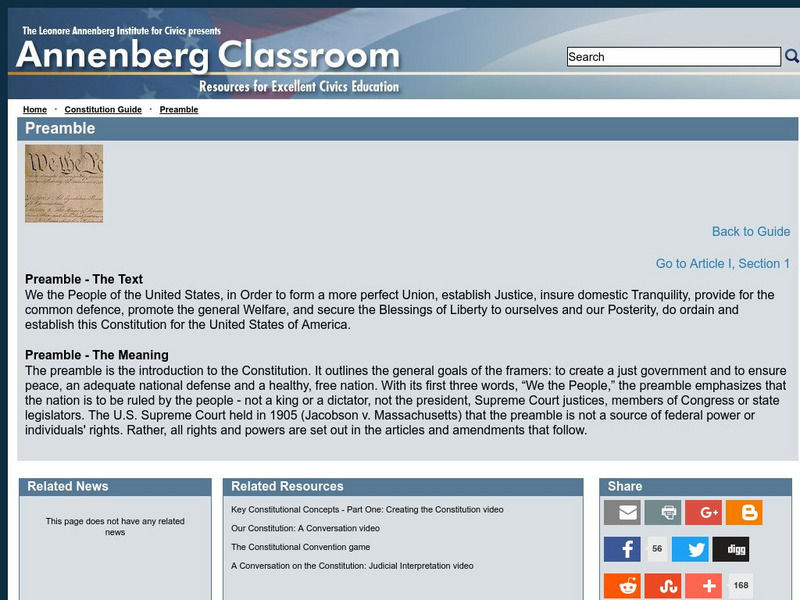
Annenberg Classroom: The Preamble
The preamble is the introduction to the Constitution. It outlines the general goals of the framers: to create a just government and to ensure peace, adequate national defense, and a healthy, free nation. With its first three words, "We...

Annenberg Foundation
Annenberg Classroom: Tenth Amendment
Annenberg Classroom resource on the 10th Amendment which attempts to create a balance of power between federal and state government. With links to related news articles and resources.
National Cable Satellite Corporation
National Cable Satellite Corporation: C Span Classroom
Check out these free video-based materials for social studies teachers. Includes videos on current event issues, lesson plans on a variety of topics, and bell ringers. Engage your class with video clips that make the Constitution come...
Annenberg Foundation
Annenberg Classroom: The Constitutional Convention
Travel back to 1787 and become a delegate to the convention in Philadelphia. As the Founding Fathers struggle to decide how the young nation will be governed, explore how very different men representing their states' conflicting...
Annenberg Foundation
Annenberg Classroom: Seventeenth Amendment
Provides the text and meaning of the 17th Amendment. Includes link to a timeline for it.
ReadWriteThink
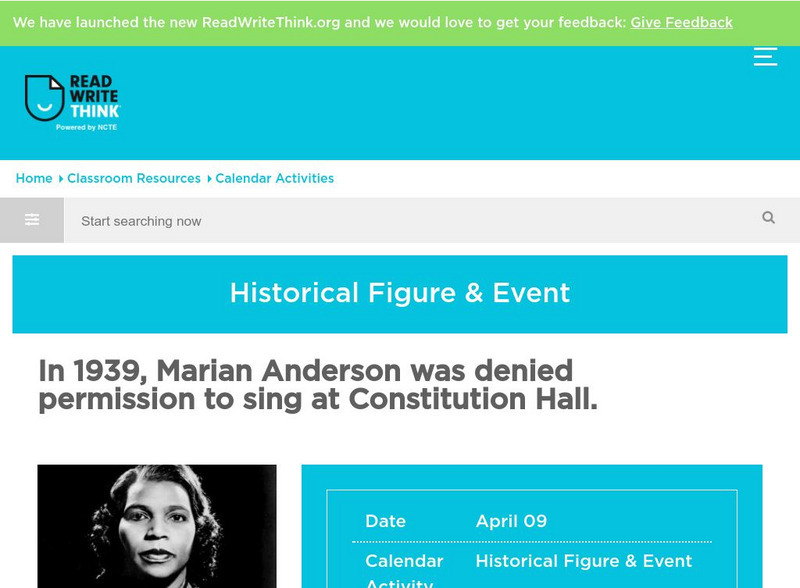
Read Write Think: Marian Anderson Classroom Activity
A brief discussion of the relevance and importance of Marian Anderson to American history, as well as a lesson plan based on her contribution. Provides lessons, web links, and a bibliography, and includes a scanned version of Eleanor...
PBS
Pbs Teachers: Why Celebrate Constitution Day? (Lesson Plan)
A lesson in understanding the significance of the U.S. Constitution revolving around an editorial that explains two modes of interpreting the constitution: "living document" versus "original intent."
Annenberg Foundation
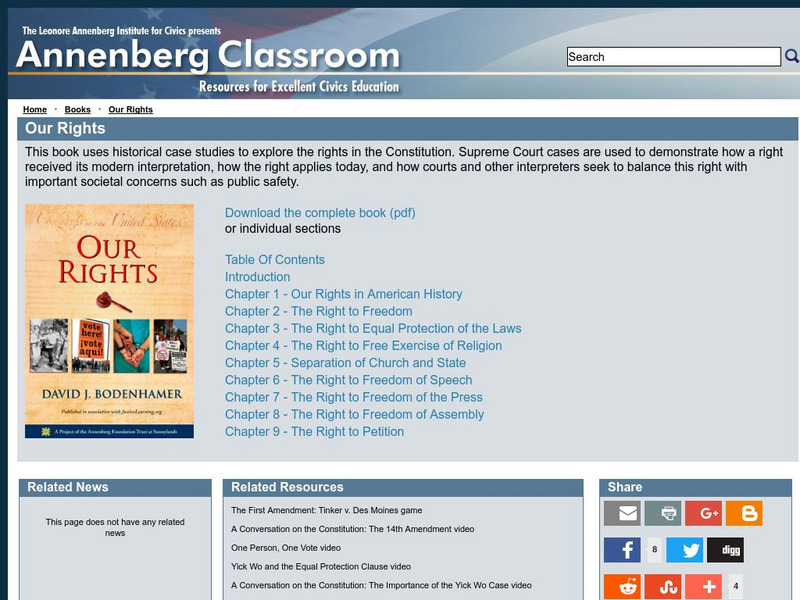
Annenberg Classroom: Our Rights
This book uses historical case studies to explore the rights in the Constitution. Supreme Court cases are used to demonstrate how a right received its modern interpretation, how the right applies today, and how courts and other...
Annenberg Foundation
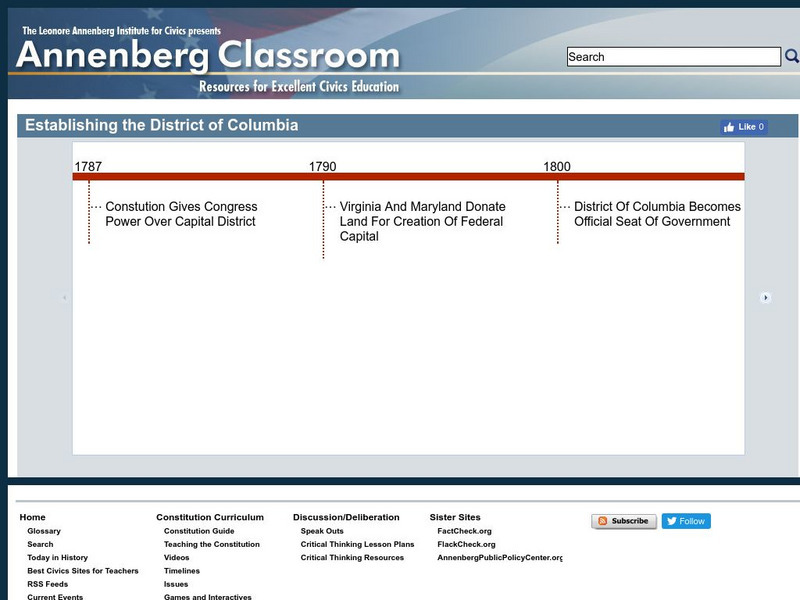
Annenberg Classroom: Establishing the District of Columbia
This website contains a timeline of establishing the District of Columbia.
Constitutional Rights Foundation
Constitutional Rights Foundation: City Youth Unit: Crime Prevention [Pdf]
This unit is focused on helping students understand resources for solving and preventing crime. They compare crime prevention methods of today and in the past, take part in simulation exercises, and participate in a service learning...
Tom Richey
Tom richey.net: Introduction to English Constitutionalism
A PowerPoint presentation created by a history teacher that teachers can use in their classroom. This presentation focuses on the emergence of the English constitution.
The Dirksen Congressional Center
Congress Link: Lesson Plans
The Dirksen Congressional Center provides abundant lesson plans on all aspects of the US Congress and the US Constitution. All lessons contain time frames, objectives, and links to material, and are built around Bloom's taxonomy.

PBS
Structure of Congress and the Legislative Process Lesson
This instructional activity explores the structure of Congress and the legislative process. There is an introduction, a research activity, an assessment, and a role play activity.
PBS
Pbs: Rediscovering George Washington
Discussion lesson plan that introduces and examines the concept of government by consent of the governed. Includes a reading for class distribution and references to primary source documents.

Scholastic
Scholastic: Democracy for Kids: Understanding Rights and Responsibilities
Scholastic offers a series of printable panels and classroom activities in PDF format that focus on a U.S. citizen's right to express his- or herself. Content focuses on the Bill of Rights and its provisions for freedom of religion,...

Other
Us Courts: Sixth Amendment Activities
Activities for the classroom in which students apply landmark Supreme Court cases to contemporary scenarios related to the right to counsel and right to a fair trial. With plan for teachers, word bank, and links to related resources.
CommonLit
Common Lit: Why Does No One Ever Thank Me for the Magna Carta?
CommonLit.org is a wonderful resource to use in a Language Arts classroom. Each story or article is accompanied by guided reading questions, assessment questions, and discussion questions. In addition, students can click on words to see...
PBS
Pbs Teachers: Theory of the American Founding: Why Government? (Lesson Plan)
A lesson that considers how the American founders answered the question, What is government? Examines why, from the point of view of the founders, government is not only necessary, but good for human beings.

ReadWriteThink
Read Write Think: The Pros and Cons of Discussion
Contains plans for four lessons that use "Harrison Bergeron" by Kurt Vonnegut, Jr. to engage students in a discussion about what constitutes equality. Lessons use re-writes, persuasive essays, computer activities, and informal class...
Textbook of Bacteriology
Todar's Online Textbook of Bacteriology: Immune Defense: Inducible Defenses
A comprehensive approach inducible defenses and how they function differently than constitutive defenses. A discussion of immunological system, the immune responses and acquired immunity, complete with bold-face vocabulary terms. A...
Science Education Resource Center at Carleton College
Serc: Classifying Chemical and Physical Changes in Various Materials/substances
In this classroom lab, students will investigate the characteristics of a chemical change. Students will also provide a definition of what constitutes a physical change through observation of several examples. Students will use/create...