Hi, what do you want to do?






CK-12 Foundation
Ck 12 Exploration Series: Simulations: Physics: Cliff Diver
[Free Registration/Login Required] Learn about the relationship between position and velocity for a diver accelerating under the influence of gravity and air resistance. Measure velocity and position based on variables of the height of...
University of Colorado
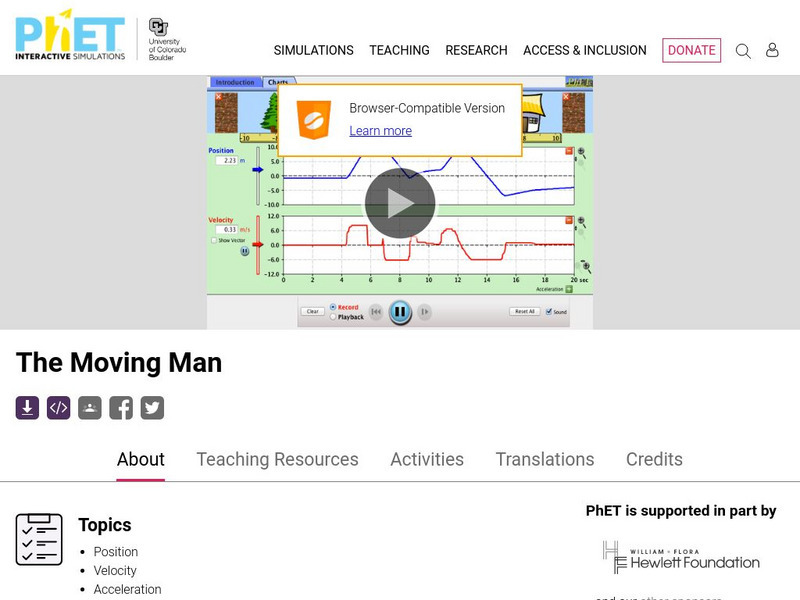
University of Colorado: Ph Et Interactive Simulations: The Moving Man
Learn about position, velocity, and acceleration graphs. Move the little man back and forth with the mouse and plot his motion, and then set the position, velocity, or acceleration and let the simulation move the man for you.
TeachEngineering
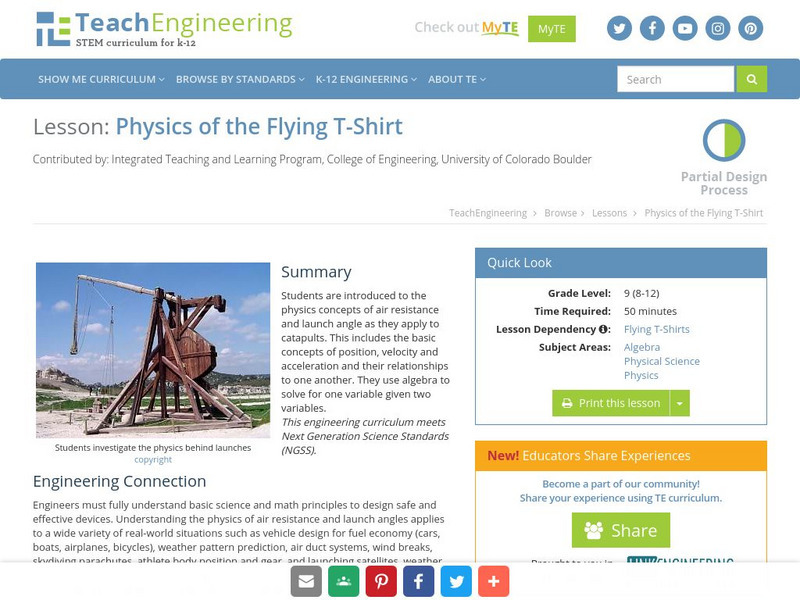
Teach Engineering: Physics of the Flying T Shirt
Students are introduced to the physics concepts of air resistance and launch angle as they apply to catapults. This includes the basic concepts of position, velocity and acceleration and their relationships to one another. They use...
TeachEngineering
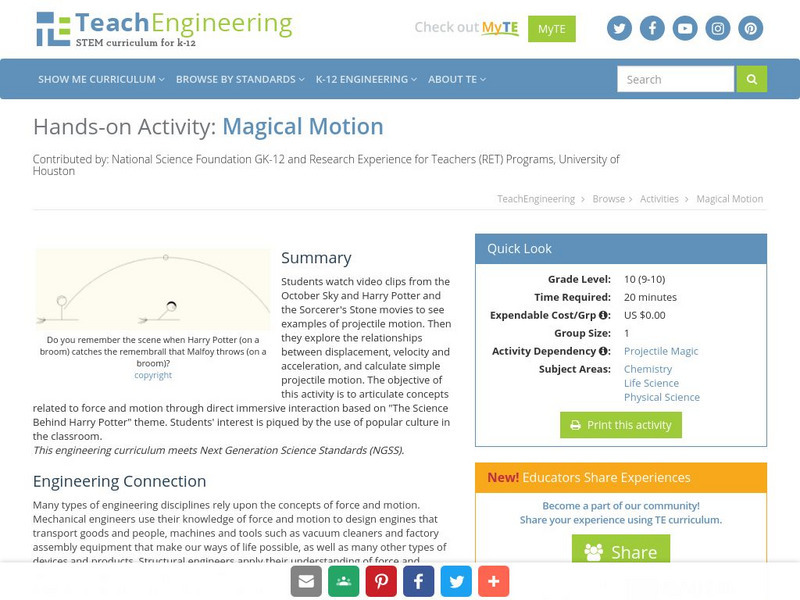
Teach Engineering: Magical Motion
Students watch video clips from the October Sky and Harry Potter and the Sorcerer's Stone movies to see examples of projectile motion. Then they explore the relationships between displacement, velocity and acceleration, and calculate...
CK-12 Foundation
Ck 12 Exploration Series: Simulations: Physics: Irwin 2 D
[Free Registration/Login Required] Learn about the trajectories in two dimensions through simulation and examples. Some of the concepts identified are motion and velocity.
TeachEngineering
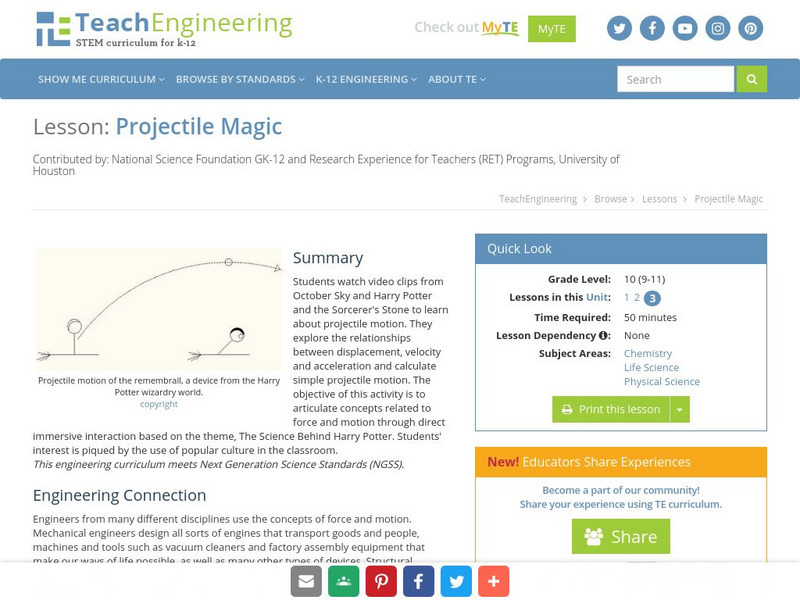
Teach Engineering: Projectile Magic
Students watch video clips from October Sky and Harry Potter and the Sorcerer's Stone to learn about projectile motion. They explore the relationships between displacement, velocity and acceleration and calculate simple projectile...
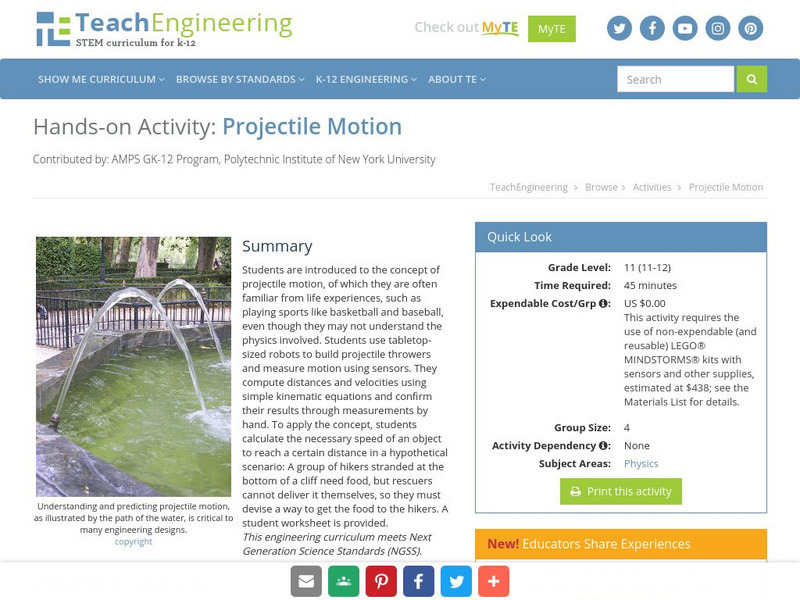
TeachEngineering
Teach Engineering: Projectile Motion
Students are introduced to the concept of projectile motion, of which they are often familiar from life experiences,such as playing sports such as basketball or baseball, even though they may not understand the physics involved. Students...

Khan Academy
Khan Academy: Velocity and Acceleration Vectors
This 11-problem quiz/practice helps students to understand how velocity and acceleration can be represented using vectors.

Khan Academy
Khan Academy: What Is Centripetal Acceleration?
Learn what centripetal acceleration means and how to calculate it. Included are two example problems with solutions.

Scholastic
Scholastic: Study Jams! Science: Forces and Motion: Acceleration
A video and a short quiz on acceleration.
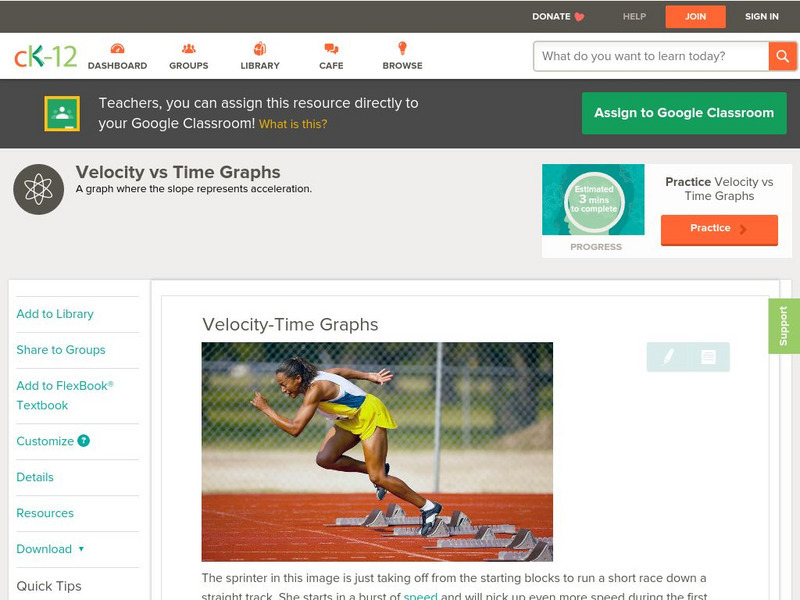
CK-12 Foundation
Ck 12: Physical Science: Velocity Time Graphs
[Free Registration/Login may be required to access all resource tools.] How to draw a velocity-time graph and what it represents.
Physics Classroom
The Physics Classroom: 1 D Kinematics: Scalars and Vectors
This illustrated tutorial focuses on several examples of vector and scalar quantities including distance, displacement, speed, velocity, and acceleration.
Physics Classroom
The Physics Classroom: Horizontal and Vertical Components of Velocity
Students learn how to describe the motion of projectiles numerically; specifically how the numerical values of the x and y components of the velocity and displacement change with time. Includes animations and interactive simulation.
Sophia Learning
Sophia: Acceleration
A slide show illustrating two types of acceleration as they are related to velocity and time. Learn how to solve a simple equation, and calculate average acceleration.
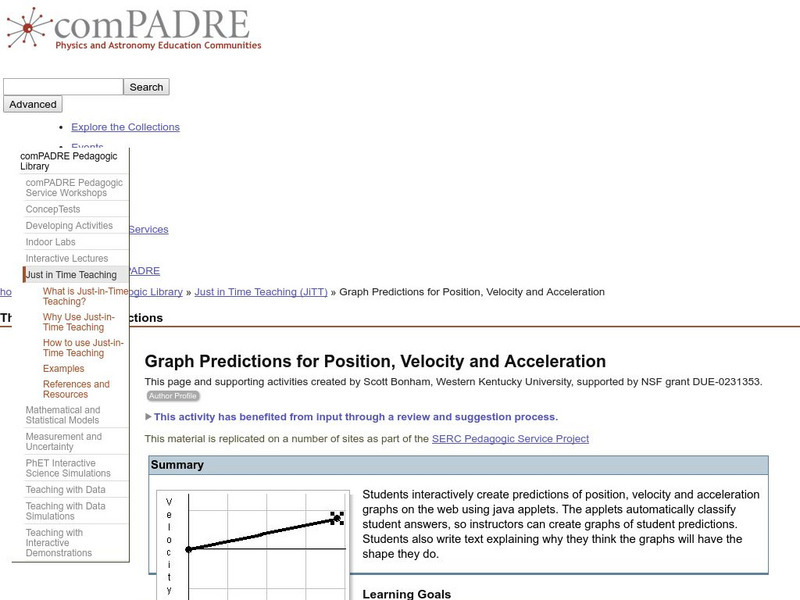
Science Education Resource Center at Carleton College
Serc: Graph Predictions for Position, Velocity and Acceleration
Students interactively create predictions of position, velocity, and acceleration graphs using java applets. The applets automatically classify student answers, so instructors can create graphs of student predictions.

CK-12 Foundation
Ck 12: Plix Series: Uniform Acceleration
[Free Registration/Login Required] Using the average acceleration formula, calculate the velocity of a falling ball, and then check your answer by dragging the point along the line in the given graph. After the activity, answer one...
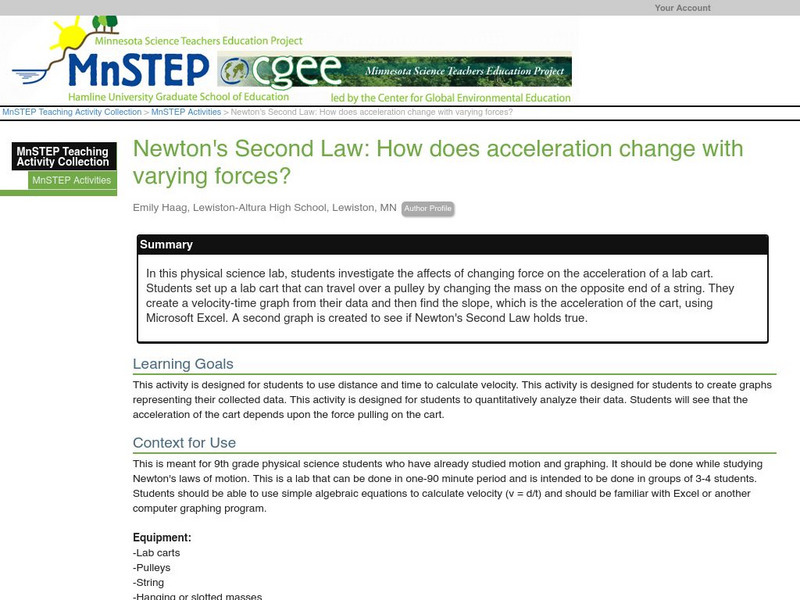
Science Education Resource Center at Carleton College
Serc: Newton's Second Law: How Does Acceleration Change With Varying Forces?
In this lab activity, young scholars investigate the effects of changing force on the acceleration of a lab cart testing Newton's Second Law of Motion. They will use distance and time to calculate velocity and create a graph representing...
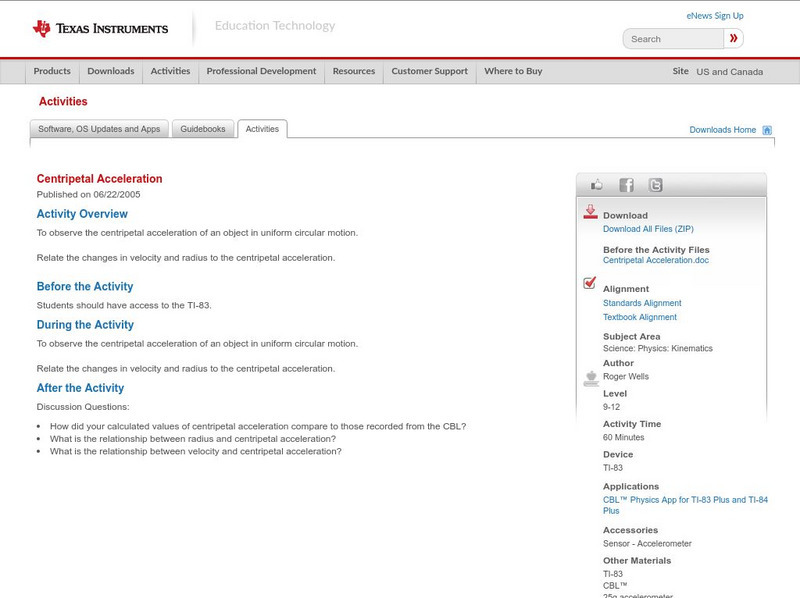
Texas Instruments
Texas Instruments: Centripetal Acceleration
For this activity, students observe the centripetal acceleration of an object in uniform circular motion. Relate the changes in velocity and radius to the centripetal acceleration.
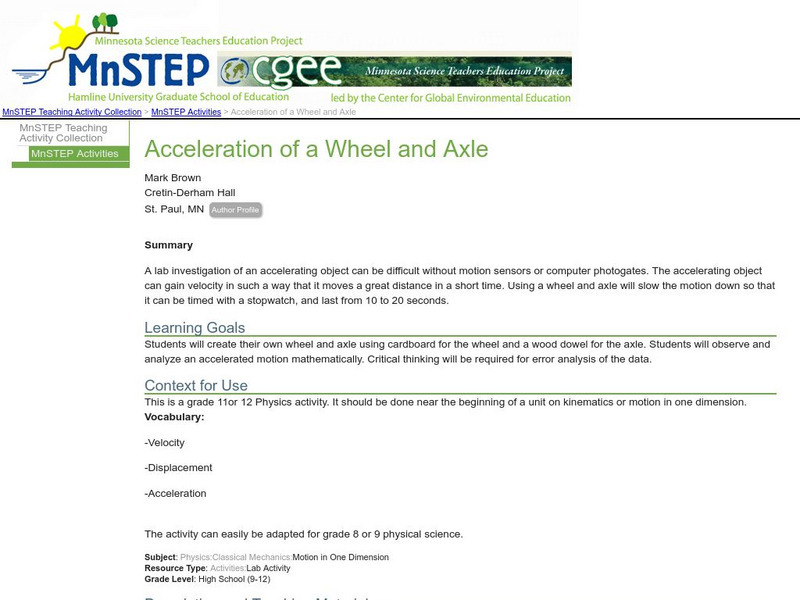
Science Education Resource Center at Carleton College
Serc: Acceleration of a Wheel and Axle
A lab investigation of an accelerating object can be difficult without motion sensors or computer photogates. The accelerating object can gain velocity in such a way that it moves a great distance in a short time.
PBS
Pbs: A Classical and Relativistic Trip to a Black Hole
This PBS site is a classroom activity that takes a trip to a black hole. Students apply calculations on distance, velocity, acceleration, time, circular motion, density, and more.
Physics Classroom
The Physics Classroom: 1 D Kinematics: How Fast? And How Far?
Students understand the physics of a free falling object through these illustrated example problems.
CK-12 Foundation
Ck 12: Analysis: Quotient Rule and Higher Derivatives
[Free Registration/Login may be required to access all resource tools.] In the lesson students study the derivatives of rational functions and higher derivatives of polynomial functions. Students examine guided notes, review guided...
Physics Classroom
The Physics Classroom: Circular and Satellite Motion: Principles for Satellites
Students explore how a satellite's motion is governed by the same physics principles and described by the same mathematical equations.
Physics Classroom
The Physics Classroom: Motion and Forces in Two Dimensions: Vector Components
Students examine examples of vectors that are directed in two dimensions- upward and rightward, northward and westward, eastward and southward, etc.