Hi, what do you want to do?






Other
Center for Education Partnerships: The Marble Roll
In this Science-athon, students try to make their marble roll the farthest across a flat surface, using their knowledge of forces, motion, and energy to guide them through their apparatus design. Teachers must enroll online.
Texas Instruments
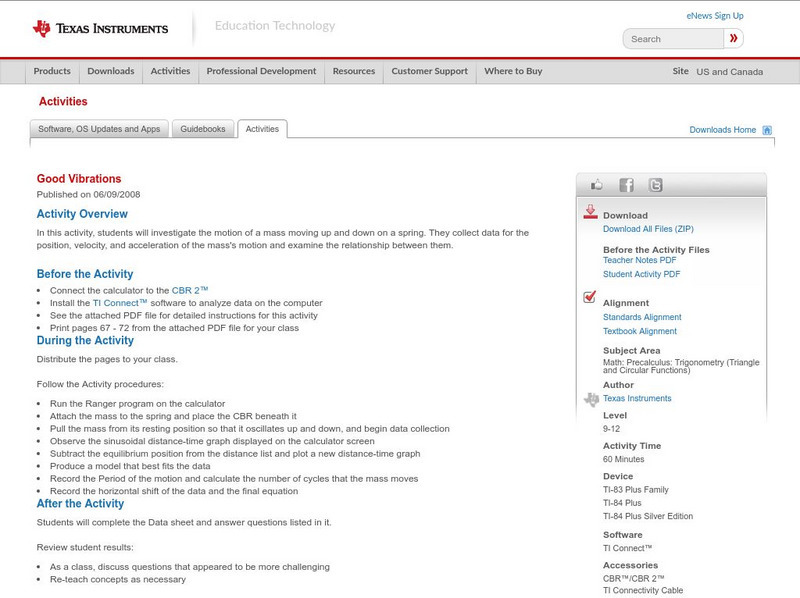
Texas Instruments: Good Vibrations
In this activity, students will investigate the motion of a mass moving up and down on a spring. They collect data for the position, velocity, and acceleration of the mass's motion and examine the relationship between them.
University of Colorado
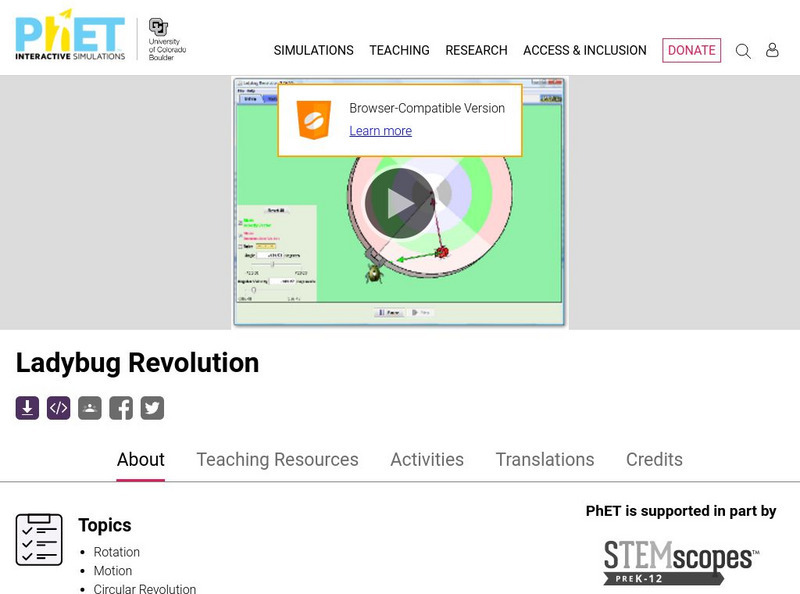
University of Colorado: Ph Et Interactive Simulations: Ladybug Revolution
Join the ladybug in an exploration of rotational motion. Rotate the merry-go-round to change its angle, or choose a constant angular velocity or angular acceleration. Explore how circular motion relates to the bug's x,y position,...
Physics Classroom
The Physics Classroom: 1 D Kinematics
A six-lesson e-textbook covering topics in one dimension kinematics. Lessons include informational text, interactive activities, and quick, interactive comprehension checks along the way.
PBS
Pbs Learning Media: Defying Gravity
Students are asked how acceleration, mass, momentum and velocity are involved in mountain boarding. [0:32]
University of Colorado
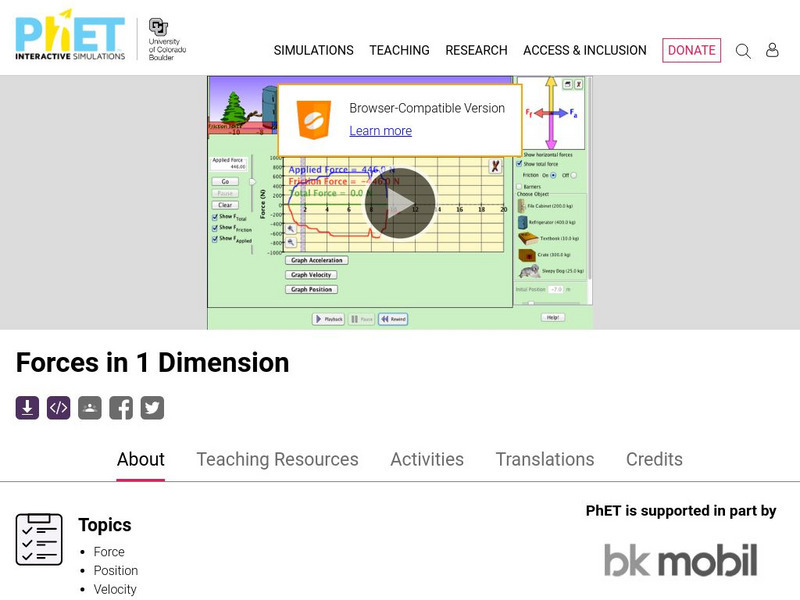
University of Colorado: Ph Et Interactive Simulations: Forces in 1 Dimension
Explore the forces at work when you try to push a filing cabinet. Create an applied force and see the resulting friction force and total force acting on the cabinet. Charts show the forces, position, velocity, and acceleration vs. time....

Georgia Department of Education
Ga Virtual Learning: Linear Motion
A learning module where students gain an understanding of the relationships between the different kinds of motion. Students will be able to explain free-fall motion and use kinematics equations to calculate problems involving falling...
University of Colorado
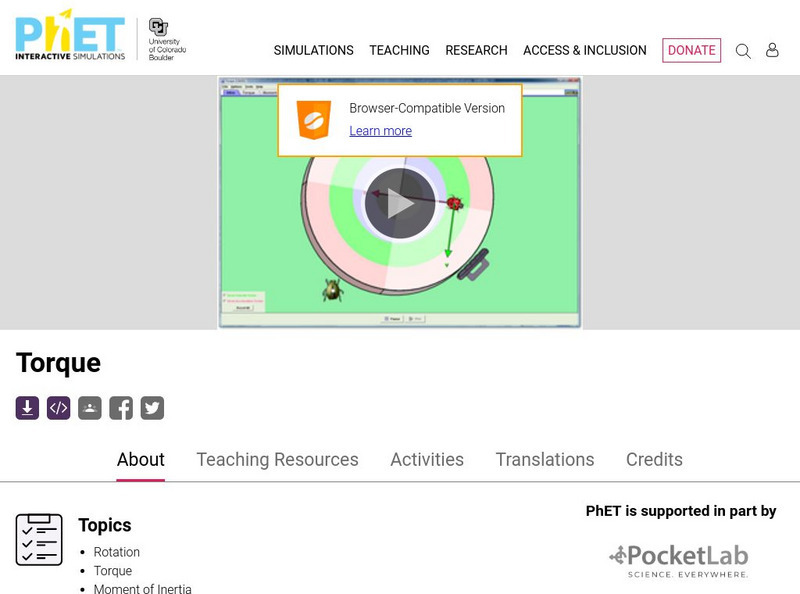
University of Colorado: Ph Et Interactive Simulations: Torque
Experiment how torque causes an object to rotate. This interactive simulation shows how angular acceleration, moment of inertia, angular momentum, and torque relate to one another.
University of Colorado
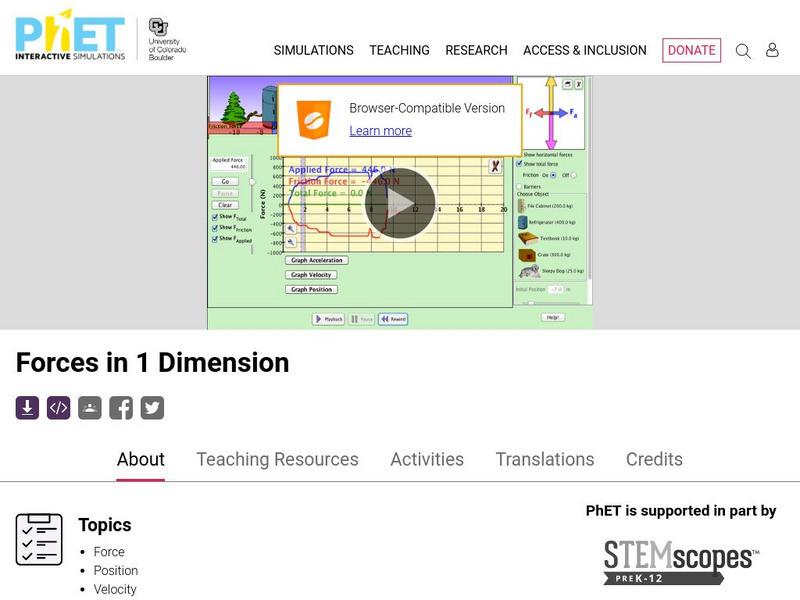
University of Colorado: Ph Et Interactive Simulations: Forces in One Dimension
Use this simulation to see the results of applying a force to move an object. Analyze forces and friction using graphs.
CK-12 Foundation
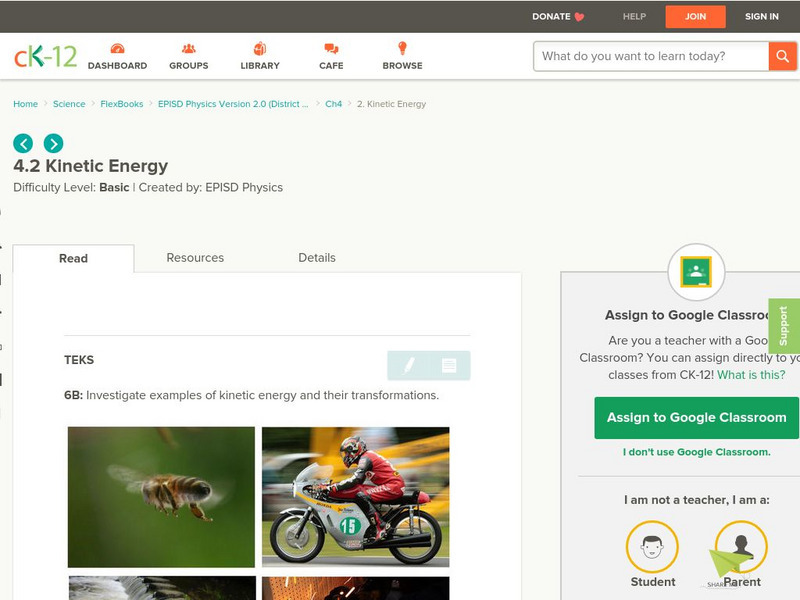
Ck 12: Kinetic Energy
[Free Registration/Login may be required to access all resource tools.] In this online lesson students will begin to investigate examples of kinetic energy and their transformations.
Texas Education Agency
Texas Gateway: Changes in Motion
Given diagrams or scenarios, students will measure and graph changes in motion.
TeachEngineering
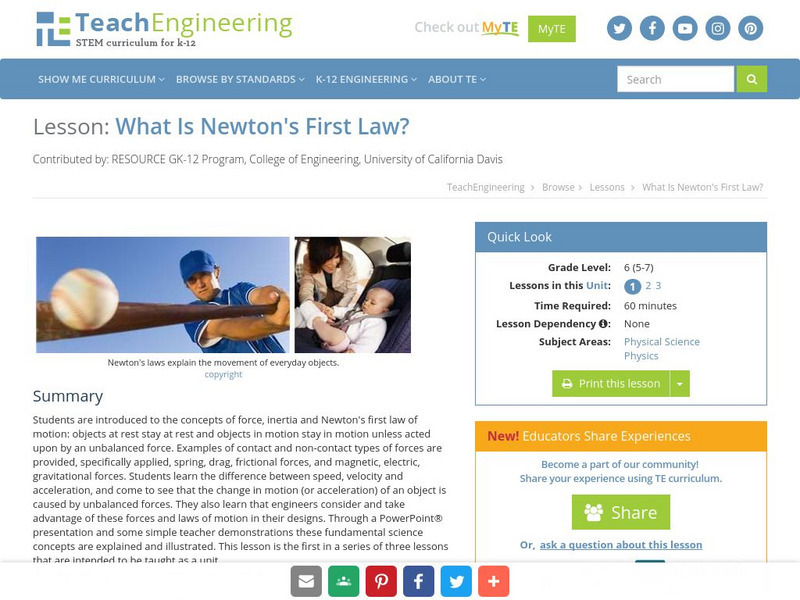
Teach Engineering: What Is Newton's First Law?
Students are introduced to the concepts of force, inertia, and Newton's first law of motion: objects at rest stay at rest and objects in motion stay in motion unless acted upon by an unbalanced force.This lesson is the first in a series...
Department of Defense
Do Dea: Working With Parabolic Projectile Paths
Using the free-fall constants and gravity acceleration equations, we can determine many things about the position, velocity, and speed of a projectile. Here are a few examples and explanations. This is a great review for the AP Calculus...
Walter Fendt
Walter Fendt: Movimiento Con Aceleracion Constante
A short interactive activity which allows you to visualize a constant acceleration. You can modify the initial position, the initial velocity and the acceleration.
Walter Fendt
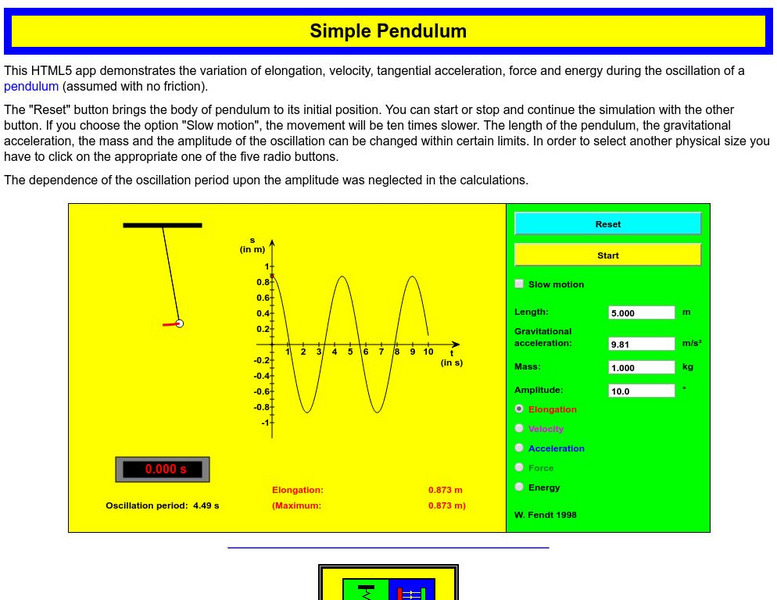
Walter Fendt: Simple Pendulum
This app demonstrates how elongation, velocity, tangential acceleration, force, and energy are affected when a pendulum oscillates.
Cosmo Learning
Cosmo Learning: Mechanics of Solids
A collection of video lectures from a course introducing students to the mechanics of solids. Webpage includes forty-one lectures from a professor at the National Programme on Technology Enhanced Learning. Lectures vary in length and...
MadSci Network
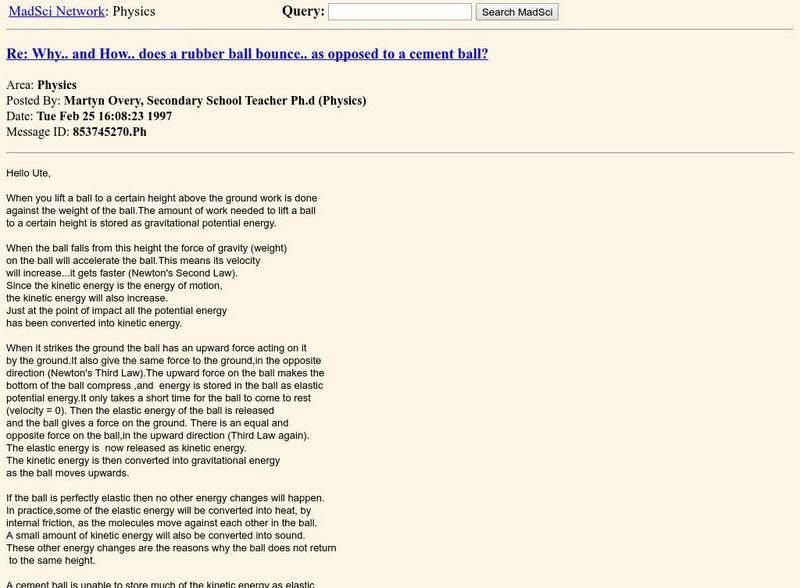
The Mad Scientist Network: Bouncing Rubber Ball
A question and answer format is used to relate elastic potential energy to the bounce of a rubber ball. Explanation of this simple phenomenon is thorough, complete, and free of trite statements.

Khan Academy
Khan Academy: 2 D Projectile Motion: Identifying Graphs for Projectiles
Match graphs with the correct scenario for the projectile motion by understanding velocity, acceleration, and displacement.
Department of Defense
Do Dea: Free Fall Constants for Earth
When you work with equations that show position, velocity, acceleration of objects that are flying or falling through the air, you will be using the constant that is the acceleration due to gravity. View formulas, explanations, and...
Stanford University
Stanford University: Conventionality of Simultaneity
This site from Stanford University is on the topic of simultaneity in relativity.
TeachEngineering
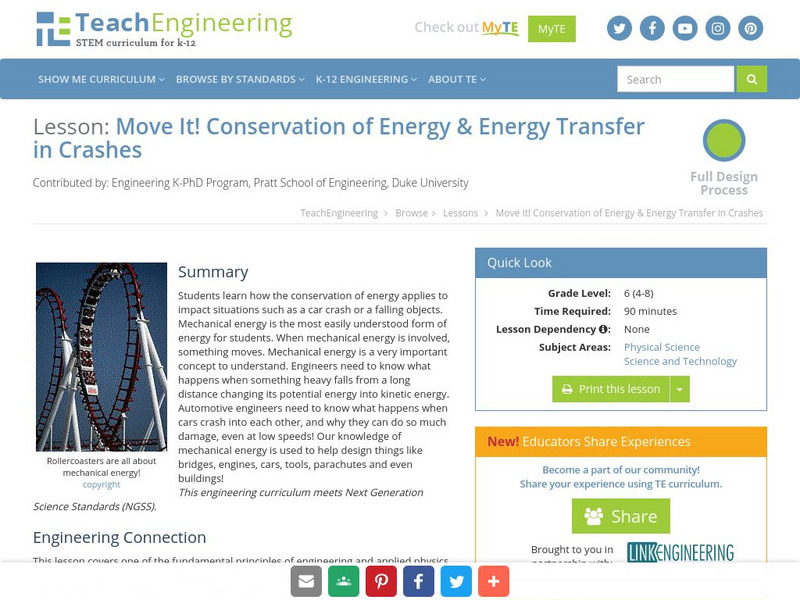
Teach Engineering: Move It!
Mechanical energy is the most easily understood form of energy for students. When there is mechanical energy involved, something moves. Mechanical energy is a very important concept to understand. Engineers need to know what happens when...
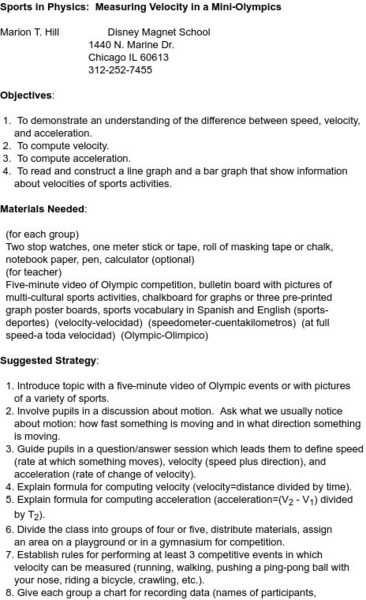
Science and Mathematics Initiative for Learning Enhancement (SMILE)
Smile: Sports in Physics: Measuring Velocity in a Mini Olympic
The Illinois Institute of Technology provides this site on Physics. It is a student lab investigation in which students compare the concept and quantity of velocity to that of acceleration. Includes directions, ideas for assessment, a...

Khan Academy
Khan Academy: Angled Launch Projectile Vectors
Can you predict how the components of projectile's velocity and acceleration change during their trajectory? This practice includes questions for students to test their problem solving skills with angled launch projectile vectors.
Texas Instruments
Texas Instruments: Numb3 Rs: Seeing in the Dark
Based off of the hit television show NUMB3RS, this lesson has students try to emulate a time vs. distance graph on their graphing calculator using the CBR2. Next, the CBR2 is "swept" across an area in which three students are standing to...